
I sit across from incredibly successful professionals every week who think they just have a time management problem. They drop onto my couch, usually checking their phone one last time, sometimes anxious or worried. They tell me they are tired. They tell me they need to be more efficient, maybe optimize their mornings, maybe push a little harder for that next promotion to afford the condo upgrade.
Frankly, their mornings are fine. Their calendars are fine. What they are actually experiencing is a nervous system responding through deeply learned protective patterns, frantically trying to navigate modern boardrooms and marriages as if they were situations that feel extremely threatening or overwhelming. We talk about the fight, flight, freeze, and fawn trauma responses as if they are abstract clinical concepts. They aren’t. They are the invisible architecture of how we love, work, and survive when our bodies decide we are no longer safe.
What Drives Automatic Trauma Survival Strategies?
You don’t choose how you react when the bottom drops out of your world. Your body makes that decision for you, usually in fractions of a millisecond. We like to think of ourselves as highly evolved, rational creatures who can logic our way out of any situation. The reality is far messier.
When a threatening situation emerges, your higher cognitive functions are effectively sidelined. Your autonomic nervous system takes the lead that operates on a very simple your nervous system continuously evaluates whether you feel safe or challenged.
Biological Alarm Activation
Long before you consciously register a threat, your amygdala acts as an internal smoke detector. It scans your environment for cues of danger. A harsh tone of voice. A slammed door. The subtle shift in a partner’s facial expression. If it senses a threat, it bypasses your rational brain entirely.
This is the raw instinct of survival. The body floods with stress hormones, prioritizing immediate self-preservation over long-term emotional regulation. It is a brilliant, life-saving design for evading physical harm. It is significantly less helpful when the perceived danger is an email from your boss. Understanding this biological cascade requires looking at Polyvagal Theory and the autonomic nervous system which maps exactly how our bodies transition between states of connection and states of defense.
Sympathetic Action States
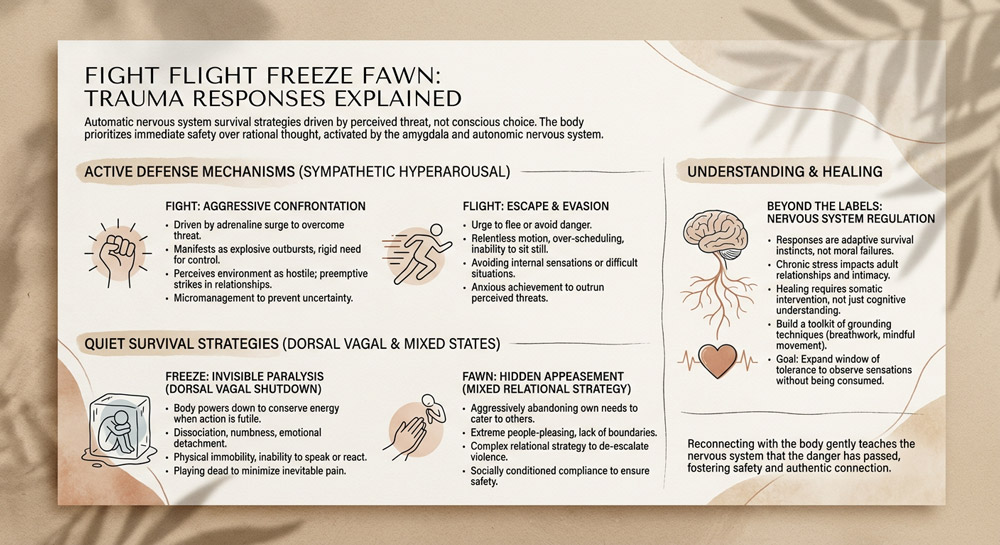
If your body decides you have a fighting chance to overcome or escape the threat, it steps heavily on the gas pedal. The sympathetic nervous system engages.
Your heart rate skyrockets. Your breathing becomes shallow and rapid. Blood rushes to your major muscle groups, preparing you to either throw a punch or run for your life. This is the physiological engine behind the classic fight and flight responses, deeply rooted in the physiology of the stress reaction. You feel a sudden surge of kinetic energy, an undeniable urge to act, move, or destroy the obstacle in front of you.
Parasympathetic Shutdown States
Sometimes, the brain calculates that fighting is impossible and running is futile. When action is no longer a viable survival strategy, the body slams on the brakes.
This is the dorsal vagal shutdown. Your parasympathetic nervous system takes over, dropping your heart rate, numbing your physical sensations, and pulling your consciousness away from the unbearable present moment. You become immobilized. This profound biological collapse is what drives the freeze response, a phenomenon beautifully detailed in clinical explorations of the freeze response and trauma. The body literally powers down to conserve energy and minimize the pain of an inevitable strike.
Identify Active Defense Mechanisms And Symptoms
We tend to recognize the noisy survival strategies easily. They take up space. They cause negative consequences that is hard to ignore. When an individual’s nervous system relies on active mobilization, their trauma responses look aggressive, chaotic, or restlessly productive.
Aggressive Confrontation Traits
The fight response is often mischaracterized simply as physical violence. Sure, it can look like a bar brawl, but in the sterile environments of our modern lives, it usually looks like a desperate need for control.
When people feel deeply unsafe, they might use anger as a way to create distance or protection to keep others at a safe distance. A person stuck in a chronic fight response might exhibit:
-
Explosive outbursts over seemingly minor inconveniences
-
A pervasive belief that everyone is against them, leading to preemptive strikes in relationships
-
A rigid, unyielding demand for perfection from themselves and their partners
-
A tendency to micromanage every aspect of their environment to prevent unexpected threats
They are trying to create a sense of control over uncertainty. They believe that if they are the biggest, loudest, most formidable force in the room, the threat cannot touch them. It is an exhausting way to live.
Escape And Evasion Behaviors
Flight is the art of disappearing. While it occasionally means literally walking out the door mid-argument, it more frequently manifests as relentless motion.
The anxious achiever running 90 miles an hour, taking on three side hustles, and refusing to sit still for five minutes is often in chronic flight. They are outrunning their own shadows. Avoidance is the core mechanism here. You see this heavily in the impact of caffeine on flight response, where survivors chemically induce adrenaline to keep moving so they never have to sit quietly with their own bodies.
Why Quiet Survival Strategies Escape Immediate Detection
Here is where my opinion really lands. I think freeze and fawn are dangerously misunderstood because they just don’t look dramatic.
Fight and flight get the attention because they escalate. Freeze and fawn can look identical to being “chill,” “helpful,” or “low maintenance.” So therapists, partners, and the individuals themselves often miss these responses until the psychological house is already burning down.
Invisible Paralysis Symptoms
Freeze is not a choice to ignore someone. It is a systemic lockdown.
A person in freeze might dissociate during a conflict, their eyes going flat and vacant. To an observer, they might seem stubborn or coldly detached. Internally, they are experiencing terrifying paralysis. They cannot speak. They cannot process the words being directed at them. They are trapped inside a body that has decided playing dead is the only way to survive the encounter.
Hidden Appeasement Tactics
Fawning is a complex, deeply relational survival mechanism. Introduced widely in Pete Walker’s original 4Fs trauma typology, the fawn response mechanism involves aggressively abandoning one’s own needs to anticipate and cater to the demands of an aggressor.
It looks like extreme people-pleasing. It looks like having no boundaries. But make no mistake, beneath the smiling compliance is a nervous system screaming in terror. Unmasking the fawn response mechanism requires recognizing that this person is not simply being nice; they are performing surgery on your mood to ensure you do not become a threat to them.
The Feign Alternative
There is nuance here that the traditional models miss. Some experts propose a purposeful adaptation of fawning. Rather than a total loss of self, a survivor might use a calculated display of submission to de-escalate violence. This purposeful action is sometimes called “feign.” It is a highly intelligent, situational tactic where the individual pretends to align with the aggressor to secure an exit route or minimize harm, particularly relevant in cases of domestic abuse or sexual assault.
Abandon The Personality Test Approach To Trauma
I’m gonna be blunt. I don’t buy the “fight/flight/freeze/fawn” framing as the clean, universal thermostat people online act like it is. It’s a useful metaphor for how threat biology can express itself, sure. But when therapists treat it like a neat menu of fixed responses—or like you can just diagnose someone by which letter they pick—it starts getting sloppy and vibes-based.
The Appeasement Misconception
People talk about fawn like it’s just another biological setting on equal footing with fight or flight. I think it’s far more complicated.
Fawning can absolutely be a physiological response to danger—the instinct to become useful and harmless. But it is also where a massive amount of social conditioning and relational strategy gets braided together. When you lump everything under one label, you accidentally flatten someone’s actual lived problem into “your system chooses fawn.” That’s not therapy. That’s taxonomy.
Danger Control Tactics
If I am using this framework in session, I want it to stay flexible. I want these categories treated as possible expressions of threat, not as an identity, and certainly not as destiny.
I’d much rather ask a client, “What did you learn would keep you safer?” than “Are you fawn or fight?” Because the second question makes people feel pinned down. Pinned-down clients don’t heal; they perform. We need to unpack trauma by looking at how a person attempts to manage the relationship so the danger goes away, rather than just labeling the behavior.
Social Conditioning Impact
Fawn frequently overlaps with cultural values, attachment style, and boundary learning. In highly pressurized societies where compliance is heavily rewarded and dissent is punished, fawning becomes a socially sanctioned survival mode. You can read deeper into this intersection in a recent feminist grounded theory of trauma which illustrates how marginalized groups are essentially trained to appease those in power to survive.
|
Response Type |
Primary Biological State |
Core Relational Strategy |
How It Mask Itself |
|---|---|---|---|
|
Fight |
Sympathetic (Hyperarousal) |
Dominate the threat |
“Strong leadership” or “High standards” |
|
Flight |
Sympathetic (Hyperarousal) |
Escape the threat |
“Ambitious drive” or “Busy schedule” |
|
Freeze |
Dorsal Vagal (Hypoarousal) |
Disconnect from threat |
“Laid back” or “Unbothered” |
|
Fawn |
Mixed state |
Appease the threat |
“Selfless helper” or “Team player” |
How Chronic Stress Impacts Adult Relationships
When you carry unresolved traumatic stress, intimacy feels dangerous. Close relationships require vulnerability, which is the exact opposite of what a hyper-vigilant nervous system wants.
If your dominant trauma response is flight, you might chronically abandon partners the moment conflict arises. If you lean toward fawning, you might build an entire marriage around a falsely empowered survival persona, silently accumulating resentment until you eventually implode. Understanding fearful attachment styles is critical here. The very mechanisms that kept you alive in a dangerous childhood are now the exact barriers preventing you from experiencing the authentic connection you are desperate for.
Build Actionable Strategies For Nervous System Regulation
You cannot think your way out of a physiological response. Cognitive Behavioral Therapy is great, but if your body is convinced a tiger is in the room, talking about your feelings won’t lower your heart rate.
Healing requires somatic intervention. You have to train the body to experience safety in the present moment. This begins with co-regulation—borrowing a therapist’s or a safe partner’s calm nervous system to help stabilize your own. From there, you build a toolkit of grounding techniques. Something as simple as learning how controlled airflow disrupts the fight-or-flight response can be revolutionary for a trauma survivor who has never felt in control of their own physical arousal.
The goal of trauma therapy isn’t to never feel fear again. It is to expand your window of tolerance so that when the stress signals appear, you can observe the sensations without being entirely consumed by them.
Can Someone Exhibit Multiple Stress Patterns Simultaneously?
Absolutely. The nervous system is incredibly fluid. A person might fawn with their abusive boss all day, maintaining a perfect, compliant smile, only to come home and immediately flip into a fight response with their spouse over a misplaced pair of shoes.
You might also see hybrid responses. “Fright and flight” is common, where someone argues aggressively while simultaneously pacing toward the door. The body will use whatever combination of tactics past experiences have proven most effective in keeping you alive.
FAQ
Are trauma responses permanent? No. While they are deeply ingrained neurological pathways, neuroplasticity allows the brain to heal. With consistent therapeutic intervention such as Multichannel Eye Movement Integration (MEMI), Brain Switch 2.0 or mindfulness practices, survivors can remap their nervous system to default to connection rather than defense.
How do I stop fawning if it feels like my only option? Start with micro-boundaries. You don’t have to say a hard “no” immediately. Practice buying time by saying, “Let me check my calendar and get back to you.” This small pause interrupts the automatic appeasement instinct.
Why do I freeze when I know I should defend myself? Because your cognitive brain is offline. Your body has calculated that fighting back will increase the risk of severe harm. Freeze is a brilliant biological protection mechanism; it is not a sign of weakness or cowardice.
Conclusion
We live in a culture that loves to pathologize pain and sell quick-fix remedies for complex human suffering. But your trauma responses are not a moral failure. They are not a sign that you are broken.
Whether you fight, run, shut down, or relentlessly appease, your body has been doing exactly what it was designed to do: keep you breathing through unimaginable circumstances. The work now is not to shame these survival mechanisms, but to thank them for getting you this far. Only then can you gently teach your nervous system that the danger has passed, and you can begin to feel safe and supported again.