
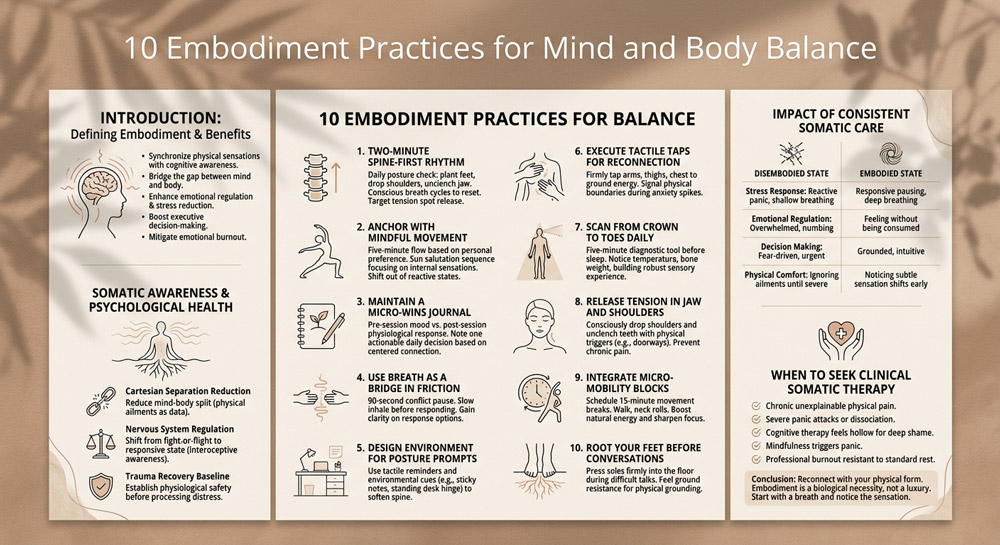
Embodiment practices are evidence-based therapeutic interventions designed to synchronize physical sensations with cognitive awareness. By bridging the gap between the mind and the physical body, these techniques serve as critical tools for emotional regulation, stress reduction, and psychological safety in both clinical and professional environments. Organizations and individuals utilizing structured embodiment strategies frequently report measurable decreases in emotional burnout and a significant enhancement in executive decision-making capacity. These practices range from conscious breathing protocols to targeted somatic movement, providing a systematic approach to nervous system regulation.
We treat the human body like a rented vehicle. You drive it to exhaustion, ignore the check engine light, and only take it to the shop when the wheels fall off. I see this constantly in corporate professionals who intellectualize their exhaustion. They sit in my office and try to logic their way out of a physiological threat state. You cannot out-think a dysregulated nervous system. Embodiment is the practice of actually inhabiting your physical form rather than just dragging it from meeting to meeting.
What Defines Somatic Awareness and Psychological Health?
Most of us were taught to value the mind at the expense of the human self. We sit still. We memorize facts. We learn early on that compliance equals success. This strips away our innate sensory experience. Somatic awareness reintroduces you to your own physical sensations.
Cartesian Separation Reduction
Western medicine and psychology have historically operated on a strict mind body split. René Descartes famously convinced everyone that thinking was the only proof of existence. Academic researchers now recognize that understanding what is embodied about cognition reduces this harmful separation. Your physical ailments are rarely just physical. The tension in your gut is data. The tightness in your throat is information. Ignoring this data creates profound psychological distress.
Nervous System Regulation
A dysregulated nervous system perceives threats in innocuous emails and casual remarks. You snap at your partner. You doom-scroll until 2 AM. Somatic awareness shifts your biology from fight or flight into a responsive, grounded state. The clinical data on interoceptive awareness skills for emotion regulation supports this directly. Noticing your internal sensations gives you a crucial micro-second of space before you react.
Trauma Recovery Baseline
You cannot force healing. Traditional talk therapy can sometimes keep a traumatized person intellectualizing their pain, completely bypassing the implicit, non-verbal memory stored in their tissues. Researchers studying somatic experiencing effectiveness emphasize that establishing baseline physiological safety is required before processing severe distress. Integrating mindfulness into a trauma-sensitive framework provides a healing context that respects the whole self. If you are exploring alternative PTSD treatments, physical safety is always step one.
Establish a Two-Minute Spine-First Daily Rhythm
Consistency outshines inspiration. A ten-minute daily routine beats a grand plan that never leaves your notebook. You need a language your nervous system understands.
Posture Check Focus
A former client of mine started her day with a two-minute body check-in while riding the office elevator. She planted her feet firmly. She dropped her shoulders. She unclenched her jaw. Within a week, her tendency to interrupt colleagues during morning meetings vanished. Find a physical trigger in your morning routine to check your alignment.
Breath Cycle Control
Sit or stand tall. Lengthen your inhale. Soften your exhale. You do not need absolute silence or a meditation cushion. You just need to notice the physical sensation of air entering your lungs. Conscious breathing acts as a reset button for a spiraling mind.
Tension Spot Release
Scan your physical structure from your crown to your toes. When you find a knot of tension, pause right there. Breathe directly into that spot for three full cycles. Give yourself permission to let it soften. It sounds boring. It is the exact anchor that keeps you present when chaos erupts hours later.
Anchor Your Nervous System With Mindful Movement
Movement recalibrates your biology. The goal is not exercise or physical fitness. The goal is experiencing unique sensations as you inhabit space.
Five Minute Flow
Pick a short movement practice you actually enjoy. A five-minute stretching flow in your living room works perfectly. Do not make it punitive. Follow your personal preferences and let your physical habits dictate the rhythm. This supports profound body love.
Sun Salutation Sequence
A basic yoga sequence connects breath to motion. Embodied yoga is not about achieving the perfect pose. It focuses on the internal sensations of extending your limbs and rooting your feet. The academic literature on yoga and the experience of embodiment shows deep links between simple postures and an increased sense of physical agency.
Responsive State Shift
When you move with intention, you shift out of a reactive state. Somatic movement strategies within brain therapy for anxiety rely on this exact mechanism. You are literally moving stuck emotional energy through your body.
Maintain a Daily Journal for Micro-Wins
Do not build a performance log to judge yourself. Build an embodiment journal to map what actually moves you.
Pre-Session State
Write down one sentence about your mood before you begin your embodiment exercise. Just note the raw physical sensation. Maybe your chest feels tight. Maybe your mind is racing. Honesty creates clarity.
Post-Session Shift
After your session, record the physiological response. Did the tightness dissolve? Do you feel heavier in your seat? Tracking these unique sensations builds a catalog of comfortable possibilities.
Actionable Daily Decision
Note one small decision you will make today because you feel more connected to your center. Maybe you will decline a meeting you do not need to attend. Small choices built on a foundation of self love compound over time.
Use Breath as a Bridge Amidst Friction
Friction is inevitable. How you meet it determines your psychological health. We often react violently to stress because we abandon our bodies the moment we feel threatened.
Conflict Pause Strategy
A colleague recently implemented a 90-second breath ritual before initiating stressful client calls. Over two weeks, the panic spikes disappeared. She found herself actually listening instead of just enduring the conversation. This consistent nervous system regulation routine changes outcomes.
Slow Inhale Execution
When someone challenges you, take a slow inhale before you open your mouth. Feel the air hit the back of your throat. This tiny gap between stimulus and response is where your true power lives.
Response Option Clarity
Pausing reveals options you would never see while operating in heated momentum. You might realize the argument is not worth your energy. You might find a more compassionate way to express your boundary.
Design Your Environment for Posture Prompts
Willpower is an unreliable resource. Relying on it to fix your physical habits will fail. Design your environment to prompt you. Put a sticky note on your monitor. Keep a standing desk with a slight hinge to remind yourself to soften your spine during long tasks. When your surroundings whisper subtle cues, you naturally drop back into body awareness without fighting yourself.
Execute Tactile Taps for Immediate Reconnection
When anxiety spikes, your energy rushes up into your head. You lose contact with the ground. Tactile tapping is a core component of somatic grounding. Firmly tap your arms, your thighs, and your chest. The physical impact sends immediate signals to your brain that you possess a physical boundary. People healing financial anxiety and money trauma often use this technique when opening stressful bank statements. It pulls you out of abstract terror and back into the present moment.
Scan from Crown to Toes Daily
The daily body scan is a diagnostic tool. Lie flat on your back for five minutes before sleeping. Direct your attention to the top of your head, then slowly pan downward. Notice the temperature of your skin. Notice the weight of your bones. This builds a robust sensory experience over time.
Release Tension in Jaw and Shoulders
We carry massive amounts of unspoken emotion in our jaws and shoulders. The words we swallow become physical density. Every time you walk through a doorway today, drop your shoulders half an inch. Unclench your teeth. These micro-doses of release prevent tension from calcifying into chronic pain.
Integrate Micro-Mobility Blocks Amidst Tasks
Sitting still for eight hours is an assault on the human body. Schedule 15-minute mobility blocks into your afternoon. Walk 20 feet across the room. Roll your neck. Doing this consistently boosts your natural energy reserves and sharpens your focus far better than a third cup of coffee. Incorporating these physical activities combats the heavy fatigue that precedes deep depression.
Root Your Feet Before Conversations
If you anticipate a difficult conversation, press the soles of your feet firmly into the floor. Feel the resistance of the ground. This physical grounding strategy is frequently taught in relationship anxiety support sessions. A physically grounded person is much harder to manipulate emotionally.
How Does Consistent Somatic Care Change Daily Life?
Living as a disembodied brain creates a frantic, superficial existence. Reconnecting with your body fundamentally alters how you perceive reality. The shift is not magical. It is deeply biological.
|
Daily Experience Area |
Disembodied State |
Embodied State |
|---|---|---|
|
Stress Response |
Reactive, immediate panic, shallow breathing |
Responsive, intentional pausing, deep breathing |
|
Emotional Regulation |
Overwhelmed by intense emotions, numbing behaviors |
Capable of feeling emotions without being consumed |
|
Decision Making |
Driven by fear, urgency, and external validation |
Grounded in clarity, personal values, and intuition |
|
Physical Comfort |
Ignoring physical ailments until they become severe |
Noticing subtle unique sensation shifts early |
Consistent embodiment work nurtures resilience. You stop running from discomfort. You start trusting your own capacity to handle reality. Activists utilizing embodiment as self-care report stronger autonomy and massive reductions in emotional burnout.
When Should You Seek Clinical Somatic Therapy?
Sometimes a daily meditation or self massage routine is not enough. Severe trauma rewires the nervous system in ways that require professional guidance. If your spiritual journey feels like it is bypassing actual psychological healing (a phenomenon known as spiritual bypassing), it is time to seek support.
-
You experience chronic, unexplainable physical pain that doctors cannot diagnose.
-
Your daily anxiety manifests as severe panic attacks or complete dissociation.
-
You are attempting to process deep toxic shame and finding that cognitive therapy alone feels hollow.
-
You notice that mindfulness or conscious breathing actually triggers panic rather than relaxation.
-
You are treating professional burnout through somatic therapy because standard vacations no longer provide rest.
Working with a clinical professional trained in somatic psychology or transpersonal psychology ensures you navigate these intense emotions safely.
FAQ
What are embodiment practices? They are intentional physical routines—like breathwork, movement therapy, or sensory awareness exercises—designed to connect your conscious mind with your physical sensations.
How often should I practice somatic awareness? Daily consistency matters more than duration. A focused two-minute physical expression of posture checking every morning is far more effective than an occasional hour-long class.
Can embodiment help with financial stress? Absolutely. Financial fears trigger severe physical panic. Consulting a money mindset coach who utilizes somatic tools helps decouple your self esteem from your bank account.
Is feminine embodiment different from regular somatic work? Feminine embodiment specifically focuses on connecting with the innate, fluid energy and physical wisdom often suppressed in highly structured, patriarchal environments. It prioritizes feeling over doing.
Conclusion
Embodiment practices are not a spiritual luxury. They are a biological necessity. We inhabit a culture obsessed with optimizing output while quietly eroding the very conditions that make people feel alive. Returning to your body requires radical curiosity. It asks you to stop treating your physical form as an inconvenience and start treating it as your home. You do not need to become a zen master to experience the profound benefits of a regulated nervous system. Start with your feet on the floor. Take a breath. Notice the sensation. The rest follows.