
You wake up, and before the coffee is even poured, the mental ledger is already being balanced. You are behind. You did not do enough yesterday. You are completely underqualified for that morning presentation. We tend to accept this critical inner voice as the necessary tax on ambition. We assume that without a taskmaster living inside our heads, we would simply stop trying. This assumption deeply misunderstands how human psychology actually functions. The inner critic is not something to eliminate or fight against, nor is it a source of objective truth. It is a protective part of yourself using outdated strategies to help you cope to keep you safe in an imperfect world.
Navigating high-pressure environments often demands that we optimize for output while quietly eroding the conditions that make us feel seen as human beings. We rely on the critic to push us forward. Yet, research continuously demonstrates that sacrificing our sense of worth in pursuit of productivity has steep psychological costs. To actually heal, we must stop fighting against our own thoughts and begin treating this nagging voice with curiosity rather than contempt.
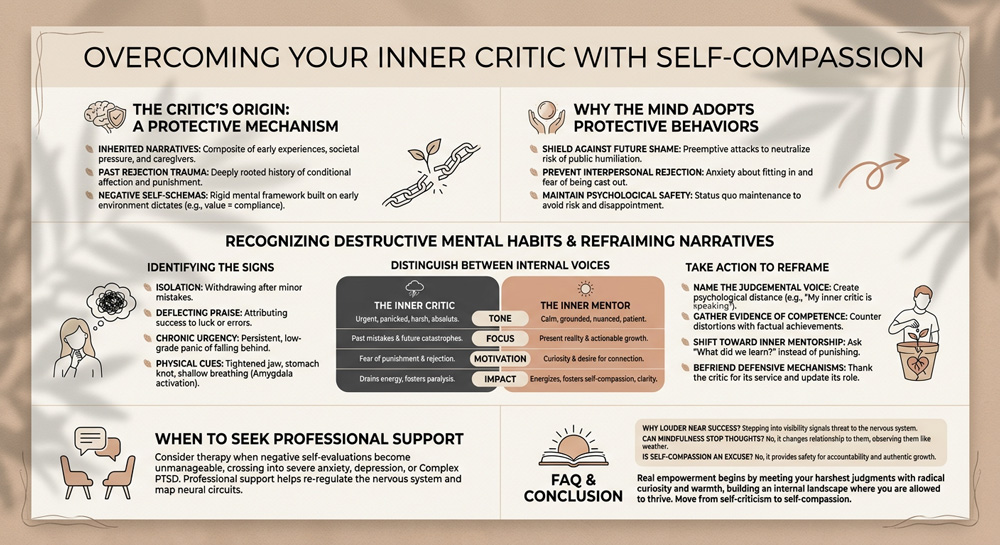
Where Do Harsh Internal Judgments Originate?
We are not born with a running commentary detailing our inadequacies. That voice is inherited, absorbed, and eventually internalized. It is a composite sketch of early life experiences, societal pressures, and the caregivers who shaped our initial understanding of the world.
Past Rejection Trauma
I often sit with clients who hold impressive titles, live in beautiful homes, and carry immense emotional weight. When we trace the critical thoughts back to their origin, we usually find a deeply rooted history of rejection or conditional affection. A child who is severely punished for a poor grade does not learn to simply try harder. They learn that smaller people get hurt by bigger people, and that love is entirely dependent on performance. This early trauma forces the developing brain to adopt a harsh internal narrative as a preemptive strike. If you beat yourself up first, the logic goes, the external world cannot surprise you with rejection.
Negative Self-Schemas
Over time, isolated traumatic events solidify into negative self-schemas. Think of a schema as the underlying operating system of your mind. If your early environment dictated that you were only valuable when you were quiet and compliant, your mind builds a rigid framework around that belief. Any deviation from compliance triggers the critical inner voice, which floods your system with guilt to force you back into line. This processual disturbance interferes with your organismic experiencing—your natural ability to interact with the world authentically—because every action is filtered through a lens of anticipated failure.
Protective Personality Parts
The Internal Family Systems (IFS) model offers a profoundly compassionate lens for this phenomenon. According to IFS, the inner critic is not your core self. It is a subpersonality—a distinct, protective part of your psyche that formed during moments of acute vulnerability. Hal and Sidra Stone’s Voice Dialogue Model similarly identifies this critic as an inner controller that continuously judges your behavior to shield you from being ostracized. These psychological parts carry the heavy burden of your early pain. They are exhausted, running on the logic of a frightened child, and desperately in need of your warmth.
Why Does Your Mind Adopt Protective Behaviors?
Your brain naturally prioritizes safety and protection. The destructive behaviors we attribute to our critics are actually misguided attempts at preservation. Understanding the specific protective functions of these internal narratives is the first step toward understanding and responding to them differently.
Shield Against Future Shame
Harsh inner critics rely heavily on shame as a behavioral deterrent. If you grew up in an environment where mistakes were met with humiliation, your mind learned that shame is a profound threat to your psychological survival. The critic steps in to interrupt harsh inner critics to cultivate authentic self-compassion by launching preemptive attacks. It tells you that your creative work is terrible before you ever show it to anyone, effectively neutralizing the risk of public humiliation.
Prevent Potential Interpersonal Rejection
We are wired for connection. For early humans, being cast out of the tribe meant certain death. Today, that evolutionary fear translates into severe anxiety about fitting in, particularly in competitive corporate spaces. The critic meticulously scans your social interactions, analyzing every word you spoke at dinner last night, looking for any sign that you might be rejected. It demands perfection because it falsely equates perfection with belonging.
Maintain Perceived Psychological Safety
There is a strange comfort in predictability, even if that predictability is painful. The critic maintains a status quo. If you constantly tell yourself you are unworthy of a healthy relationship or financial abundance, you never have to take the terrifying risk of actually pursuing them. This maintains an illusion of control. You are never blindsided by disappointment because you have already convinced yourself that disappointment is your baseline.
How Do You Recognize Destructive Mental Habits?
The inner critic is a master of camouflage. It often masquerades as objective reality, making it incredibly difficult to catch in the act. You have to learn to observe the downstream effects of the critic before you can challenge the voice itself.
-
You isolate yourself after minor mistakes: Instead of seeking connection when you feel inadequate, you withdraw, convinced that your flaws make you a burden to others.
-
You deflect genuine praise: When someone compliments your work, your immediate reflex is to explain why they are wrong or attribute your success entirely to luck.
-
You operate in a state of chronic urgency: You feel a persistent, low-grade panic that you are falling behind, even when the data of your life proves you are highly competent.
Notice Physical Stress Cues
Your nervous system will often react to critical thoughts before your conscious mind even registers them. Studies examining what happens to the brain during self-criticism show a distinct activation in the amygdala, the brain’s threat-detection center, and the default mode network, which governs rumination. Physically, this manifests as a tightened jaw, a knot in the stomach, or shallow breathing. When you notice these somatic cues, pause. Your body is reacting to an internal threat.
Track Repetitive Thought Loops
The prattling mind loves a well-worn groove. Destructive mental habits rarely feature new material; they play the same greatest hits on a loop. You might notice a recurring narrative about your financial worth, tied to older stories that acquiring more is the only path to safety. Tracking these loops requires a degree of spaciousness. You have to step back and observe the chatter without immediately buying into its premise.
Distinguish Between Internal Voices
You are not the voice; you are the awareness listening to it. Distinguishing between the critic and the true self requires identifying the tonal differences in your internal dialogue.
|
Characteristic |
The Inner Critic |
The Inner Mentor |
|---|---|---|
|
Tone |
Urgent, panicked, harsh, absolute. |
Calm, grounded, nuanced, patient. |
|
Focus |
Past mistakes and future catastrophes. |
Present reality and actionable growth. |
|
Motivation |
Fear of punishment and rejection. |
Curiosity and a desire for genuine connection. |
|
Impact |
Drains energy, fosters paralysis. |
Energizes, fosters self-compassion, promotes clarity. |
Take Action to Reframe Negative Narratives
Awareness is necessary, but it is not sufficient for lasting change. You have to actively retrain the inner critic by changing how you respond when the voice gets loud.
Name the Judgemental Voice
Psychological distance is a powerful tool. When you say, “I am a failure,” you fuse your entire identity with a fleeting emotion. When you say, “My inner critic is currently telling me a story about being a failure,” you create space. Some practitioners even recommend giving this subpersonality a name. By externalizing the guilt tripper, you stop taking its dramatic proclamations so personally.
Gather Evidence of Competence
The critic relies on cognitive distortions, particularly all-or-nothing thinking. It will completely ignore a decade of hard work to focus on a single typo in an email. You counter this by relying on evidence-based reality checks. When the imposter syndrome flares up—a phenomenon that deeply impacts creative work and professional risk-taking —consciously list the actual, tangible challenges you have successfully navigated. This is not about forcing toxic positivity; it is about demanding factual accuracy from your own mind.
Shift Toward Inner Mentorship
Compliance is not character. Forcing yourself to behave through sheer punitive will eventually leads to burnout. True resilience requires shifting from an internal dictator to an inner mentor. A mentor does not ignore mistakes, but they contextualize them. They ask, “What did we learn here?” rather than declaring, “You ruined everything.” You can actively cultivate inner compassion through daily action by speaking to yourself with the exact same tone and grace you would naturally offer a close friend who is struggling.
Befriend Your Defensive Psychological Mechanisms
This is perhaps the most contrarian shift in the healing process: you have to stop hating your inner critic. Hating the critic just creates more internal conflict. It is another form of self-rejection.
When you understand that this harsh voice was born out of a desperate need to keep you safe when you were small and vulnerable, the anger begins to soften. You can actually thank the critic for its service. Acknowledge that its hyper-vigilance kept you alive during difficult chapters of your life, but firmly let it know that you are an adult now. You have new tools. You no longer need to be pressured into feeling safe. This friendly approach to inner work dramatically reduces the volume of the critical thoughts.
When Should You Seek Professional Therapy?
There is a distinct line between normal, annoying mental chatter and a critical inner voice that fundamentally paralyzes your life. When the negative self-evaluations become entirely unmanageable, crossing into severe anxiety, persistent depression, or the territory of Complex PTSD, sheer willpower is no longer enough.
If your internal narrative constantly attacks your inherent right to exist, or if the psychological pain makes it impossible to maintain relationships and basic daily functioning, seeking a trained psychotherapist is vital. Experiential psychotherapies and trauma-informed care provide the containment necessary to map these neural circuits and safely re-regulate your nervous system. You do not have to carry the heavy lifting of relational repair and rehab alone.
FAQ
Why does my inner critic get louder when I am close to success? Success often requires visibility and risk. Because your critic operates as a protective mechanism to shield you from potential failure and public shame, stepping into a bigger arena signals a massive threat to your nervous system. The voice gets louder not because you are failing, but because you are expanding past your old comfort zones.
Can mindfulness actually stop the negative thoughts? Mindfulness practice does not delete the thoughts; it changes your relationship to them. By anchoring your attention in the present moment, you learn to observe the critical thoughts passing through your mind like weather, rather than accepting them as fundamental truths about your identity.
Is self-compassion just making excuses for bad behavior? This is a very common misconception rooted in a punitive worldview. Self-compassion is the opposite of lazy detachment. A highly critical mind often avoids accountability because the shame of admitting a mistake is too overwhelming. A compassionate mind provides the psychological safety required to look honestly at your shortcomings, make amends, and genuinely commit to growth without the heavy burden of self-hatred.
Conclusion
We live in a culture that relentlessly demands scale, optimization, and constant upgrading, leaving very little room for the messy, unpolished reality of being human. Your inner critic is simply echoing the demands of a society that has forgotten how to nurture. Real empowerment begins the moment you decide to stop reinforcing patterns of self-criticism. By meeting your harshest internal judgments with radical curiosity and unwavering warmth, you slowly build an internal landscape where you are actually allowed to thrive.