
Last updated on July 2, 2026
In today’s fast-paced corporate environment, optimizing interpersonal dynamics and ensuring team cohesion are critical metrics for organizational success. Professionals are frequently encouraged to foster collaborative alignment, maximize stakeholder value, and maintain frictionless working relationships to drive continuous output.
This mindset can be highly detrimental.
We live in a culture obsessed with compliance and output. We optimize for frictionless behavior and quietly erode the conditions that make people feel seen. People pleasing is never just about being nice. It is treating someone else’s comfort like it matters more than your own truth. You end up doing it on autopilot. You smile. You agree. You perform the required “I am totally fine” energy while quietly suffocating under the weight of expectations. You abandon your sense of self to manage the feelings of others.
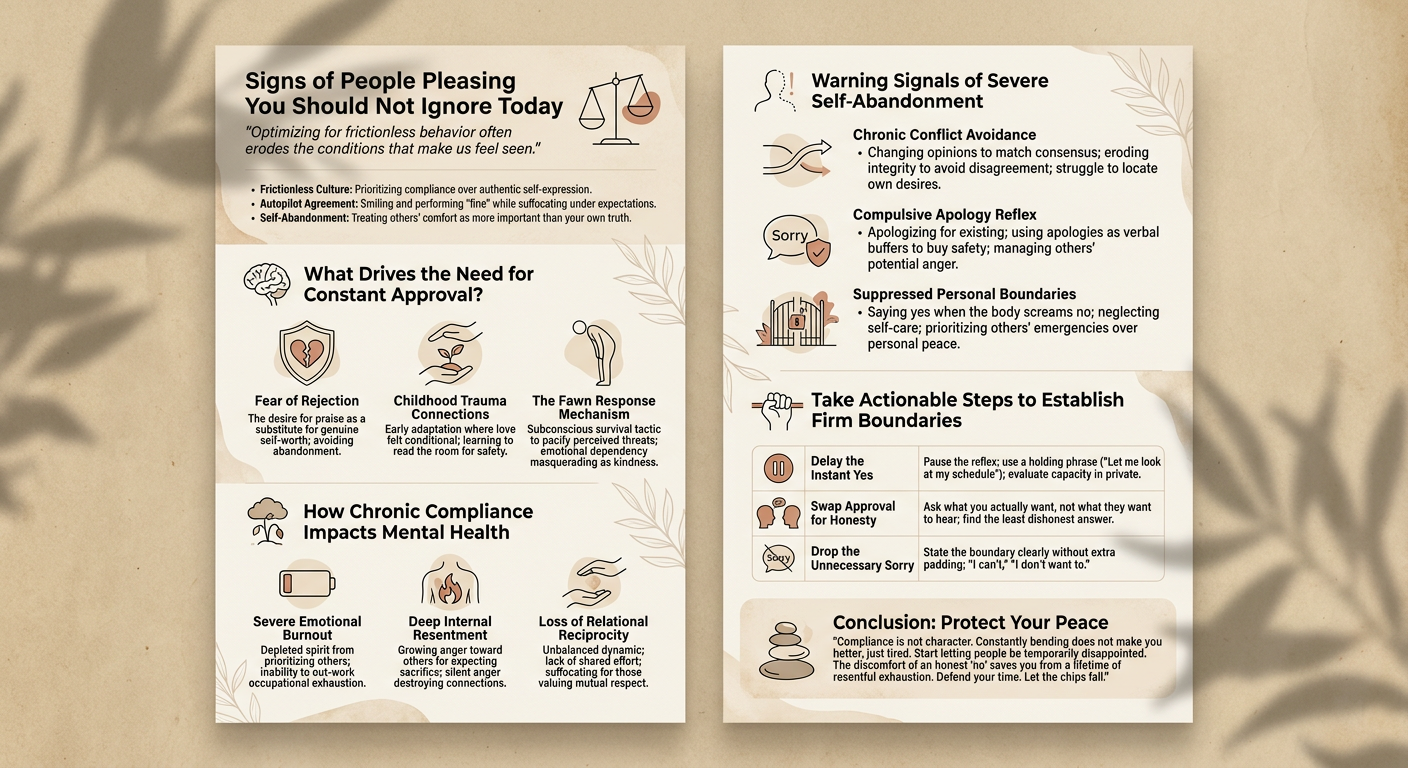
What Drives the Need for Constant Approval?
Fear of Rejection
A lot of this behavior is just fear wearing a friendly costume. Fear that if you stop performing pleasantness, you will lose connection. You worry about being left behind. Some individuals do this to avoid abandonment. Others do it because they mistakenly believe they are only valuable when they are useful or agreeable. The desire for praise becomes a substitute for genuine self worth. You use the approval of everyone around you to regulate your own nervous system.
Childhood Trauma Connections
This behavior often originates in early development. A child who learns early that love is conditional will adapt immediately. If being useful guarantees safety, they become incredibly useful. They learn to read the room. They figure out exactly what their parents needed them to be. This ingrained habit follows them into adulthood. The habit dictates who they are allowed to be in the boardroom, in their relationships, and in their own mind. It is a brilliant adaptation for a child. It is a restrictive behavioral pattern for an adult.
The Fawn Response Mechanism
We talk about fight or flight. We rarely discuss fawning. It is a subconscious survival tactic. You pacify a perceived threat by yielding. You attempt to create a false sense of safety by becoming whatever the other person requires. You do not do this out of kindness. You do it to survive the moment. It is an emotional dependency masquerading as a helpful personality trait.
Warning Signals of Severe Self-Abandonment
Chronic Conflict Avoidance
You change your opinions to match the consensus in the room. You think you are being easygoing. You are actually eroding your own integrity. You avoid the disagreement, but the cost is your relationship with yourself. Decades of clinical observation show how chronic people pleasers struggle to make decisions when they fear others will be displeased. You lose the ability to locate your own desires.
Compulsive Apology Reflex
You apologize for existing. You say sorry when someone else bumps into you. You use apologies as a verbal buffer to soften your presence in the world. You are trying to buy safety with politeness. Over-apologizing is a glaring warning sign that you are managing someone else’s potential anger before it even exists.
Suppressed Personal Boundaries
You say yes when your body screams no. You take on the extra project. You cancel your own hobbies. You neglect basic self care. You prioritize their emergency over your own peace. When clients start asking what are the signs of unhealthy perfectionism, the conversation inevitably circles back to this exact suppression. The body keeps the score.
How Does Chronic Compliance Impact Mental Health?
Severe Emotional Burnout
Because you prioritize the needs of others above all else, your own tank runs entirely dry. You cannot out-work a depleted spirit. Experts focusing on how to recognize the signs of occupational exhaustion frequently point to this exact dynamic. You give away your energy until you have absolutely nothing left for your own life. Mental health professionals and those offering online therapy see this specific burnout daily.
Deep Internal Resentment
The longer you suppress personal limits, the more you resent the people around you. You train them to expect your sacrifice. Then you get angry at them for expecting it. This silent anger and long-term relationship resentment destroys the very connections you were trying to protect. You resent them not because they are evil. You resent them because your own needs kept getting consistently self-neglected.
Loss of Relational Reciprocity
Healthy people do not want a overly submissive. If you are always the one bending, there is no shared effort. Just your sacrifice over and over. That dynamic feels suffocating to anyone who values mutual respect.
|
The Pleaser’s Intent |
The Psychological Reality |
The Relational Outcome |
|---|---|---|
|
“I am keeping the peace.” |
You are internalizing the conflict. |
Superficial harmony masking deep resentment. |
|
“I am being a good friend.” |
You are curating a false image. |
Lack of genuine intimacy or trust. |
|
“I am avoiding their anger.” |
You are abandoning your own needs. |
Severe emotional burnout and anxiety. |
The Hidden Manipulation Behind Forced Harmony
Disguised Conflict Evasion
You think you are keeping the peace. You are actually hoarding control. By never showing your true feelings, you manipulate how others perceive you. You guarantee your own inclusion by curating a fake version of yourself. It is a quiet, subtle form of control. You decide what parts of yourself the world is allowed to interact with.
Covert Image Control
You want to be seen as the good person. The reliable colleague. The perfect partner. You perform an image to secure their comfort. It works. Until it destroys you.
Subconscious Survival Tactics
By anticipating what everyone else wants, you never have to face the vulnerability of asking for what you want. It is a defense mechanism. If you are ignoring the signs of cognitive overload, you will keep running this survival script long after the danger has passed.
Take Actionable Steps to Establish Firm Boundaries
Delay the Instant Yes
You cannot magically become proficient at setting boundaries overnight. You must slow the pattern down right at the trigger point. The request. The disagreement. That tiny panic that says something bad will happen if you refuse.
-
Pause the reflex: Force a physical delay before opening your mouth.
-
Use a holding phrase: Say “Let me look at my schedule and get back to you.”
-
Evaluate your capacity: Check your actual workload, not your aspirational one.
-
Formulate the response: Decide on your terms in private, away from their immediate pressure.
Swap Approval for Honesty
Instead of asking what they want to hear, ask yourself what you actually want to do. Find the least dishonest version of that answer. Speak it.
Drop the Unnecessary Sorry
Stop apologizing for having needs. State the boundary without the extra padding. You do not need to be aggressive. You just need to be clear. I can’t. I don’t want to. Not this time. Even if your voice shakes, it is still better than experiencing an emotional breakdown or sudden dysregulation later.
What Happens When You Reject Constant Demands?
People may feel unhappy. The established relational dynamic is disrupted. You disrupt the equilibrium they relied on. They will test the boundary. They will push back. Let them. Your job is not to manage their disappointment. Your job is to hold the line. The ones who are actually worth your time will adjust. The rest will reveal themselves fast. That is a win. You distance oneself from exploitative dynamics. You keep the peers.
How Do Healthy Relationships Respond to Boundaries?
They respect them. Mutual respect requires friction. A healthy friend or partner actually wants to know where your limits are. They do not want to guess. They do not want to accidentally exploit you. When you draw a line, a healthy person adjusts their approach. They might be temporarily disappointed by a refusal, but they do not punish you for it. They value the integrity of the connection more than the convenience of your compliance.
FAQ
Can people pleasing be managed completely? You can build enough internal safety that you no longer need to rely on external compliance to feel secure. Therapy helps heavily with this transition.
Is it possible to be kind without being a people pleaser? Absolutely. Kindness is rooted in choice. Pleasing is rooted in fear. When you say yes from a place of genuine capacity, that is kindness. When you say yes because you are terrified of saying no, that is self-abandonment.
Why do I feel incredibly guilty when I finally say no? Your brain associates compliance with safety. When you say no, your nervous system registers a threat. The guilt is just the emotional echo of an old survival habit. Let the guilt sit there. Do not act on it. It fades.
Conclusion
Compliance is not character. Constantly bending to the will of everyone around you does not make you a better person. It just makes you a more tired one. You cannot build a genuine life on a foundation of suppressed desires and swallowed words. Start letting people be temporarily disappointed. Start risking the friction. The temporary discomfort of an honest “no” will save you from a lifetime of quiet, resentful exhaustion. Protect your peace. Defend your time. Let the chips fall.