
Two colleagues sit across a small table in a brightly lit cafe. One casually asks how the weekend went. The other inhales deeply and suddenly drops a massive, unresolved personal tragedy onto the table, complete with devastating details and raw, unchecked grief. The air immediately leaves the room. A standard coffee break abruptly morphs into an impromptu crisis intervention.
This specific dynamic routinely plays out in breakrooms, living rooms, and digital spaces globally. It is the act of treating other people like an emotional receptacle, where one individual’s suffering becomes the only destination on the conversational map. Trauma dumping occurs when the sharing of profound pain is intensely one-sided, highly graphic, and blatantly ignores whether the person on the receiving end ever actually signed up for the heavy emotional burden. People often confuse the simple presence of trauma with an automatic mandate to broadcast it. Having past trauma is simply a human reality. The psychological phenomenon only becomes actively harmful when a speaker recruits an unwilling listener into their personal crisis without warning.
Clinical consensus clearly illustrates how sudden oversharing crosses the listener’s boundaries and aggressively raises baseline stress. The recipient suddenly finds themselves managing the emotional fallout of someone else, scrambling to provide comfort while their own nervous system quietly panics.
What separates emotional dumps from healthy release?
Vulnerability has become a highly sanitized corporate buzzword. Leadership seminars demand authentic storytelling. Social media rewards raw disclosure. Yet unregulated vulnerability can become overwhelming. The line dividing a healthy release from a harmful dump relies entirely on three foundational pillars: consent, reciprocity, and timing. When these elements vanish, the conversation devolves into outsourcing emotional regulation to others.
Preemptive consent checks
A healthy emotional release never functions as an unexpected burden. Before delving into heavy material, a person seeking support will naturally pause to measure the environment. They offer a clear signal that complicated information is coming. Asking a simple question about a friend’s current readiness to hear something difficult gives that listener the autonomy to opt in or politely decline. This small moment of friction protects the psychological safety of both individuals.
Mutual listener capacity
Even the most supportive friends possess finite emotional resources. A person might deeply care about a loved one but currently lack the mental bandwidth to process a traumatic experience due to their own hidden stressors. Healthy venting respects this limitation. It requires the speaker to actively read the room and gauge the actual capacity of the recipient before unloading years of unprocessed grief.
Reciprocity in dialogue
Conversations require oxygen to flow in two directions. When individuals engage in healthy venting, the dialogue remains dynamic. The speaker pauses. The listener responds. Questions are asked about how the other person is coping. Experts widely differentiate bidirectional venting from this one-sided emotional avalanche, noting that genuine connection demands mutuality.
Appropriate moment selection
Context completely alters the impact of a message. Bringing up a deeply particular trauma during a busy commute or minutes before a crucial presentation guarantees that the listener cannot process the information effectively. Proper moment selection honors the weight of the topic by ensuring the environment actually supports a meaningful, grounded response.
To further clarify this crucial distinction, consider how the two behaviors manifest in daily life:
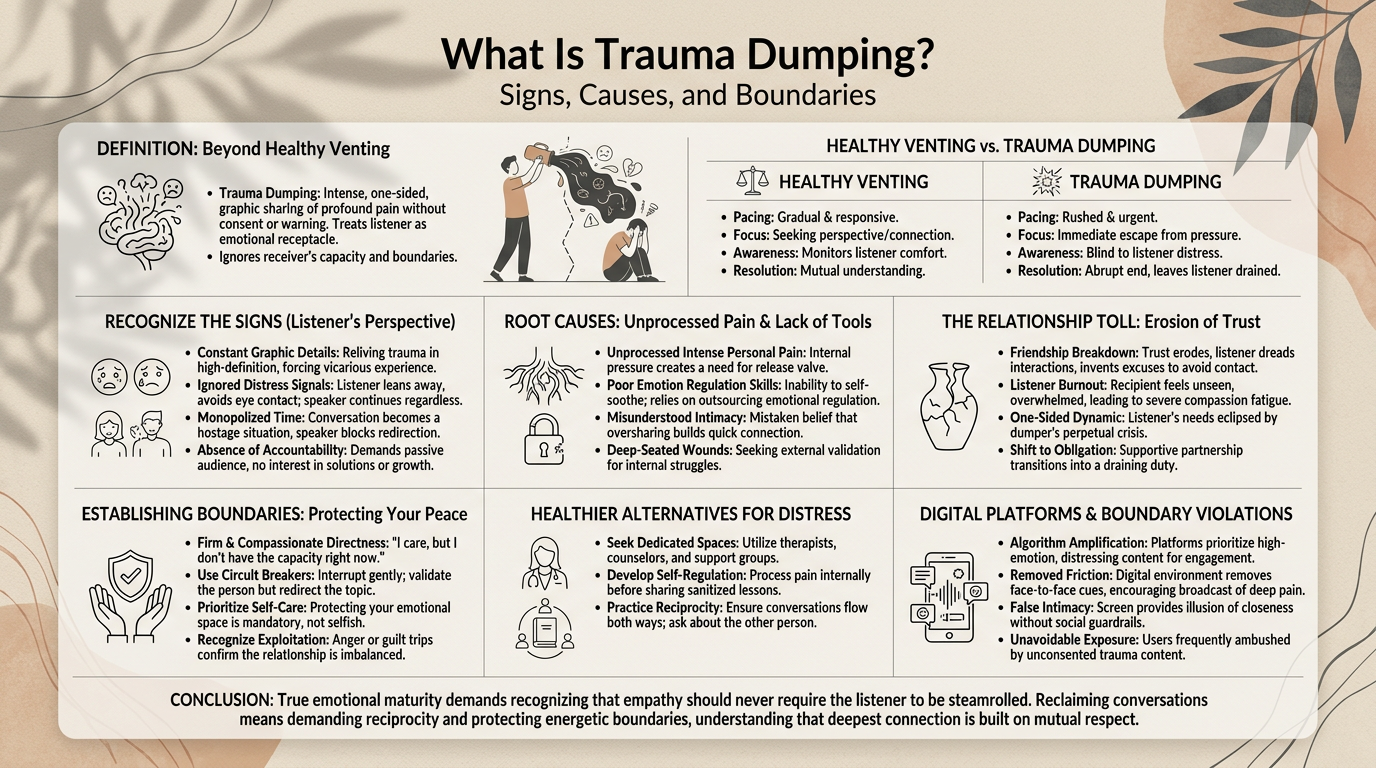
| Behavioral Marker | Healthy Venting | Trauma Dumping |
|---|---|---|
| Pacing | Gradual, structured, and responsive to the listener. | Rushed, chaotic, and entirely focused on the speaker’s urgency. |
| Focus | Seeking perspective, connection, or a brief release of frustration. | Seeking an immediate escape from unbearable internal pressure. |
| Awareness | The speaker monitors the listener’s comfort and engagement level. | The speaker remains completely blind to the listener’s distress. |
| Resolution | Often ends with mutual understanding or a shift to a lighter topic. | Ends abruptly when the speaker feels empty, leaving the listener drained. |
Recognize signs of one-sided emotional burdens
Understanding the mechanics of this behavior requires looking closely at the behavioral patterns that emerge in real time. The body of the listener usually recognizes the violation long before the logical brain catches up. Shoulders tighten. The breath becomes shallow. A profound sense of being trapped settles in.
Constant graphic pain details
A key indicator involves the sheer intensity of the narrative. The speaker does not merely summarize a difficult event. They insist on dragging the listener through every agonizing, high-definition detail. This is rarely about seeking relief mental health support; it is a mechanism of reliving the event aloud. The vividness of the story forces the listener to vicariously experience the trauma, creating a secondary layer of stress.
Ignored listener distress signals
A person caught in a dumping cycle loses all peripheral vision. The recipient might physically lean away, break eye contact, offer closed-off body language, or give short, uncomfortable responses. The speaker ignores these clear social cues. The drive to empty their emotional reservoir completely overrides any basic social empathy or awareness of the harm being done in that exact moment.
Monopolized conversation time
These interactions swallow hours whole. The individual dominates the airspace, transforming a dialogue into a hostage situation. If the listener attempts to gently steer the conversation toward a lighter topic or interject with their own experience, the speaker forcefully redirects the conversation to their own suffering.
Absence of personal accountability
Those who chronically unload their baggage rarely ask for actionable feedback. They are not looking for cognitive behavioral therapy techniques or practical solutions to their problems. They demand a passive audience. They repeatedly detail the same crisis, reinforcing a narrative where they hold zero agency, completely ignoring any opportunity for personal growth or actual repair.
Why do individuals unload uninvited emotional pain?
People rarely wake up and consciously decide to distress a peer. The behavior almost always stems from a place of profound, agonizing desperation rather than calculated malice.
- They lack basic tools to self-soothe when anxiety spikes.
- They carry deep, unaddressed wounds that constantly demand external validation.
- They mistake the intensity of a trauma bond for genuine, sustainable affection.
Unprocessed intense personal pain
When traumatic experiences remain buried and unexamined, they generate an immense internal pressure. The mind constantly looks for a release valve. Without professional help, the individual subconsciously uses random social encounters to release this internal tension. They speak the trauma aloud hoping the sheer act of vocalizing it will finally make the pain manageable.
Poor emotion regulation skills
Modern society heavily prioritizes technical skills and corporate productivity while virtually ignoring emotional literacy. Many adults simply never learned how to sit with negative feelings. When discomfort arises, their immediate reflex is to eject it outward. They rely entirely on the people around them to act as human shock absorbers, effectively outsourcing their own emotional regulation to anyone willing to stand still.
Misunderstood personal intimacy concepts
A pervasive cultural myth suggests that sharing deeply personal secrets automatically fast-tracks a relationship. Individuals struggling with isolation often use their trauma as a currency to purchase connection. They believe that if they expose their deepest wounds, the other person is socially obligated to care for them. But intimacy requires closeness and mutuality. Being talked at while visibly struggling to keep up does not build intimacy. It builds resentment.
The relationship toll of unsolicited emotional baggage
Friendships and partnerships crack under this specific type of weight. When one person consistently uses another as an unconsenting therapist, the fundamental trust within the relationship erodes. The listener begins to dread incoming calls. They invent excuses to cancel plans. They start operating in a state of hypervigilance, constantly bracing for the next emotional impact.
This dynamic leaves the recipient feeling entirely unseen. Their own struggles, joys, and daily experiences are completely eclipsed by the looming shadow of the dumper’s perpetual crisis. Researchers studying interpersonal communication note how the forced, unconsented disclosure of traumatic events immediately impacts the psychological safety of listeners, often leading directly to severe compassion fatigue. The relationship transitions from a supportive partnership into a draining obligation.
Establish firm boundaries with chronic oversharers
Society conditions people to believe that being a good friend means offering endless, unconditional access to one’s own mental space. Setting a boundary feels inherently cruel to someone raised to be a people pleaser. But compassion is not the same thing as letting oneself be steamrolled.
Interrupting the pattern requires firm, compassionate directness. A listener must learn to comfortably say that they value the relationship but cannot hold the weight of the conversation at that moment. Phrases like “I want to support you, but I do not have the emotional capacity for this topic today” serve as necessary circuit breakers. If the speaker reacts with anger or guilt trips, it only confirms that the relationship was operating on exploitation rather than mutual care. Protecting one’s own peace is a mandatory practice, not a selfish luxury.
Build healthier communication habits for personal distress
Those who recognize themselves as the ones doing the dumping face a difficult but entirely necessary pivot. The urge to share intense pain is valid, but the method requires complete restructuring.
Seeking dedicated spaces built specifically for heavy processing changes everything. Therapists, counselors, and structured support groups exist precisely for this function. They provide a safe, regulated container for traumatic events without risking the integrity of personal friendships. Psychological experts frequently point out that continuing to dump on untrained friends means it keeps the emotions entirely stuck in a loop for both the speaker and the recipient, preventing any actual healing from taking place. Developing self-regulation techniques allows an individual to process their pain internally before selectively and respectfully sharing the sanitized lessons with their community.
How do digital platforms encourage boundary violations?
The architecture of modern internet platforms actively accelerates this behavior. Algorithms are notoriously designed to prioritize and amplify high-emotion, polarizing, or distressing content because it guarantees user engagement. A person scrolling through their feed looking for lighthearted updates is routinely ambushed by graphic stories of assault, grief, or systemic abuse.
This digital environment completely removes the friction of face-to-face interaction. A user can broadcast their deepest pain to thousands of strangers without ever having to look at the discomfort on their faces. Academic studies examining user behavior demonstrate how platform algorithms actively facilitate the rapid sharing of distressing content, turning offensive content and unconsented trauma exposure into a daily, unavoidable reality for the average internet user. The screen provides a false sense of intimacy while simultaneously stripping away all necessary social guardrails.
FAQ
Is it ever okay to talk about my past trauma with friends? Yes. Sharing personal history builds deep, meaningful connections. The critical difference lies in asking for permission first, ensuring the friend has the current emotional capacity to listen, and keeping the focus on mutual understanding rather than just unloading graphic details to relieve personal anxiety.
How do I stop someone who is currently trauma dumping on me? You must interrupt them gently but firmly. You can say something like, “I care about you and want to hear about your life, but I am feeling really overwhelmed by this topic right now and need to pause this conversation.”
Does trauma dumping mean the person is toxic? Not inherently. Most people who engage in this behavior are acting out of severe, unprocessed pain and a lack of emotional regulation skills. They are usually seeking relief and connection, even though their method actively pushes people away and causes harm.
Can a relationship recover from a pattern of emotional dumping? Relationships can heal if the person doing the dumping takes accountability for their actions, seeks appropriate professional help for their trauma, and actively begins respecting the boundaries set by the listener moving forward.
Conclusion
A society overly obsessed with raw visibility often forgets the quiet necessity of holding space safely. We encourage everyone to share their stories but fail to teach anyone how to receive them without breaking under the weight. Navigating the aftermath of a traumatic experience is undeniably highly demanding work. It requires tremendous patience, professional guidance, and supportive communities.
But expecting an untrained friend, a casual colleague, or a digital stranger to absorb that pain without warning is a profound failure of care. True emotional maturity demands recognizing that while trauma deserves immense compassion, that empathy should never require the listener to be entirely steamrolled. Reclaiming our conversations means demanding reciprocity, protecting our energetic boundaries, and understanding that the deepest forms of human connection are built on mutual respect, not mutual destruction.