
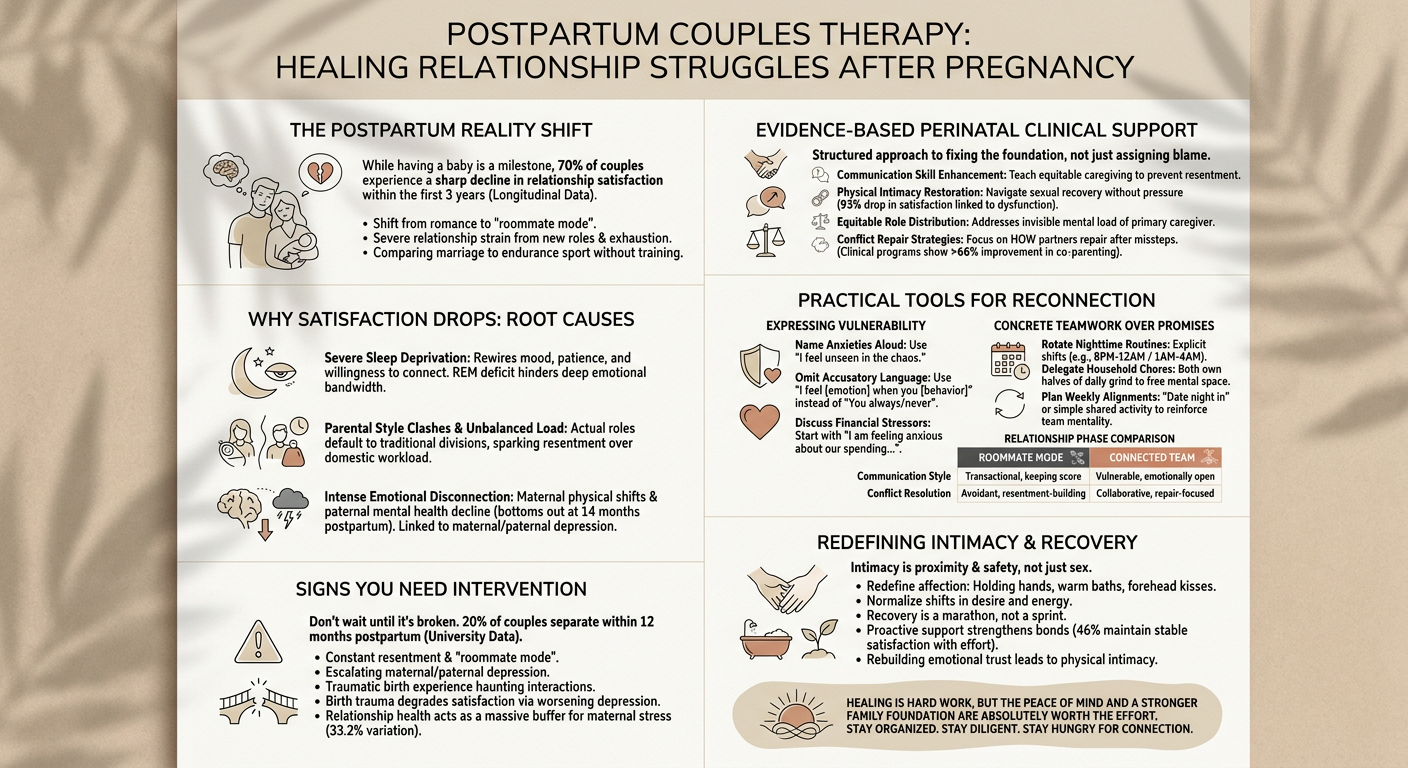
Postpartum couples therapy is designed to help new parents navigate the severe decline in relationship satisfaction that frequently occurs after having a baby. By utilising evidence-based clinical interventions explicitly targeting communication breakdowns, intimacy issues, and unaligned parenting styles, this specialized therapy helps partners shift from operating in a resentful “roommate mode” back to functioning as a supportive, connected team.
Many of us stare at our sleeping newborns in awe as we think, “Man, we actually survived the delivery, we brought this tiny human home, we did it!”
Why not take that fierce protective instinct and apply it directly to your marriage?
With enough focus and blunt honesty, you can drag your partner relationship out of the fourth trimester trenches.
The transition to parenthood represents the pinnacle of life-altering milestones, with millions of couples worldwide stepping into new roles expecting pure bliss and unshakeable family bonding.
The blood, sweat, and tears that go into the daily survival regimen of most new parents is difficult for anyone without kids to wrap their head around.
From enduring intense sleep deprivation and constant caregiving pressure to managing insane hormonal shifts that we could never anticipate ourselves, the dedication and intensity required of new parents are absolutely staggering.
Okay, so what the heck does this have to do with professional therapy?
More than you might think.
While comparing your marriage to a grueling endurance sport might seem like apples and oranges, consider the struggles that couples face during the postpartum period:
- Some days it just feels like we’re going nowhere, essentially spinning our wheels trying to support a completely exhausted, depressed partner.
- Throwing in the towel can be incredibly tempting when we’re constantly fighting over who changed the last diaper and not seeing any emotional ROI for our hard work.
- Overcoming that final barrier of deep-seated resentment can feel like staring up at a giant, seemingly impossible mountain to climb.
Couples face physical and mental roadblocks as they spend months navigating relationship challenges that can detonate in mere seconds of bickering.
But do they have to let the marriage fail?
No.
And neither should you.
It’s time to take your relationship out of the autopilot mode and get on a proactive, healing level.
How?
Why Does Relationship Satisfaction Drop During the Postpartum Phase?
Killer relationships don’t simply survive a new baby by accident: they endure as a result of fierce intentionality and a fool-proof emotional strategy.
Research constantly highlights that the transition to parenthood creates massive strain on even the most solid foundations. In fact, longitudinal data tracking couples from pregnancy through early parenthood reveals that roughly 70% of couples experience a sharp, steep decline in marital satisfaction within the first three years.
Why?
Couples evolve. Or rather, the environment forces them to, and they struggle to adapt.
Severe Sleep Deprivation
Sleep is the true currency of intimacy.
Sleep deprivation doesn’t just exhaust you; it rewires your mood, your patience, and your fundamental willingness to connect. I suspect most marriage problems in that first year postpartum stem directly from a shared, severe deficit of REM sleep. When you are running on three fragmented hours of rest, you don’t have the mental bandwidth for deep emotional connection. You just want to survive.
Parental Style Clashes
We all think we’re going to split the workload perfectly down the middle.
Yet, studies document that even though couples have egalitarian expectations late in pregnancy, actual roles default heavily to traditional gender divisions immediately after birth, sparking severe spousal conflict regarding domestic workloads. One person becomes the default manager of the infant’s life. The other waits for instructions. Resentment brews instantly.
Intense Emotional Disconnection
Mothers endure massive physical shifts, but the mental health condition of the other parent matters just as much. First-time fathers endure a continuous, steep decline in relationship health that does not bottom out until 14 months postpartum. Furthermore, maternal postpartum depression rarely operates in a vacuum; it strongly predicts paternal postnatal depression.
Evidence-Based Perinatal Clinical Support
You can’t always expect your marriage to kill it from the word “go” after bringing home a new baby.
Postpartum couples therapy isn’t about sitting on a couch and assigning blame for who ruined the intimate connection. It is an active, structured approach to fixing the foundation.
Communication Skill Enhancement
Therapists teach new parents how to share the burden of caregiving equitably, thereby preventing the resentment that brews when the primary caretaker feels entirely abandoned.
Physical Intimacy Restoration
Intimate life takes a massive hit. Clinical data tracks a significant barrier to intimacy, showing that between 41% and 83% of women experience physical or hormonal sexual dysfunction at two to three months postpartum. Furthermore, a university cohort study found that 93% of women noted an overall drop in relationship satisfaction occurring simultaneously with postpartum sexual dysfunction. Therapy helps navigate this sexual recovery without pressure.
Equitable Role Distribution
Sharing the load isn’t just about fairness. It’s about preserving the mental health of both individuals. Postpartum intimacy counseling directly addresses the invisible mental load carried by the primary caregiver.
Conflict Repair Strategies
Mental health professionals emphasize that surviving new parenthood is not about eliminating conflict. It is entirely about how partners repair after the missteps. A clinical intervention data analyzing a structured couples program demonstrated significant improvements across more than 66% of all coparenting, family violence, and mental health metrics.
How Can Couples Express Vulnerability Without Accusations?
I won’t pretend there’s a magic moment when everything snaps back to normal.
The real shift came for me when I started naming the awkward bits out loud.
Name Specific Anxieties Aloud
Exercise: The ‘Unseen’ Script
Use this concrete starter when tension rises: “I feel unseen in the chaos.” Saying those things out loud creates a clearer path to rebuild emotional closeness. Therapists and post-baby relationship experts consistently point to vulnerability as the engine of reconnecting, even when you’re overwhelmed by outside stressors.
Omit Accusatory Language
Exercise: The ‘I Statement’ Structure
Replace accusations with this specific script: “I feel [emotion] when you [behavior], and I need [support].” Stop using “You always” and “You never.” Frame the exhaustion around yourself. Discuss your depressive symptoms or postpartum anxiety without weaponizing them against your partner.
Discuss Financial Stressors
Exercise: The Budget Conversation Script
Money stress compounds prenatal stress. Begin your check-in with this specific starter: “I am feeling anxious about our spending this week because…” A family member implemented a shared budgeting check-in using this method every two weeks, which reduced money-related stress and freed mental bandwidth for actual connection rather than grinding over finances while exhausted.
Prioritize Concrete Teamwork Over Grand Partner Promises
Early after the baby arrives, resentment grows when tasks pile up. Reclaiming small, concrete acts of teamwork beats grand promises.
Rotate Nighttime Routines
The turning point for many couples is turning chores and caregiving into explicit, visible teamwork. “I’ll take the 8 PM to midnight wake windows; you take the 1 AM to 4 AM shift.” It isn’t glamorous, but it feels like you are in the same lifeboat instead of rowing in opposite directions.
Delegate Household Chores
When both partners own halves of the daily grind, the mental space opens for genuine connection. Late-night talks stop being about logistics and start being about hopes, fears, and shared jokes.
Plan Weekly Alignments
Another colleague started a “date night in” habit once a week, swapping who cooks and who cleans up. They kept it simple: a movie, a board game, or a walk with the fetus-turned-screaming-infant in the stroller. The ritual became a reliable marker that they were still a team.
| Relationship Phase | Communication Style | Conflict Resolution |
|---|---|---|
| Roommate Mode | Transactional, logistical, keeping score | Avoidant, resentment-building |
| Connected Team | Vulnerable, emotionally open | Collaborative, repair-focused |
Redefine Affection When Sleep Becomes the True Currency
Postpartum intimacy isn’t only about sex; it’s about proximity and safety.
Holding hands. A warm bath together. A five-minute forehead kiss before bed.
Redefining intimacy to include non-sexual affection reduces the crushing pressure and makes the idea of “being close again” significantly less intimidating. It normalizes the shifts in desire and energy that come after childbirth.
If you hope for your marriage to stay resilient, you can’t afford to ignore these small micro-moments of connection.
What Signs Indicate the Need for Professional Intervention?
You might wonder if your relationship issues are just standard marital problems or something requiring licensed marriage and family psychology intervention.
University-tracked data indicates that approximately 20% of couples separate or end their relationship within the first 12 months following the birth of a child.
Do not wait until the marriage is already broken to seek couples counseling. If you are experiencing constant resentment, if maternal depression is escalating, or if the ghost of a negative birth experience haunts your daily interactions, you need an expert. Up to 34% of mothers and 26% of partners subjectively perceive their childbirth experience as a highly negative or traumatic event, escalating long-term relationship tension. Clinical modeling proves that postpartum post-traumatic stress disorder (PTSD) symptoms from traumatic births degrade relationship satisfaction entirely through the pathway of worsening maternal depression.
Childbirth trauma is real. Posttraumatic stress destroys the emotional bridge between partners.
A study mapping maternal mental health found that relationship health acts as a massive buffer, directly accounting for 33.2% of the overall variation in a mother’s postpartum stress levels. Healing the marriage heals the mother. Healing the mother heals the family.
How Long Does Relationship Recovery Usually Take?
Remember: relationship repair represents a marathon and not a sprint.
Think about how long-distance runners kick it into high gear at the end of the race: the fact that they were ever “behind” becomes irrelevant as long as they cross the finish line together.
Evaluating transition-to-parenthood psychoeducational therapy shows that husband contempt decreases and positive affect increases at 3 months, which successfully predicts long-term, positive communication fixes at 1 year.
You have to play the long game. Countering the narrative that all relationships fail post-baby, dyadic latent class growth analysis confirms that 46% of couples successfully maintain highly stable satisfaction and commitment levels by leveraging supportive responses and high relational self-expansion.
FAQ
Can individual therapy replace postpartum couples therapy? While individual therapy is fantastic for addressing specific depressive disorders, anxiety disorders, or individual postpartum pathologies, it cannot entirely replace couples sessions. Relationship dynamics require both parties in the room. You cannot fix a dynamic if only half the team is running the plays.
Does a difficult birth experience automatically lead to divorce? Absolutely not. While a negative birth experience introduces severe psychological hurdles, compassionate therapists can help process that specific trauma. As William Doherty’s research on the transition to parenthood often highlights, proactive partner support during and after a traumatic birth can actually strengthen offspring attachment and marital bonds if handled correctly.
Will my intimate life ever go back to normal? Normal is a moving target. Your intimate life will evolve. Psychometric data shows that for every single point increase in a mother’s relationship satisfaction score, her overall physiological and psychological health quality of life increases by 0.39 points. Rebuilding emotional trust leads directly to rebuilding physical intimacy.
Conclusion
Building.
Communicating.
Testing your boundaries.
Fostering a healthy relationship after a baby represents a lot of hard work, and there are no shortcuts.
Much like elite athletes, new parents should consider patience, focus, and consistency as key virtues to help ensure their success.
Stay organized. Stay diligent. Stay hungry for connection.
Your efforts will pay off, and your family will be infinitely stronger for it.