
I think “life coaching therapy” is a blurry label that makes ordinary coaching sound more substantial than it is. People love mashing words together to create an illusion of depth. You see it constantly in the wellness space. Someone wants the clinical authority of a mental health therapist but the unregulated freedom of a coach. The result is a marketing chimera. A licensed therapist diagnoses and treats psychological disorders. A life coach helps you map out future aspirations. They are fundamentally different disciplines. “Tools, motivation, and inspiration” is a nice pitch, but that’s not a reason to hand over therapy money.
When you mix life coaching and therapy together in your mind, you risk paying for the wrong kind of support. If your nervous system is chronically overtaken by past experiences, paying someone to help you “crush your goals” is wildly ineffective. We live in a culture obsessed with scale and endless upgrading. We want to optimize our careers, our relationships, our very personalities. But optimization requires a stable foundation.
What separates clinical treatment from personal development?
The boundary between healing and planning is where the confusion usually starts. We tend to view our emotional struggles as logistical problems that just need a better spreadsheet or a more aggressive morning routine.
Past trauma resolution
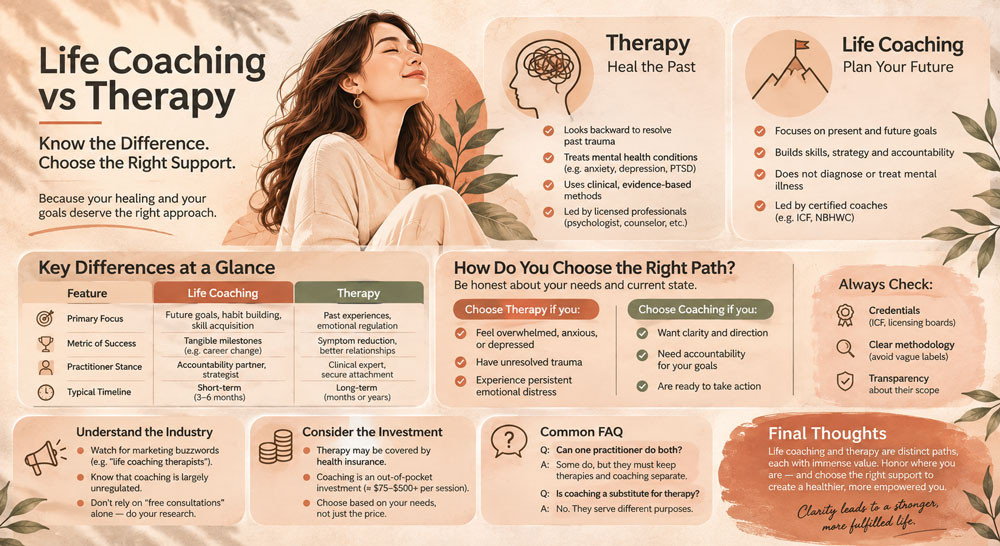
Therapy can often be seen to look backward to make sense of the present. A licensed professional, whether a psychologist or someone holding a master’s degree in counseling, is best trained in trauma-informed care. They understand the complex neural circuits underlying emotional regulation. When you sit with a life therapist, you are engaging in relational repair. You are exploring the deeply ingrained patterns inherited from your family of origin, unraveling the coping mechanisms that kept you safe as a child but are suffocating you as an adult.
Clinical work is messy. It requires immense patience and a compassionate container. It is not about forcing a silver lining onto your history.
Future goal execution
Coaching looks at the present and charts a path forward. The primary objective is personal growth and career transition. A coach assumes you are already at a functional baseline. You have the emotional capacity to take action, but perhaps you lack clarity or accountability. The focus is strictly on building skills and strategies to cross a specific finish line.
If you are navigating a complex corporate hierarchy or trying to launch a business, finding someone skilled in workplace burnout coaching can be highly beneficial. Interestingly, significant reductions in depression (-22.5%) and anxiety (-12.0%) symptoms have been observed via technology-enabled, ICF-certified coaching platforms. But these non-clinical health outcomes are secondary benefits of taking purposeful action, not the primary treatment of a mental health diagnosis.
Mental health diagnosis
Only a licensed professional counselor, psychiatrist, or similarly credentialed mental health provider can diagnose and treat clinical disorders like depression, anxiety, or PTSD. They operate under a strict scope of practice governed by regulatory boards. There is an established mandatory distinction between clinical psychological diagnosis and non-clinical life coaching that ethical practitioners strictly follow. Coaches do not diagnose. If a coach attempts to treat your trauma using cognitive behavioral techniques without clinical licensure, they are practicing outside their legal and ethical bounds.
Understand the blurry practitioner labels
The internet is a wild west of credentials. Anyone can buy a domain name and call themselves a specialist in human transformation.
Marketing language skepticism
Titles like “life coaching therapists” or “mindset healers” may be designed to bypass critical thinking. They borrow the trusted lexicon of psychotherapy and attach it to unregulated services. In my practice, I frequently meet corporate professionals dealing with severe burnout who initially sought help from a “high-performance coach.” They were taught to push harder, to optimize their calendars, to ignore their body’s desperate plea for rest. The marketing promised empowerment, but the methodology delivered exhaustion.
Unregulated industry standards
Unlike the medical or therapeutic fields, the life coaching profession is fundamentally unregulated by state or national licensing boards. You do not legally need a specific degree or an established training program to call yourself a life coach. This variability creates a minefield for consumers. While the International Coaching Federation (ICF) provides rigorous certification requirements, participation is voluntary.
Free consultation traps
I’d be especially skeptical of a directory calling providers “quality-vetted” without showing what that means. A free intro call is useful, sure—but it’s a sales filter, not proof the service is worth paying for. Many directories rely on a pay-to-play model where coaches pay a monthly fee to be listed. The “vetting” is often just verifying that a credit card cleared. When looking for a personal life coach, you have to do your own due diligence regarding their education, their specific methodologies, and their professional boundaries.
Core differences in session structure
The day-to-day experience of sitting in a room (or on a Zoom call) with these two types of practitioners feels completely different.
Practitioner methodology
A therapist often employs an open-ended, exploratory approach. The process is client-led. The therapist holds space, asking questions that gently probe the subconscious. It is about understanding the “why” behind your behaviors.
A coach is highly directive and action-oriented. Sessions often end with homework, action items, and measurable targets. It is deeply focused on the “how.” They utilize strengths-based coaching principles to leverage what you are already good at, rather than fixing what feels misaligned.
Expected timeline
Therapy can span months or years. Healing is not linear, and untangling decades of conditioning takes whatever time it takes. Coaching is typically structured around short-term engagements—perhaps a three-month or six-month program designed to bridge a specific gap in your personal and professional life.
Success metrics
|
Feature |
Life Coaching |
Therapy |
|---|---|---|
|
Primary Focus |
Future goals, habit building, skill acquisition |
Past experiences, emotional regulation, trauma |
|
Metric of Success |
Tangible milestones achieved (e.g., job transition) |
Symptom reduction, improved relational dynamics |
|
Practitioner Stance |
Accountability partner, strategist |
Clinical expert, secure attachment figure |
|
Typical Format |
Structured programs, defined timelines |
Open-ended exploration, ongoing care |
How do you choose the right path?
Deciding between a mental health therapist and a life coach comes down to assessing your current capacity and your desired outcome.
Current functional baseline
You have to be honest about your psychological bandwidth.
-
Are your daily functions impaired by overwhelming anxiety or profound sadness?
-
Do you find yourself constantly triggered by interactions at work or home, leading to disproportionate emotional responses?
-
Are you seeking relief from deep-seated feelings of worthlessness or persistent relationship anxiety?
If you answered yes, you need clinical support. Attempting to life coach your way out of clinical burnout is like trying to furnish a house while the foundation is sinking. You must engage in true therapy for burnout to regain your resilience before you worry about scaling your output.
Specific objective clarity
If I wanted help getting organized or staying motivated, I’d start with a concrete goal and a plan I can actually follow. I wouldn’t pay extra just because somebody wrapped that in therapy language. When you know exactly what you want—a career pivot, a clearer business strategy, a better system for managing your week—a coach is the perfect catalyst. They provide the scaffolding to turn vague aspirations into executed reality.
Evaluate credentials and directory vetting
Because the coaching industry lacks uniform legal oversight, the burden of verification falls entirely on you. Do not take a polished website as evidence of expertise.
Look for individuals who have completed accredited training programs. For coaches, the gold standard involves credentials from the ICF or the National Board for Health & Wellness Coaching (NBHWC). These bodies enforce strict board certification standards and exam requirements that ensure a baseline of competency. For therapists, verify their licensure through your local state or national board (such as the ACA for professional counselors). A legitimate practitioner will always be completely transparent about their qualifications and the explicit limitations of their practice.
There is a massive global market breakdown showing 42% interest in wellness coaching, which means the market is flooded with well-meaning amateurs. Demand evidence of their training. Ask about their supervision. If they cannot clearly articulate the difference between their services and clinical psychotherapy, walk away.
What are the typical financial expectations?
Money carries profound emotional weight. In places like Singapore, where I practice, money is heavily tied to identity, status, and the relentless script of “upgrading.” Investing in yourself should be an act of intentional care, not another source of financial distress.
Therapy is often recognized as a medical necessity. Depending on your location and diagnosis, sessions with a licensed professional may be partially or fully covered by health insurance. This makes long-term psychological support more accessible for many individuals.
Life coaching is rarely covered by insurance because it is not a medical treatment. It is an out-of-pocket investment in your personal development. Fees vary wildly. A new coach might charge $75 a session, while a seasoned executive coach might command $500 or more an hour. You are paying for their specific expertise, their framework, and the anticipated return on investment in your life or business.
FAQ
Can one practitioner do both life coaching and therapy? Some licensed therapists also offer coaching services, but they must keep the two practices ethically and administratively separate. A practitioner cannot serve as your clinical therapist and your coach simultaneously due to inherent conflicts of interest.
Is life coaching a substitute for mental health counseling? Never. Coaching provides excellent support for individuals seeking forward momentum, but it lacks the clinical frameworks necessary to safely treat psychological disorders or complex trauma.
Why do some coaches use therapeutic techniques? Many coaches integrate tools derived from cognitive behavioral therapy or mindfulness practices to help clients overcome limiting beliefs. However, applying a tool is very different from conducting clinical treatment. Using a mindfulness exercise to calm pre-meeting jitters is coaching; using it to manage clinical panic attacks requires a therapist.
Conclusion
We are hungry for authentic connection and profound clarity, but we often look for it in the wrong places, using the wrong labels. Life coaching and therapy are entirely distinct paths, each holding immense value when utilized correctly. You do not need to mask your desire for career strategy in the language of healing, nor should you attempt to goal-set your way out of deep psychological distress.
Honor where you actually are. If you need a safe harbor to process the weight of your past, find a compassionate, evidence-based therapist. If you need a strategic partner to help you build a new future, hire a credentialed coach. Clarity begins the moment you stop settling for blurry definitions and start demanding the precise support your humanity deserves.