
Last updated on November 17, 2026
Introduction
In today’s highly optimized corporate environment, professionals are constantly seeking innovative psychological frameworks to maximize output and drive sustainable performance.
Except, that is exactly the kind of corporate speak we use to avoid talking about what is really happening inside our heads. Everyone is talking about upgrading their thinking. “Abundance mindset” sounds like a motivational sticker slapped on ordinary advice: be proactive, stay optimistic, learn from your missteps. Fine. But calling it a mindset doesn’t magically make more love, wealth, or health appear.
We live in a culture obsessed with scale and metrics. We optimize for output and quietly erode the conditions that make people feel secure. When you are running on empty, trying to manifest an abundant life feels like a cruel joke. The part of an abundance mindset I’d actually keep is treating setbacks as useful information and taking action instead of spiraling. The rest is incredibly easy to turn into feel-good fluff that asks you to buy a meditation promising an abundance of everything. I wouldn’t spend money trying to manifest a better life. I’d pick a real goal, take the next practical step, and call that progress.
Developing an abundance mindset is not about repeating empty affirmations in the mirror. It is the rigorous, often uncomfortable practice of rewiring your Inner O.S. so that you can navigate constraints without letting them dictate your self-worth.
What separates scarcity from plenty?
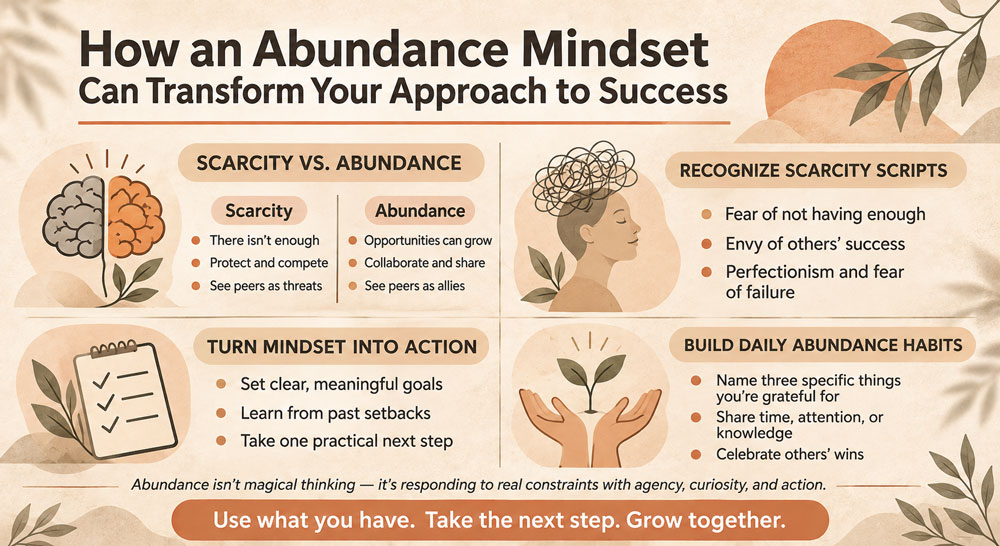
Stephen Covey famously coined the term in his foundational book, The 7 Habits of Highly Effective People. Covey suggested that most people operate from a script of scarcity, viewing life as a pie with a finite number of slices. If someone else gets a big piece, yours naturally shrinks.
The shift to an abundance mentality requires you to fundamentally challenge that math. It is recognizing that human capacity, creativity, and connection are not finite. You don’t hoard resources; you circulate them.
Zero-sum mentality
A scarcity mindset operates on the assumption of insufficiency. There is never enough money, enough time, or enough recognition to go around. This cognitive framing is physically exhausting. When you believe resources are perpetually scarce, your brain literally has less room to process complex problems.
Research highlights how this mental tax functions, showing that the cognitive bandwidth consumed by scarcity can cause equivalent to a 13-point drop in effective IQ. You become reactive. You guard your ideas. You view a colleague’s promotion as a direct threat to your own career trajectory.
Infinite opportunity
Abundant thinking flips the script. It operates on the premise that opportunities can be created collaboratively. When you stop guarding your slice of the pie, you suddenly have the psychological safety to bake an entirely new one.
This is not toxic positivity. It is emotional regulation. Clinical data reinforces this, demonstrating that transitioning from a scarcity to an abundance mindset impacts problem-solving and empathy, especially in high-stress professional environments. You are no longer fighting for survival. You are cultivating curiosity.
Useful feedback loops
When you operate from a place of scarcity, every misstep is a permanent stain on your record. You hide. You deflect. You blame.
An abundance mindset treats a misstep as data. It strips the shame from the equation. If a project stalls, it simply means the current approach requires adjustment. You learn ways to get unstuck. You ask for help because you trust that admitting a gap in knowledge does not diminish your fundamental value.
|
Mindset Framework |
Primary Belief |
Response to Setbacks |
View of Peers |
|---|---|---|---|
|
Scarcity Mentality |
There is not enough. |
Conceal and defend. |
Competitors blocking the path. |
|
Abundance Mentality |
There is plenty for everyone. |
Analyze and iterate. |
Collaborators and sounding boards. |
Recognize hidden scarcity patterns
You cannot shift limiting beliefs toward actionable abundance if you refuse to acknowledge the scarcity scripts running quietly in the background of your life. They disguise themselves as pragmatism. They masquerade as ambition.
Resource limitations
It starts with the baseline assumption that you do not have enough resources to survive. This is not always about money. Sometimes it is about emotional bandwidth or time constraints.
When you perceive a lack of resources, your perspective narrows. A foundational psychological overview reveals how these mentalities consume or free up mental bandwidth across various socio-economic realities. You stop planning for the future because you are entirely consumed by the fires of the present.
Here are the silent signs you are stuck in resource limitation:
-
You constantly use phrases like “I can’t afford to” regarding time, not just finances.
-
You physically tense up when asked to share your expertise or network.
-
You prioritize immediate, low-value wins over long-term strategic growth.
-
You feel a quiet resentment when someone else takes a well-deserved break.
Envy of success
Status games are exhausting. In highly competitive environments—like Singapore, where the journey from HDB to a condo feels culturally mandated—envy is the default language. We look at the car someone drives or the school their child attends, and we use those material goods to measure our own worth.
Envy is a massive indicator of a scarcity mindset. If you feel diminished by another person’s success, you are telling yourself that their win somehow depleted the global reservoir of happiness. It did not.
Fear of failure
We often dress this up as perfectionism. But the refusal to risk a new endeavor is rooted in the belief that your reputation cannot withstand a hit. You redefine success narrowly so you never have to stretch.
This fear keeps you small. It demands that you stay in a job you hate or a relationship that drains you, simply because the known constraint feels safer than the unknown possibility.
Turn abstract motivation into practical action
We spend far too much time intellectualizing our thoughts. You can read every book on having an abundance mindset, but until you change your behavior, your brain will remain wired for scarcity.
Set concrete goals
Clarity is the antidote to anxiety. Vague ambitions like “I want to be wealthy” or “I want to be happy” give your brain nothing to execute.
Pick a real goal. Define what you actually want in life, free from the expectations of your parents or your peers. Write down the exact metrics. I will reach my goals through using my resources intentionally, not by waiting for a cosmic handout.
Analyze past failures
Look at the places where you stumbled. Do not turn away from them.
Relational repair and professional resilience both require you to look at the mess honestly. Why did that launch not work? Why did that conversation escalate? When you strip the emotion out of the event, you are left with pure, actionable intelligence.
Execute next steps
Stop waiting for the perfect conditions. The pursuit of perfection is just a socially acceptable form of procrastination.
Identify the smallest viable action you can take today and do it. If you need to execute actionable tactics to manage self-doubt, start by simply sending the email you have been drafting for three days. You’ll figure out a plan for step two only after step one is complete.
Build daily habits for permanent change
A positive mindset is not a personality trait. It is a daily practice. You must actively train your brain to notice what is working, because its evolutionary default is to scan for danger.
Intentional gratitude
An attitude of gratitude is not about ignoring systemic problems or pretending everything is fine when it isn’t. It is a deliberate focus on what you already possess.
Focusing on gratitude rewires your neural pathways. Start a journaling routine. Write down three hyper-specific things you are grateful for each morning. This simple exercise builds the cognitive muscle required to spot opportunities instead of just threats.
Generous contributions
Scarcity makes you clench your fists. Generosity forces you to open them.
You do not need a massive bank account to be generous. Give your time. Give your full, undivided attention to a colleague. Share a contact. When you freely give what you fear losing, you prove to your unconscious mind that there are enough resources to go around.
Peer celebration
The next time a peer wins, celebrate it loudly. Send the congratulatory message. Buy the coffee.
When you actively participate in the joy of others, you correlate with long-term resilience and better health outcomes. You dismantle the hierarchy of envy and replace it with a network of mutual support.
Why do manifestation techniques often fail?
Have we commercialized hope? The wellness industry packages “abundance” as a consumer product, suggesting that if you just think the right thoughts, things will magically unfold – which can be dangerous in its own right.
This completely bypasses the messy, human reality of trauma, systemic inequality, and psychological safety. Manifestation without action is just wishing. It asks you to bypass the necessary friction of growth. It teaches you to ignore negative emotions rather than processing them.
Genuine resilience requires you to face the reality of your current situation, acknowledge the constraints, and still choose to move forward with a belief in your own agency.
How do you build healthy wealth relationships?
Money is never just money. It carries intergenerational identity. It carries the unspoken rules of who we are allowed to be.
Building a healthy relationship with wealth means separating your net worth from your self-worth. High net worth individuals often still operate from profound scarcity, hoarding wealth out of a conviction that it will all disappear tomorrow. True wealth is having the emotional regulation to let money pass through your life as a tool.
When organizations prioritize this kind of emotional intelligence, the entire environment shifts. Shifting workplace environments from defensive postures to abundance-based operations fosters genuine loyalty and psychological safety. People stop performing for the metrics and start contributing to the mission.
FAQ
What is the definition of an abundance mindset? It is the belief that there are enough resources, opportunities, and success for everyone. It contrasts sharply with a scarcity mindset, which views life as a zero-sum game.
Can you develop an abundance mindset if you grew up in poverty? Yes. While early experiences of financial lack deeply wire the brain for scarcity, intentional habits and trauma-informed support can gradually reframe these limiting beliefs into expansive thinking.
How does Stephen Covey’s 7 habits relate to this? Covey popularized the concept, arguing that effective leadership and personal growth require moving away from viewing life as a competition for finite resources.
What is the fastest way to stop scarcity scripts? Awareness. Catch yourself when you feel envy or panic over a perceived lack. Pause, regulate your nervous system, and deliberately list the resources you currently have at your disposal.
Conclusion
An abundance mentality is not a magic wand. It will not shield you from grief, economic downturns, or the inherent friction of being human.
But it will change how you respond to the fire. Instead of burning down your relationships or retreating into a shell of self-preservation, you will learn to stand in the heat. You will stop waiting for someone else to hand you the permission to live an abundant life. You will look at the resources you have right now, you will look at the people standing beside you, and you will get to work. That is not manifesting. That is taking responsibility for your own growth.