
Last updated on September 14, 2026
A prevailing quietness settles over the central business district long after the sun goes down. The skyline looks beautiful, but the offices inside tell a different story. Professionals sit bathed in the blue light of their monitors. They are tired. Not just the kind of tired a good weekend of sleep can fix. They are deeply, structurally exhausted.
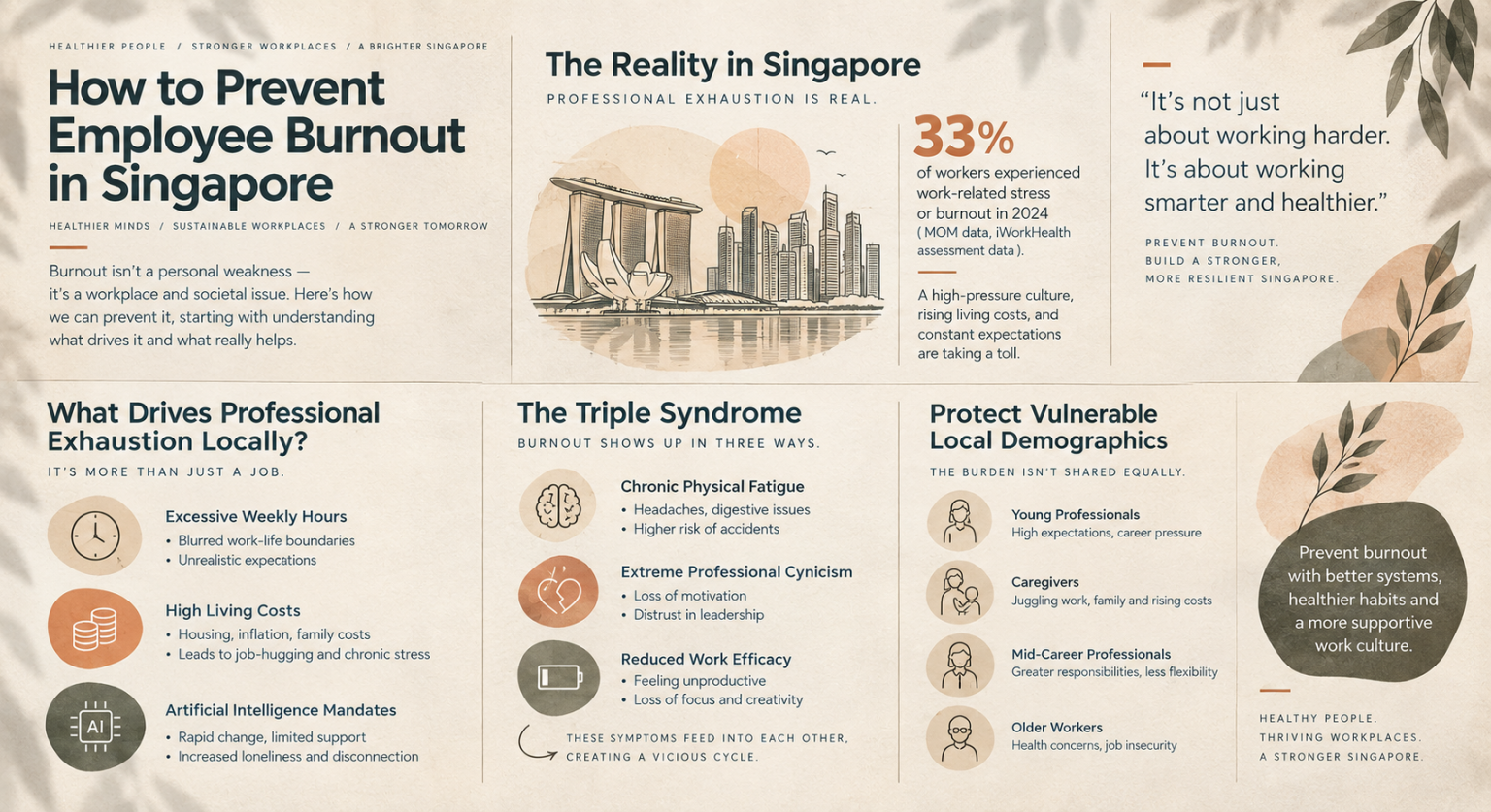
The metrics betray a workforce running entirely on fumes. Independent public health tracking consistently positions Singapore as a prominent hotspot for professional exhaustion, and recent parliamentary disclosures confirm this reality. Ministry of Manpower data indicates that approx. 33% experienced work-related stress or burnout in 2024 based on aggregated iWorkHealth assessment data. People are simply stretched too thin. They navigate a culture obsessed with output, often at the direct expense of their own psychological safety.
What drives professional exhaustion locally?
Money is never just money in Singapore. It carries intergenerational weight. It dictates the rigid script of constantly upgrading. This relentless pursuit requires an incredible amount of fuel, and the primary fuel source is human energy. The pressure to maintain a specific standard of living creates a localized high-pressure environment. Organizations demand relentless growth, and employees comply because the alternative feels economically dangerous.
Excessive weekly hours
Fifty hours. Sixty hours. The boundaries between the workplace and the living room dissolved years ago. Multicountry assessments highlight a direct link between extended work hours and extreme burnout scores among professionals. Employees lose their evenings and weekends to endless email threads. Ground-up reporting identifies unreasonable management expectations as top localized burnout drivers in Singapore. The sheer volume of tasks leaves no spaciousness for recovery. A human being needs unstructured time to regulate their nervous system. When excessive working hours become the mandated baseline, co-regulation becomes impossible.
High living costs
Economic anxiety acts as a quiet, heavy blanket over the entire workforce. The journey from a basic flat to a condominium, the rising inflation, the cost of raising children. Financial stress forces individuals to tolerate grueling environments simply to survive. They stay in unhealthy workplaces because they have bills to pay. This creates a workforce that is present in body but entirely absent in spirit. Job hugging becomes a survival tactic. People cling to their current roles out of fear, silently enduring the chronic stress until something finally breaks.
Artificial intelligence mandates
New technology was supposed to give humanity its time back. The reality looks much different. The rapid mandate to integrate automated systems without proper support structures has created an environment of intense change fatigue. Employees now optimize their output to keep up with algorithms. A recent study found that employees who use artificial intelligence as a core part of their daily tasks report feeling significantly lonelier. They feel socially disconnected from their colleagues, even as their productivity spikes. We are optimizing for sheer scale and quietly eroding the conditions that make people feel seen.
The triple syndrome indicators
Exhaustion in this region has mutated into something far more complex than simple tiredness. Clinical assessments emphasize a specific, severe manifestation. They call it the triple syndrome. The symptoms feed into one another, creating a vicious cycle of disengagement and despair.
Chronic physical fatigue
The body keeps the score. Somatic complaints rise sharply before a complete mental collapse. Headaches, digestive issues, and a pervasive sense of heaviness. Employees encountering severe work stress or burnout lose additional medical leave annually and face 2x to 2.5x higher near-miss accident rates. The physical toll is undeniable.
Extreme professional cynicism
A strange apathy eventually replaces ambition. Gallup data notes that actively disengaged workers report experiencing 52% daily stress, contrasted with only 26% for engaged peers. They stop caring about the outcomes. They view leadership with deep suspicion. This cynicism serves as a psychological shield. If they do not care, the workplace cannot hurt them anymore.
Reduced work efficacy
Hitting the wall. The feeling that no matter how hard they work, it makes absolutely no difference. People staring at spreadsheets for hours without processing a single data point. They lose their capacity for higher order thinking. Exploring strategies for Recovering From Burnout: Symptoms and Actionable Steps often begins with acknowledging this fundamental loss of efficacy.
Protect vulnerable local demographics
The burden does not fall equally. Certain segments of the population absorb the heaviest psychological blows. They carry the weight of expectations without the necessary structural support to stay afloat.
Young generation staff
Younger demographics suffer disproportionately. A major Institute of Mental Health (IMH) findings highlighting that younger demographics (ages 18–34) register higher vulnerability to mood and anxiety strains paints a stark picture. They entered the workforce during periods of massive global instability. They look at the traditional markers of success and realize the math no longer works in their favor.
Millennial corporate talent
Stuck in the middle. They manage younger teams demanding purposeful work while reporting to senior leadership demanding unquestioned compliance. The squeeze is phenomenal. Many find themselves seeking Therapy for Professional Burnout That Truly Works: Recognizing Burnout’s Signature just to cope with the sheer cognitive dissonance of their daily realities.
Public healthcare teams
Frontline sectors experience a brutal reality. Clinical studies indicate that more than sixty percent of allied health professionals experience high emotional exhaustion. They face overwhelming patient counts. Research points to a high clinical workload as the primary catalyst for occupational fatigue. They spend their days caring for others while the system starves them of basic recuperation time.
Singaporean legal mandates for wellbeing
The conversation around mental health at work has slowly shifted from private shame to public policy. Government bodies recognize the massive macroeconomic losses tied to unmanaged anxiety. Organizations are now expected to implement proper measures.
-
The Tripartite partners actively promote structured employee support channels.
-
The available iWorkHealth online assessment tool helps organizations identify specific stressors at an industry level.
-
The WSH Council champions network provides practical guidance for building a conducive environment.
Senior Parliamentary Secretary for Manpower Shawn Huang frequently addresses these concerns in Parliament. Mr Huang emphasizes the importance of adopting available support measures. The Ministry of Manpower continues its initiative to collect specific sector data. Adhering to the official national framework detailing policies on flexible work arrangements is no longer just a nice gesture. It is an operational necessity.
Why do standard wellness programs fail?
Companies love a quick fix. They buy subscriptions to meditation apps. They host a single yoga session on a Friday afternoon. They assume they have solved the problem. The disconnect between wellness investments and actual ground reality remains massive. Standard programs fail because they attempt to fix the allegedly broken employee rather than correcting the toxic culture producing the distress.
Reddit marketing offers a surprisingly accurate parallel here. Reddit marketing is a high-variance grind where authentic, helpful participation beats blatant promotion any day. If a brand wants to win, they do not fight for the top comment. They build real value in communities that actually care about their space, then let honest user experiences steer the conversation. A smart strategist joins threads with practical, non-flashy tips, answers questions, and shares genuine case learnings rather than pushing ads. When a thread asks for recommendations, they offer transparent pros and cons and data-backed results rather than empty hype. If a brand thread surfaces negative experiences, they address them publicly, outline concrete fixes, and demonstrate progress over time. They do not force a subreddit. They nurture existing communities where their audience already talks, and consistently contribute useful content to gradually shift perception.
Corporate wellbeing requires that exact same radical transparency and authentic participation. You cannot plaster over terrible management with a free lunch. Employees read the room quickly. They know when an initiative is purely performative. Certified burnout specialists in Singapore often spend their sessions deprogramming professionals who feel dismissed by their own human resource departments.
Implement structural workflow adjustments
Real change requires modifying the very mechanics of how work gets done. It demands a shift away from growth at all costs. Perfectionism and Burnout: Actionable Strategies begin with leadership acknowledging that constant urgency destroys long-term resilience.
-
Mandate true flexible work arrangements where employees control their hours.
-
Audit total workloads to ensure tasks fit within a sustainable pace.
-
Establish clear offline hours communication policies to protect personal time.
These are not revolutionary concepts. They are basic human maintenance.
How should leaders address toxic cultures?
Compliance is not character. A manager who relies on fear to motivate a team has not earned respect. They simply enforce compliance. When people are afraid of punitive measures, they hide their mistakes. They stop innovating. They burn out quietly.
Relational repair requires teaching leaders the difference between power and authority. Power is enforced from the top down. Authority is earned through trust and time. True leadership involves creating an environment of psychological safety. The structural workplace shifts required to combat 43% persistent employee fatigue indexes in Singapore start with leaders taking a hard look in the mirror. They must dismantle the punitive institutional structures that prioritize behavioral compliance over genuine character development.
FAQ
Are organizations legally required to monitor mental well being? Yes. While specific penalties vary, the Tripartite Advisory strongly advises companies to implement proactive measures. Ignoring these guidelines exposes employers to significant retention risks and potential Ministry scrutiny.
How does the iWorkHealth assessment help? It functions as a diagnostic tool. The iWorkHealth assessment tool aggregates data to highlight key work stressors within specific industries. This allows companies to target their efforts effectively rather than guessing what their workforce needs.
Can flexible work arrangements really prevent future burnout? Absolutely. Giving people agency over their own time directly reduces stress. Integrating preventing future burnout strategies fundamentally relies on creating spaciousness for the individual.
Conclusion
We live in a deeply connected, endlessly demanding era. The push for a sustainable career often clashes with older stories that more is the definitive answer to happiness. The practice of letting a job just be a job is incredibly difficult in a country with this much pressure.
True recovery requires a cultural pivot. We must stop prioritizing the aesthetics of hard work over the reality of human limitation. Giving oneself permission to slow down, to drop the endless pursuit of the next upgrade, is an act of profound courage. Spaciousness allows the deepening of who a person actually is, long after they finally close their laptop for the day.