
Last updated on August 28, 2026
Introduction
The modern corporate framework treats occupational exhaustion as an operational deficit requiring immediate optimization. Human resources departments deploy resilience modules. Management expects a return to baseline productivity within the fiscal quarter. This rigid, systemic view of burnout profoundly misunderstands human cognition and emotional well-being.
Narrative therapy offers a radically different paradigm. It is an evidence-based clinical intervention that fundamentally separates a person’s identity from their exhaustion. By externalizing systemic work pressures, this therapeutic process allows professionals to systematically re-author their lived experiences. It dismantles the limiting thought patterns that equate personal worth with economic output. When an individual stops internalizing their professional despair, they can objectively observe the demands of their job without letting those demands dictate their core self.
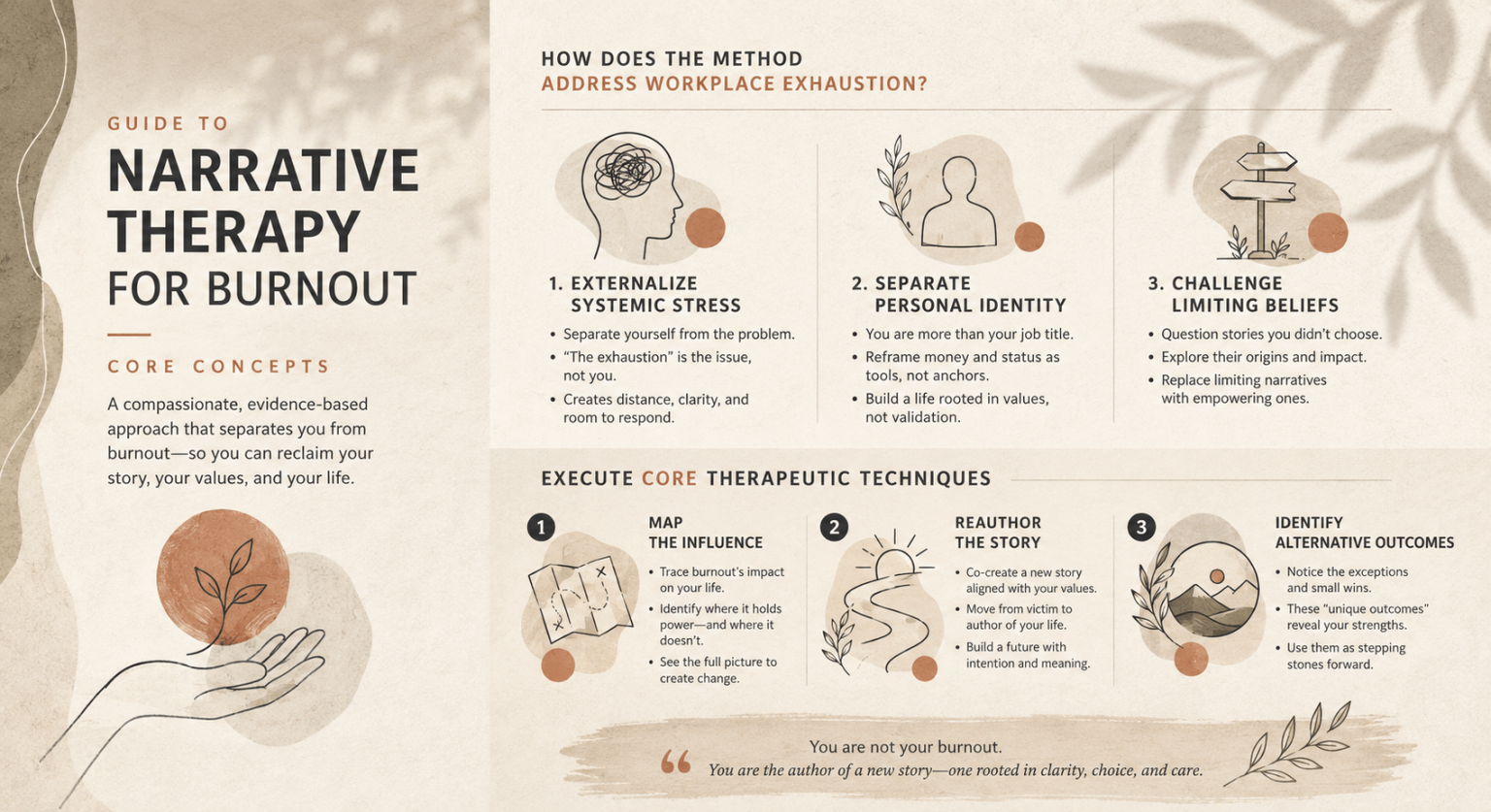
How Does the Method Address Workplace Exhaustion?
Externalize Systemic Stress
Burnout relies on fusion. It convinces a professional that their inability to handle eighty-hour workweeks is a deep character flaw. Narrative therapy severs this connection through a process called externalization. The person is no longer the problem. The problem is the problem.
Therapists intentionally change the linguistic structure of the conversation. A client stops saying, “I am an exhausted manager,” and begins exploring how “the exhaustion is impacting my role.” This linguistic shift is not a superficial trick. As outlined in a foundational text regarding collaborative narrative therapy, moving away from a top-down medical model allows a practitioner to honor the lived sociocultural context of the individual. The stress becomes an external entity that can be negotiated with, rather than a permanent condition to be endured.
Separate Personal Identity
In highly competitive environments where constantly upgrading one’s lifestyle is the unspoken norm, a career easily consumes the entire self. The car you drive, the neighborhood you live in, the job title on your email signature. These become the metrics of existence.
When a career falters, the self shatters. Narrative therapy builds a partition between who someone is and what they do for a living. It creates a space where a person can observe their profession critically. Money and status are reframed as tools that pass through a life, not anchors that define its worth. This separation provides profound clarity. It gives clients the psychological safety needed to evaluate their career trajectory without the dread of existential collapse.
Challenge Limiting Beliefs
Dominant narratives often go unquestioned. A corporate professional might hold a rigid belief that stepping back from a leadership role means they are incapable of growth. These stories are usually handed down by demanding parents, competitive peers, or an institutional culture that worships output above all else.
A narrative therapist acts as a curious investigator. They gently interrogate these absolute statements. Who benefits from this specific story? Where did this idea originate? By mapping the history of these limiting thought patterns, the client realizes they are living out a script written by someone else. Challenging these beliefs is the first step toward genuine empowerment.
Execute Core Therapeutic Techniques
Map the Influence
You cannot dismantle an oppressive story until you understand its exact dimensions. During counseling sessions, a therapist will ask the client to trace the precise footprint of their burnout.
How does the stress behave? Does it follow the client to the dinner table? Does it dictate their financial choices? Does it steal their sleep? Mapping this influence validates the client’s lived experience. It visually and conversationally demonstrates the sheer weight of the external pressure. Simultaneously, the therapist will map the client’s influence over the problem. They look for the boundaries. The specific times and places where the burnout has no power.
Reauthor the Story
Stripping away a destructive life story leaves a void. A new narrative must take its place. This phase requires immense creativity and compassionate facilitation. The goal is to construct a preferred narrative that aligns with the individual’s actual values, rather than the demands of their industry.
The client and therapist work collaboratively to weave a new plot. According to clinical demonstrations utilizing structural processes to help clients emotionally re-author internalized distress, this technique helps individuals move from a state of passive victimization to active authorship. They stop reciting the tragedies of their professional life and begin outlining a future rooted in mindfulness and intentional connection.
Identify Alternative Outcomes
People suffering from severe exhaustion tend to focus exclusively on the moments they felt overwhelmed. They ignore the exceptions. In narrative practice, these exceptions are known as “unique outcomes.”
A therapist listens intently for these hidden moments. The Tuesday afternoon when the client set a firm boundary with a demanding client. The morning they prioritized breakfast over checking emails. These seemingly minor events are critical data points. Detailed methodological breakdowns categorizing specific narrative scaffolding techniques show that pulling these unique outcomes into the light helps thicken alternative life plots. It proves that the dominant story of total burnout is actually incomplete.
Review Expected Psychological Benefits
Restore Personal Agency
Helplessness is the hallmark of chronic stress. The individual feels entirely at the mercy of their calendar, their boss, or their financial obligations. Narrative work directly addresses this helplessness. By externalizing the problem and highlighting the moments of resistance, the client reclaims the driver’s seat. They realize they possess the skill to influence their environment.
Reconnect with Core Values
Corporate metrics often replace human values. A person might enter a profession wanting to help people, only to find themselves optimizing for quarterly revenue. The narrative approach strips away these inherited corporate mandates. It forces a return to the foundation. What actually matters? Usually, it is relational depth. Intentional living. Nurturing a family. Once these core values are clarified, the client can use them as a compass to navigate their current job or plan an exit strategy.
Reduce Professional Exhaustion
This method is not just philosophical. It produces tangible relief. When a person no longer carries the weight of systemic dysfunction on their own shoulders, their nervous system begins to settle. Extensive analyses hosted on PubMed Central report that narrative approaches effectively lower compassion fatigue and enhance emotional regulation, particularly in high-stress roles. The exhaustion recedes because the client is no longer struggling against their own sense of self.
Examine Current Empirical Limitations
Qualitative Data Reliance
Narrative therapy lives in the realm of subjectivity. It is about meaning-making and language. Consequently, much of the research backing narrative therapy relies heavily on qualitative data. Transcripts, case studies, self-reported improvements. While this data is incredibly rich and nuanced, it lacks the numerical rigidity that some medical boards demand. You cannot easily quantify a shift in a person’s life story on a standardized graph.
Clinical Trial Scarcity
Because the therapeutic process is highly individualized and non-linear, creating standardized, large-scale studies is difficult. A formal study registered on PubMed highlights how unmanaged professional burnout impacts care quality, yet finding massive randomized controlled trials specifically isolating narrative interventions for general workplace stress remains a challenge. Researchers are actively developing trial protocols published via PubMed Central to structure semi-structured narrative inquiry, but the empirical library is still growing compared to older, more rigid modalities.
Active Participation Demands
This is not a passive treatment. A client cannot simply sit on a couch, vent about their manager for fifty minutes, and expect to heal. The narrative therapy process demands rigorous cognitive participation. The client must be willing to interrogate their own thought patterns, engage in creative storytelling, and actively resist the comfort of their old, problem-saturated narratives.
Compare with ACT and CBT
Understanding how narrative therapy differs from other popular psychological treatments helps individuals choose the right path for their mental health care.
|
Therapeutic Approach |
Core Philosophy |
View of Occupational Burnout |
Primary Treatment Goal |
|---|---|---|---|
|
Cognitive Behavioral Therapy (CBT) |
Thoughts influence feelings and behaviors. |
Burnout is exacerbated by cognitive distortions and irrational thinking. |
Correct faulty thought patterns and develop practical coping skills. |
|
Acceptance and Commitment Therapy (ACT) |
Suffering is a natural part of life; resistance causes pain. |
Burnout stems from emotional rigidity and disconnection from values. |
Increase psychological flexibility and commit to value-based actions. |
|
Narrative Therapy |
People make meaning through the stories they construct. |
Burnout is an oppressive, external story forced upon the individual. |
Externalize the problem and collaboratively re-author a new life story. |
Who Needs This Specific Intervention?
Certain individuals and professions benefit exponentially from this specific framework. The method is incredibly effective for those who feel their identity has been entirely overtaken by external expectations.
-
Corporate Leaders Experiencing Apathy: Executives who have achieved all material markers of success but feel entirely disconnected from their work. They need to separate their self-worth from their job title.
-
Healthcare and Trauma Professionals: Psychotherapists, nurses, and doctors facing systemic collapse. These roles demand immense compassion, and narrative practices help preserve empathy without internalizing patient trauma.
-
Individuals Facing Money Psychology Struggles: People who equate their financial net worth with their human value.
-
New Parents Navigating Role Transitions: Mothers and fathers grappling with the loss of their pre-parental identities, struggling to integrate their career aspirations with their new caregiving realities.
What Happens During the Initial Session?
The first meeting with a narrative therapist feels distinctly different from traditional counseling. There is usually very little time spent diagnosing or labeling. Instead, the practitioner immediately begins laying the groundwork for externalization.
They will ask questions that sound slightly unusual. “When did the burnout first convince you that you had to answer emails on a Sunday?” or “What does the exhaustion demand from you on a daily basis?”
These externalizing questions are designed to gently interrupt the client’s out of their typical thought loops. The therapist acts as an inquisitive co-author, carefully listening for the dominant story while scanning for the hidden, healthier narratives waiting to be developed. It is a collaborative, holistic exploration of the client’s lived realities, establishing a foundation of deep psychological safety.
FAQ
-
Is narrative therapy just talking about my past? It involves the past, but it is deeply focused on constructing the future. You analyze past experiences specifically to uncover the origin of limiting beliefs and to find evidence of your resilience, which you then use to build a healthier current reality.
-
How does this approach help with severe anxiety or depression caused by work? By treating anxiety and depression as external forces rather than inherent flaws, clients experience immediate relief from self-blame. Platforms matching clients to care, such as Grow Therapy, often highlight how this separation allows individuals to address severe mental health conditions objectively.
-
Can narrative techniques be used alongside crisis intervention? Yes. While organizations managing immediate danger prioritize safety first, narrative theory can be integrated into recovery to help individuals reframe their survival stories and navigate away from despair.
Conclusion
We live in a culture obsessed with scale and output. Scale your business. Optimize your time. Maximize your leverage. But unrestrained scaling at the cost of human connection creates a profound emptiness. When professionals inevitably collapse under this weight, the standard response is to patch them up and send them back to the front lines.
Narrative therapy rejects this mechanical view of humanity. It recognizes that compliance is not character, and enduring a toxic work environment is not a badge of honor. By externalizing the exhaustion and nurturing curiosity, this therapeutic practice offers a way out of the complex corporate environment. It grants individuals the permission to drop the stories that no longer serve them, and the clarity to finally write their own.