
Last updated on September 14, 2026
In modern professional environments, the metrics of success are universally observable and frequently celebrated. Promotions are announced, revenue targets are crushed, and quarterly performance reviews yield quantifiable data that validate your worth to the organization. Behind this observable data lies a quiet, pervasive reality where an individual’s nervous system is operating with very limited energy. You wake up. The chest tightness is already there. You check your phone, reply to three emails before your feet hit the floor, and immediately calculate the social currency required to navigate your morning strategy meeting. This is the lived experience of high functioning anxiety.
We live in a corporate culture obsessed with unending upward mobility. We optimize for output and gradually reduce the conditions that make people feel safe. People who live with this specific brand of anxiety look like they are thriving because society labels their trauma responses as ambition. They are the go-to problem solvers, the dependable partners, and the elite performers. Yet underneath that polished exterior is an absolute inability to turn off the persistent feelings of dread.
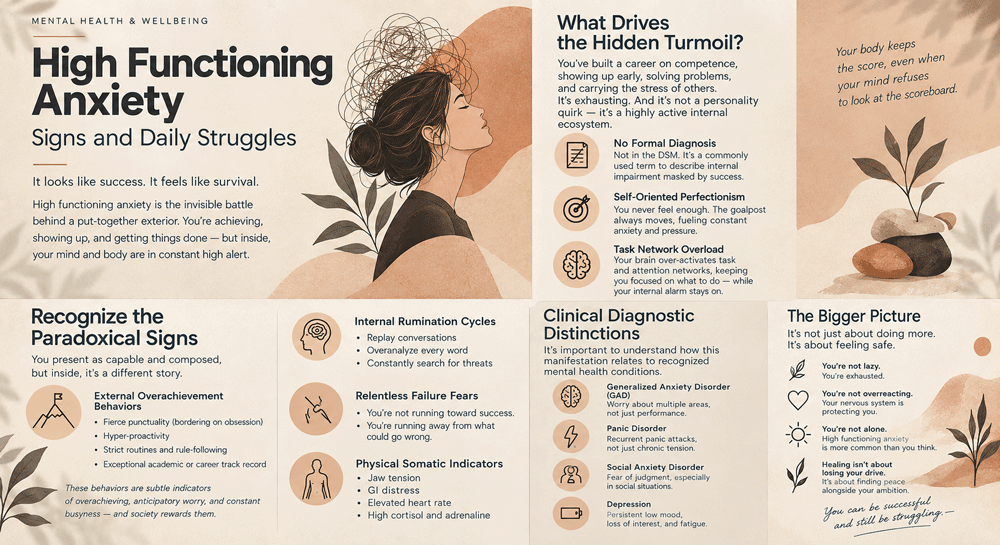
What Drives The Hidden Turmoil?
You have spent the last decade building a career meticulously calibrated to project competence, arriving early to meetings, answering messages late at night, and absorbing the stress of your entire team so seamlessly that management simply assumes you possess some infinite well of resilience. It exhausts you. This turmoil is not a personality quirk. It is a highly active, constantly shifting internal ecosystem.
Formal Diagnosis Absence
High functioning anxiety is not actually found in the Diagnostic and Statistical Manual of Mental Disorders. A psychiatrist cannot officially code it on an insurance form. The term itself functions more as a colloquial term widely used by clinicians to describe internal impairment masked by a successful exterior. Because there is no formal diagnosis, people suffering from it often gaslight themselves. You tell yourself that since you are still paying your mortgage and hitting your KPIs, your mental health must be fine. The lack of a diagnostic label allows the suffering to stay safely hidden behind a veil of competence.
Self Oriented Perfectionism
Academic researchers often view these symptoms through the lens of perfectionism. Self-oriented perfectionism is an incredibly demanding pattern. When you accomplish a major goal, you do not feel joy or satisfaction. The goalpost simply moves. You immediately raise your high standards for the next task, trapping yourself in a continuous loop of anticipatory anxiety. This constant goal-shifting fuels the anxiety symptoms because nothing you do will ever be enough to grant you permission to rest.
Task Network Overload
Neuroscience provides a fascinating lens into this phenomenon. Neuroimaging suggests that individuals pushing through severe anxiety do not actually experience less fear than those who are visibly debilitated. Instead, they over-activate specific areas of the brain. The cingulo-opercular and ventral attention networks go into overdrive to monitor tasks and force external focus. Your brain is literally redirecting cognitive resources to force you to answer emails while an internal alarm system remains highly active.
Recognize The Paradoxical Signs
The discrepancy between the outward presentation and the inner reality is jarring. I often see clients who present as exceptionally put-together professionals, yet their internal dialogue is an intense cycle of self-criticism.
External Overachievement Behaviors
On the outside, the behavior looks like the ultimate blueprint for success.
-
Fierce punctuality that borders on obsession.
-
Intense hyper-proactivity to anticipate and solve problems before they even occur.
-
Strict adherence to routines and rule-following.
-
An exceptional track record of academic or career achievement.
These are subtle indicators like overachieving, anticipatory worry, and a constant need for busyness that society actively rewards. We rarely question the mental health of someone who is making the company money.
Internal Rumination Cycles
The mental chatter never stops. You replay conversations from three days ago, dissecting every word choice to ensure nobody misinterpreted your tone. This rumination is a core symptom of the anxiety disorder. It drains your cognitive battery. You might find yourself analyzing relationship anxiety signs in your personal life because your brain is desperately searching for threats to neutralize.
Relentless Failure Fears
Many high-achieving individuals are not running toward success. They are running away from the perceived catastrophe of falling short. This relentless fear strips away any genuine curiosity or joy in the work. You are just managing risk. Frankly, it is a trauma response disguised as a career strategy.
Physical Somatic Indicators
Your body keeps the score, even when your mind refuses to look at the scoreboard. Physical symptoms often manifest long before you consciously acknowledge your mental health issue. You might experience chronic jaw tension, unexplained gastrointestinal distress, or an elevated heart rate. Clinical literature frequently points to an amygdala-hypothalamus hormonal cascade that floods the body with cortisol and adrenaline. Your nervous system is constantly bracing for an impact that never comes.
Clinical Diagnostic Distinctions
Because the diagnostic landscape can be confusing, it is helpful to map out how this specific manifestation relates to recognized mental health disorders.
Generalized Disorder Spectrum
Most medical professionals view this as a specific presentation on the generalized anxiety spectrum. The DSM-5 criteria requiring hard-to-manage worry alongside restlessness and sleep disruption provides a baseline.
|
Diagnostic Aspect |
Standard Generalized Anxiety |
High Functioning Presentation |
|---|---|---|
|
Daily Life Impact |
Obvious impairment in social or work domains |
Apparent excellence in work domains, hidden distress |
|
Coping Mechanisms |
Often leans toward avoidance behaviors |
Relies on hyper-vigilance and over-preparation |
|
Somatic Complaints |
Fatigue, muscle tension, insomnia |
Tension headaches, IBS, chronic low-grade exhaustion |
|
Social Perception |
Seen as a worrier or visibly struggling |
Seen as a driven, Type-A leader |
Psychological Distress Camouflage
People with high functioning anxiety are experts at camouflage. They mask their psychological distress with a cheerful, highly competent social composure. They will research unmasking burnout symptoms in secret late at night, yet show up the next morning with color-coded spreadsheets. This camouflage is often maintained through people-pleasing and a deep-seated fear of disappointing others, which gets triggered aggressively in corporate environments.
Why Does Cognitive Exhaustion Occur?
Imagine driving a car down the highway at 90 miles per hour with the parking brake fully engaged. The car is moving fast, but the system is under considerable strain. Cognitive exhaustion occurs because suppressing intense feelings requires an extraordinary amount of daily energy. Your brain is performing double duty. It is processing the actual complex work you are paid to do, while simultaneously running a massive background program to keep the anxious thoughts contained. Over time, this leads to a complete depletion of serotonin and dopamine reserves. You are left with a diminished sense of energy and motivation, entirely devoid of motivation or clarity. This is often when people start researching executive burnout signs because they can no longer maintain the facade.
Implement Daily Relief Tactics
We cannot positive-think our way out of a nervous system response. Relief requires somatic, evidence-based interventions that signal safety to the body.
First, you have to practice non-attachment to your output. Your value as a human being does not fluctuate based on your productivity. Try incorporating small, intentional moments of mindfulness into your day. This does not mean sitting in a lotus position for an hour. It means taking two minutes between Zoom calls to literally feel your feet on the floor and breathe into your stomach.
You must also set boundaries around your availability. The intersection of people-pleasing, fear of disappointing others, and specific workplace triggers makes boundary-setting feel incredibly challenging. Do it anyway. Let a minor email go unanswered until tomorrow. Notice that the world does not end. Exposure to small, safe boundaries helps rewire the belief that you must be universally accessible to be valued.
Evaluate Professional Support Criteria
Knowing when to seek therapy is tricky when you are technically still functioning. Do not wait for a full-blown crisis. If your baseline state is chronic stress, agitation, or a complete inability to rest, it is time to engage a professional. Consider finding a therapist or psychiatrist who understands the nuances of high-achieving professionals. Look out for concurrent signs of depression which frequently co-occur when the anxiety engine finally burns out.
Proper anxiety treatment offers compassionate, trauma-informed spaces to deconstruct the beliefs keeping you trapped. Mental health resources like cognitive behavioral therapy or acceptance and commitment therapy provide clear frameworks for unhooking from negative thoughts. Medication, including SSRIs or other psychiatric options, can also lower the physiological volume of the anxiety so that behavioral work can actually take root.
Can Treatment Rewire Neural Pathways?
The short answer is yes. Neuroplasticity is real. Your brain learned that hyper-vigilance kept you safe during earlier, chaotic parts of your life. It can learn new, healthier associations. Evidence-based treatments actively reshape how your brain responds to stress. By engaging in therapy and consistently practicing emotional regulation, you slowly build a new neural architecture. You teach the amygdala that a delayed project is just a delayed project, not much greater threat than it actually is. It takes time, patience, and a willingness to feel messy.
FAQ
Is high functioning anxiety the same as OCD or ADHD? No. While there can be overlapping traits like hyper-focus or intrusive mental chatter, they are distinct clinical entities. High functioning anxiety primarily centers on excessive worry and anticipatory fear, whereas OCD involves specific obsessions and compulsions, and ADHD is rooted in neurodevelopmental differences affecting executive function.
How do I talk to my boss about this when I look fine on paper? Focus on sustainability. You do not need to disclose your entire mental health history. Frame the conversation around optimizing your workflow for long-term clarity and preventing exhaustion. Ask for realistic timelines and clear priorities to help manage stress.
Will I lose my edge if I cure my anxiety? This is the most common fear I hear from corporate leaders. Your anxiety is not the source of your talent. Your intelligence, resilience, and curiosity are your actual superpowers. Anxiety is just the harsh whip you have been using to drive them. When you move away from self-pressure, you actually gain access to much deeper, more sustainable creativity.
Are there statistics on how many people deal with this? Because it is not a formal diagnosis, exact numbers are elusive. However, looking at the broader epidemiological context showing prevalence, roughly a third of adults experience an anxiety disorder at some point, and many of those individuals maintain high levels of outward functionality while hiding severe internal distress.
Conclusion
We desperately need a new paradigm for how we define success in our daily lives. Measuring a person’s worth by their ability to generate output while under extreme psychological duress is profoundly unhelpful. Growth should not require the total sacrifice of your nervous system. By stepping out of the shadows, naming the exhaustion, and seeking compassionate support, you stop being a human doing. You finally grant yourself the permission to be a human being.