
Last updated on September 4, 2026
A body positivity coach is a credentialed professional who facilitates behavioral change by prioritizing a client’s physical and emotional wellbeing over traditional aesthetic metrics. They operate within the health sector to dismantle the adverse psychological impacts of diet culture, utilizing evidence-based frameworks to foster body acceptance. The primary objective is to help individuals cultivate a healthier relationship with their physical form.
That is the corporate summary. The textbook definition.
The wellness industry loves packaging radical social concepts into consumable programs. Coaching in this space is not about staring into a mirror and reciting affirmations until the insecurity eliminates. It is about untangling a human being’s worth from the numbers on a scale. It involves looking at the real use of sport and movement. People are hungry for connection to their physical selves, not another spreadsheet tracking their caloric deficit. Although one may think that is the whole point of fitness. Until it isn’t.
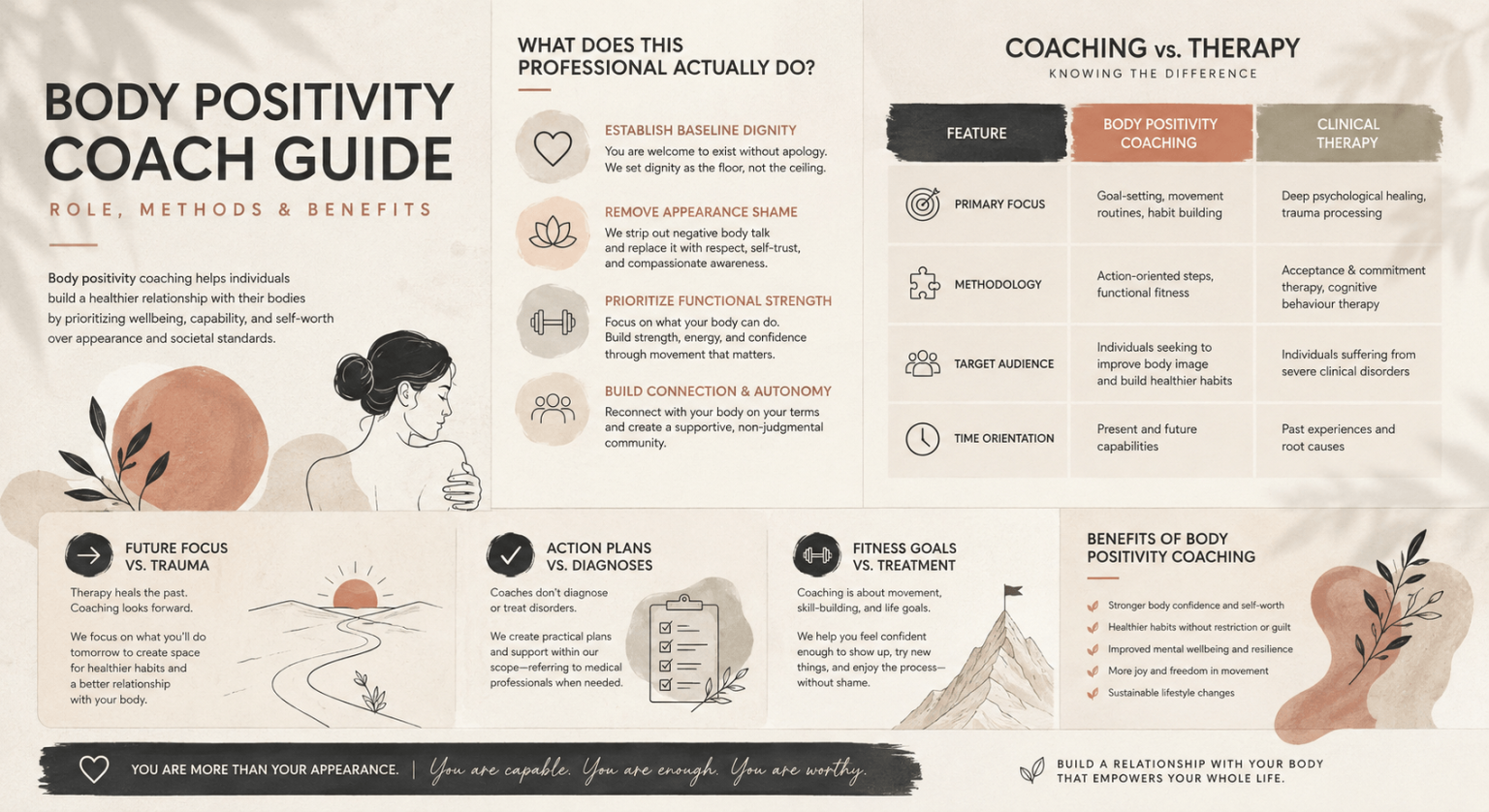
What Does This Professional Actually Do?
Many professionals in the fitness world rely heavily on guilt to motivate. A specialized coach flips this dynamic entirely. They guide individuals through the messy process of reclaiming their physical autonomy without the constant background noise of societal beauty standards.
Establish Baseline Dignity
Body positivity should mean an individual is welcome to exist without apology. A competent coach sets this as the floor, not the ceiling. The goal is lowering harm and raising capability. It gets highly problematic when a pro body diversity stance is used merely as a marketing gimmick while the actual instruction remains infantilizing. True body confident coaching respects the client’s current physical state while thoughtfully challenging their perceived limitations.
Remove Appearance Shame
The traditional gym environment frequently runs on negative energy. Phrases like “earning your dinner” or “burning off the weekend” are tossed around casually. A body acceptance coach actively strips this rhetoric out of the session. Hearing negative body talk is a learned script, and unlearning it takes deliberate effort. They help clients recognize that critique of their athletic form is not a critique of their inherent value.
Prioritize Functional Strength
Focus on what the physical form does. Running a 5-mile trail can be a profound mental health anchor. Stress goes down. Confidence goes up. Athletes feel powerful doing something difficult. That is not a gimmick. When individuals shift their focus toward adding 10 pounds to their deadlift rather than losing 10 pounds of mass, the entire relationship with physical exertion changes.
Separate Wellness Guidance From Clinical Therapy
There is a distinct line between guiding someone toward better habits and treating profound psychological distress. Blurring these lines is dangerous.
|
Feature |
Body Positivity Coaching |
Clinical Therapy |
|---|---|---|
|
Primary Focus |
Goal-setting, movement routines, habit building |
Deep psychological healing, trauma processing |
|
Methodology |
Action-oriented steps, functional fitness |
Acceptance and commitment therapy, cognitive behaviour therapy |
|
Target Audience |
Individuals seeking to improve body image issues |
Individuals suffering from severe clinical disorders |
|
Time Orientation |
Present and future capabilities |
Past experiences and root causes |
Future Focus Versus Trauma
Therapy deals with the deeper healing of past experiences. Coaching looks relentlessly forward. While a coach might acknowledge that a client’s negative body talk stems from childhood experiences, they do not unpack that trauma. They focus on what the client is going to do tomorrow morning to build mental space for healthier habits.
Action Plans Versus Diagnoses
Coaches do not diagnose or treat clinical body image suffering. If someone is dealing with severe disordered eating, they require medical intervention and specialized psychological care. The governing bodies of the coaching industry maintain strict professional guidelines to ensure practitioners stay within their scope of practice. Understanding the nuances of size diversity and mental health is crucial, but it does not replace psychiatric care.
Fitness Goals Versus Treatment
Coaching is fundamentally about movement and life goals. It is about getting a client comfortable enough to join a community volleyball league or lift weights without agonizing over how their arms look. When the coaching practice replaces actual skill acquisition with mere vibes, it fails the client.
Tangible Benefits Beyond Diet Culture
The shift away from restriction and punishment yields highly measurable results. Individuals who work with practitioners trained in specialized wellness frameworks often report profound changes in their daily lives.
-
Decreased anxiety around food: Meals become sustenance and pleasure, rather than math equations.
-
Improved athletic recovery: Clients actually listen to physical cues and rest when necessary, rather than pushing through pain to meet an arbitrary calorie-burn target.
-
Enhanced relational depth: Less emotional energy spent obsessing over physical appearance means more energy available for friends, partners, and children.
Reduced Self-Objectification
The modern world is obsessed with the visual. Social media feeds are endless streams of curated photos. Working with a skilled practitioner helps individuals reduce their fixation on these external images. Research on body confident sport interventions suggests that when athletes stop viewing themselves from an external, hyper-critical lens, their performance and wellbeing drastically improve.
Long-Term Exercise Compliance
People quit exercising when they feel terrible about themselves. Traditional programs that demand rapid transformation usually result in burnout within months. A supportive framework encourages longevity. When a client named Debbie realizes she does not have to match a specific aesthetic to belong in a gym, her commitment to the process solidifies.
Lower Fatphobia Levels
Through dedicated education and compassionate dialogue, clients begin to unlearn their ingrained biases against various body types. They realize that health and capability exist across a wide spectrum of sizes. This inclusive perspective benefits not just the individual, but the broader community they interact with daily.
Navigate the Shift Toward Body Neutrality
Sometimes the demand to love every aspect of oneself is exhausting. It can feel like another cage.
Avoid Toxic Positivity
Forcing someone to constantly view their appearance positively is a trap. It quickly devolves into performative optimism. People do not need a coach to shower them with empty compliments while they jog in circles. If a client is required to be inspirational on demand, the coaching environment becomes oppressive. Real confidence does not require an emotional script.
Focus on Capability
This is where body neutrality enters the conversation. It is a wildly pragmatic approach. Neutrality shifts the focus entirely away from aesthetics. It is the simple acknowledgment that the physical form is a vessel that allows a person to navigate the world. Clients learn to appreciate the mechanics of their joints, the capacity of their lungs, and the strength of their muscles.
Remove Emotional Scripts
Having a bad day regarding one’s appearance is a normal human experience. In a healthy coaching dynamic, experiencing physical discomfort or dissatisfaction does not mean the individual has failed the program. The practice is about letting those negative thoughts pass through without them taking the person’s entire sense of self with them when they go.
Recognize Red Flags in Performative Programs
The commercialization of body positivity is a massive issue. A movement that originated as a radical push for civil rights and fair medical treatment has, in many corners of the internet, been diluted into a highly commodified journey of personal self-improvement.
Be highly skeptical of programs that weaponize the concept as a counter-attack. When the response to online criticism is merely escalating into a spectacle, it does not actually change the underlying societal attitudes. It just flips who is holding the punchline. The healthiest energy in this space teaches firm boundaries. It does not demand that clients turn their personal recovery into public content. Furthermore, content analyses and studies on digital culture often reveal a glaring lack of intersectionality in mainstream wellness spaces, leaving marginalized groups entirely out of the conversation.
Balance Medical Interventions With Total Acceptance
A complex tension exists currently regarding modern weight-loss medications. The rise of GLP-1 drugs has created a fracture within many acceptance communities.
Total acceptance should never require an individual to evade medical realities. If a client chooses to pursue medical interventions to manage metabolic conditions or joint pain, a truly compassionate coach supports that autonomy. Ostracizing individuals for making medical decisions regarding their own bodies turns self-love into a rigid, punishing ideology. True support respects the complex, highly personal intersection of medical science and personal comfort.
How Do Clients Measure Success Without Scales?
If we throw out the scale, the tape measure, and the body fat calipers, how do we know the coaching is actually working? The metrics of success must fundamentally change.
|
Traditional Metric |
Body-Positive Metric |
|---|---|
|
Pounds lost |
Days per week engaged in joyful movement |
|
Inches reduced |
Increase in resting energy levels |
|
Clothing size |
Comfort and ease in daily physical activities |
|
Caloric deficit |
Ability to eat intuitively without guilt |
Clients track their mental space. They notice when they can walk past a mirror without stopping to scrutinize their midsection. They measure success by their ability to participate fully in a beach day with their children, entirely unbothered by how they look in a swimsuit. These are the quiet, profound victories that educational curriculums for wellness professionals aim to facilitate.
FAQ
Are these coaches only for women? Absolutely not. While marketing often targets women, men face immense, quietly devastating pressure regarding muscularity and leanness. The concepts of body respect and functional capability apply universally across all genders and age groups.
Can youth athletes benefit from this specific approach? Yes. Introducing these concepts early is vital. Organizations are increasingly recognizing the need to support young girls and boys in sports. Providing youth with tools to combat negative messaging early on helps prevent decades of subsequent struggles.
Is this just an excuse to avoid hard workouts? This is a massive misconception. Embracing your physical reality does not mean abandoning physical effort. It means you train to become stronger, faster, and more resilient, rather than training out of a desperate need to shrink yourself.
Conclusion
The pursuit of physical wellness is a deeply personal, often messy endeavor. It requires acknowledging the vast array of body types and the unique challenges each individual faces. Finding a professional who understands the delicate balance between pushing for athletic growth and holding space for profound self-acceptance can fundamentally alter a person’s life trajectory.
It is about demanding a baseline of dignity. When the fitness industry stops trying to fix people who were never broken to begin with, true capability emerges. The human body is an instrument for experiencing the world, not an ornament designed for the passive consumption of others.