
Last updated on July 15, 2026
Executive communication often frames personal expression as a corporate asset to be optimized, a sterile tool for stakeholder alignment and brand synergy. We spend thousands of hours refining our pitch decks and rehearsing our talking points to project unwavering competence. Finding your voice, in this hyper-professionalized context, usually means memorizing a script. It creates a narrow definition of acceptable behavior. I find this approach entirely disconnected from human reality.
Any voice that pretends to exist in a vacuum is doomed. True expression is not a perfectly curated elevator pitch. Experts consistently highlight it as an active journey of self-expansion and authentic connection. Finding your voice means letting go of the pressure to constantly comply we wear just to survive the workday. It requires dropping the armor.
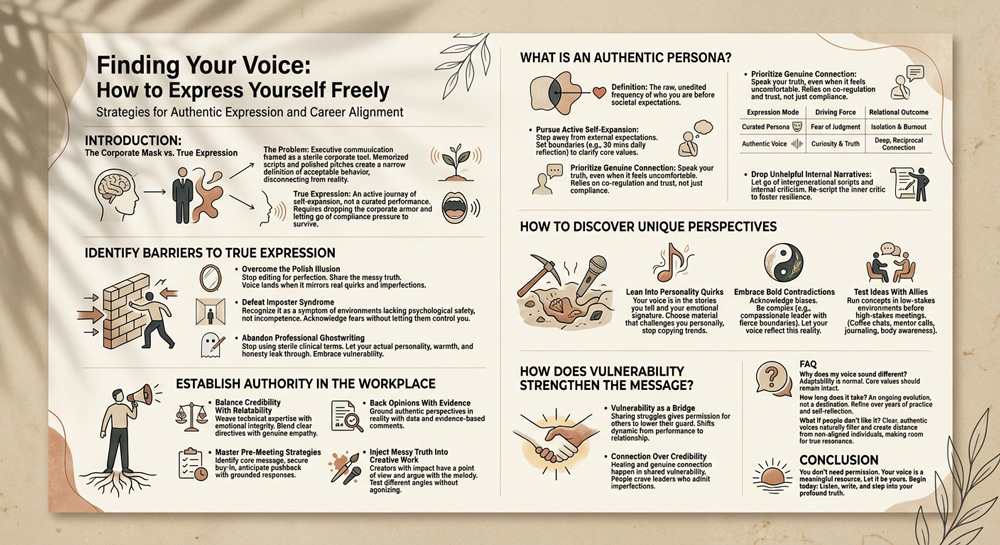
What Is an Authentic Persona?
An authentic persona is the raw, unedited frequency of who you are before the world told you who you needed to be. We live in a culture obsessed with upgrading—the endless pursuit of the next promotion, the move from an HDB flat to a private condo, the relentless optimizing of our daily routines. Amidst this noise, your true self gets buried under layers of performance.
Pursue Active Self-Expansion
Finding your voice requires the spaciousness to hear your own thoughts. Psychologists refer to this as self-expansion. It is the deliberate act of stepping away from external expectations to clarify your core values. This is not a passive experience. It requires boundary setting. You have to carve out time and physical space—perhaps setting aside 30 minutes every morning for reflection—to simply exist without producing anything. Actualization happens in these quiet margins.
Prioritize Genuine Connection
We frequently abandon our own perspectives just to fit in. We nod in meetings when we disagree. We swallow our concerns to keep the peace. Researchers point out that this compliance ultimately constitutes a betrayal of yourself. Prioritizing genuine connection means speaking your truth, even when your voice shakes. It relies on co-regulation and trust.
|
Expression Mode |
Driving Force |
Relational Outcome |
|---|---|---|
|
Curated Persona |
Fear of judgment |
Isolation and burnout |
|
Authentic Voice |
Curiosity and truth |
Deep, reciprocal connection |
Drop Unhelpful Internal Narratives
The stories we tell ourselves dictate the boundaries of our world. Many of us carry old, intergenerational scripts suggesting that our desires are too loud, too demanding, or simply unimportant. We internalize criticism from a harsh teacher or a stressed parent. Letting go of these scripts is a profound act of self-care. In my counseling sessions, we often explore the process of re-scripting the inner critic’s new voice to foster resilience rather than self-doubt.
Identify Barriers to True Expression
The mind is exceptionally good at keeping us safe, which usually translates to keeping us quiet. We invent a dozen reasons to stay silent.
Overcome the Polish Illusion
Everyone wants to sound like a TED Talk. We edit our words until they are stripped of all personality. We want glossy hype. We prefer marketing dressed up as science. I am exhausted by this. Your audience deserves the messy truth. In my experience, a person’s voice lands when it mirrors real quirks—a few inconsistent habits, a stubborn catchphrase, and a willingness to mock itself a little. If you only present the polished version, you sound like a PR bot.
Defeat Imposter Syndrome
That gnawing feeling that you do not belong in the room is rarely a sign of actual incompetence. It is usually a symptom of navigating environments that lack psychological safety. You doubt your own ear for the music because the room is out of tune. Building confidence requires acknowledging these fears without letting them drive the car.
Abandon Professional Ghostwriting
I spent years trying to sound like a “serious psychotherapist.” I used sterile clinical terms. I hid my own struggle with burnout and money psychology. I was essentially ghostwriting for a bland, professional version of myself. The moment I stopped trying to perform and started letting my actual personality leak through—the warmth, the blunt honesty—that is when the magic happened. You must acknowledge imperfection and embrace vulnerability to finally sound like yourself.
How Do You Discover Unique Perspectives?
Your perspective is not something you invent out of thin air. It is excavated from your lived experiences.
Lean Into Personality Quirks
Think about singing. Your vocal color is not just about your octave range. It is the stories you tell while you hit the notes. The emotional signature—the little rasp, the breathy edge, the dynamics you lean into—comes from living the music. To find your voice, you must choose material that challenges you personally. Stop copying trends. If you want a lasting voice, choose songs and topics that evoke a true response.
Embrace Bold Contradictions
Humans are not linear. A compelling voice acknowledges its own biases. It holds space for contradictions. You can be a deeply compassionate leader who also sets fierce, unyielding boundaries. You can advocate for slow living while still finding immense satisfaction in a hard day’s work. Let your voice reflect this complexity.
Test Ideas With Allies
Dynamic professionals often report being drowned out in loud environments. Before you bring a controversial idea to the main stage, test it in a smaller sandbox. Run it by a trusted friend.
-
Schedule a low-stakes coffee chat to float new concepts.
-
Use a 15-minute Facetime call with a mentor to refine your delivery.
-
Write your thoughts down on pages before speaking them out loud.
-
Notice how your body reacts when you articulate the idea.
Establish Authority in the Workplace
Corporate life demands influence, but influence does not require abandoning your soul. You can navigate the ecosystem while maintaining your holistic well-being.
Balance Credibility With Relatability
Finding a signature voice in leadership is a delicate act. You have to weave your technical expertise with emotional integrity. A rigid, authoritarian tone breeds resentment. A voice that blends clear directives with genuine empathy demands respect without alienating colleagues.
Master Pre-Meeting Strategies
If you struggle to enter the conversation during high-stakes meetings, the work starts before you ever enter the room.
-
Identify your core message ahead of time.
-
Secure buy-in from at least one supportive colleague beforehand.
-
Anticipate pushback and prepare calm, grounded responses.
Back Opinions With Evidence
Do not just share feelings. Ground your authentic perspective in reality. When you actively arm yourself with cogent comments and back your opinions with evidence-based data, you bridge the gap between human intuition and professional necessity.
Inject Messy Truth Into Creative Work
Whether you are writing a book, painting, or recording a podcast, your art requires a point of view. The creators who capture our attention do not just hit the right notes. They argue with the melody. They insist on a perspective.
You develop this by simply doing the work, over and over. Treating your output as a high-volume publishing experiment allows you to test different angles without agonizing over a single piece. Write the morning pages. Record the rough audio. Let your true self stumble through the sentences. The contrast of an edgy, self-deprecating thought next to a vulnerable confession creates a multi-dimensional persona.
How Does Vulnerability Strengthen the Message?
We mistakenly believe that showing our humanity makes us less credible. We hide the moments we felt lost. We conceal the financial anxiety we felt in our 20s. We scrub our resumes of the messy detours.
Vulnerability acts as the ultimate bridge between speaker and listener. When you share a struggle, you give the other person permission to lower their own guard. It shifts the dynamic from a performance to a relationship. Healing happens in this shared space. People are hungry for real, in-person connection. They are starving for leaders and artists who are willing to admit they do not have it all figured out.
FAQ
Why does my voice sound different depending on who I am talking to? Adaptability is a normal human function. We naturally shift our tone based on the social context. The goal is not to sound identical in every situation, but to ensure your core values remain intact whether you are talking to a CEO or your child.
How long does it take to find my style? It is an ongoing evolution, not a destination. You will refine it over years of practice, reading, listening, and engaging in deep self-reflection. Give yourself the grace to evolve.
What if people do not like what I have to say? Some people won’t. When you establish a clear, authentic voice, you will inevitably naturally create distance from those who are not aligned with your values. This is actually a highly efficient filtering mechanism. It makes room for the people who truly resonate with your message.
Conclusion
We spend so much of our lives optimizing for output, quietly eroding the conditions that make us feel seen. We chase accolades and milestones, hoping the next achievement will finally give us the permission to speak our minds.
You do not need permission. Your voice is the most meaningful resource you have for navigating your inner O.S. and contributing to the world around you. Let it be loud. Let it be quiet. Let it be entirely, unapologetically yours. Begin the practice today. Listen to the music of your own life, write the messy pages, and step into the clarity of your own profound truth.