
Last updated on November 17, 2026
Introduction
“Therapy for self esteem” issues requires actual work, and not a surface-level confidence or mindset makeover. In corporate ecosystems and highly competitive cities, we frequently treat low self-worth as a minor operational inefficiency. A bug in the system. We assume it can be patched with a few positive affirmations or an aggressively cheerful weekend seminar. It rarely works that way. Meaningful treatment requires dismantling the deeply ingrained negative messages we have internalized about our value.
The reality of repairing your sense of self can feel ordinary. It is about understanding the origin of your negative beliefs, mapping out how they manifest in your daily relationships, and then doing the quiet, unglamorous work of changing your habits. Therapy can help you make a plan. It cannot do the plan for you. True therapeutic intervention provides the psychological safety to look at the gap between who you actually are and the persona you perform to survive.
What causes low self-esteem?
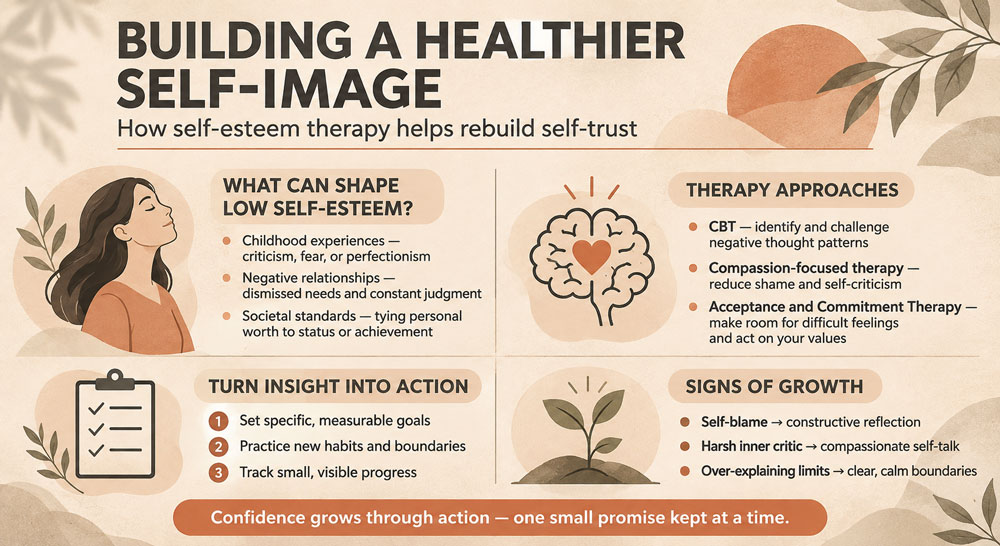
We do not wake up one morning and decide to hate ourselves. A lack of confidence is cultivated over time, watered by environments that demand compliance over character, output over humanity and harsh criticism over self-compassion.
Childhood trauma
Many of us grew up learning to read the room before we learned to read a book. When a household is struggling, whether financially or emotionally, children quickly figure out what parts of themselves are acceptable and what parts must be hidden. Physical punishment and authoritarian parenting styles teach a very specific lesson. A child who behaves solely out of fear of the cane has not developed moral clarity. They have simply learned that smaller people get hurt by bigger people. That environment severely impacts the neural circuits responsible for emotional regulation. If your early environment demanded perfection to secure love, your baseline self esteem was built on extremely fragile ground. This often results in profound challenges with anxiety or depression later in life.
Negative relationship dynamics
As adults, we often replicate the emotional climate of our childhoods. We choose partners or bosses who reinforce our most deeply held negative thoughts. Relational repair requires understanding the difference between power, which is enforced, and authority, which is earned through trust. When you exist in a dynamic where your needs are routinely dismissed or ridiculed, your inner critic becomes the loudest voice in the room. You start believing the narrative that you are inherently difficult or demanding. Toxic shame thrives in isolation, and navigating this requires Therapy for Shame: How to Heal and Rebuild Self-Worth to begin untangling your identity from the approval of others.
Unrealistic societal standards
Money and status are never just money and status, especially in places like Singapore. They carry intense emotional weight. The script of constantly upgrading your life from an HDB flat to a condo, chasing the next promotion, and securing the right school for your kids creates a relentless pressure cooker. We use material affluence to close wounds that money did not inherently cause. Unquestioned scaling at all costs is eroding our basic human need for connection. When your worth is entirely tethered to your economic output, an unexpected layoff or a missed promotion does not just hurt your bank account. It destroys your identity.
Core therapy approaches
Psychology offers various talking therapies designed to help individuals challenge negative thoughts and rebuild their resilience. The best approach depends heavily on your specific symptoms and whether your lack of confidence stems from recent burnout or decades of conditioning.
Cognitive behavioral therapy
Cognitive behavioral therapy focuses on the immediate relationship between your thoughts, feelings, and behaviors. It is highly practical. You learn to identify cognitive distortions, like assuming the worst or filtering out every compliment you receive. The focus is on finding evidence to dispute your automatic negative thinking. Clinical data demonstrates that integrating self-esteem enhancement into standard Cognitive Behavioral Therapy (CBT) significantly elevates a patient’s overall quality of life. Modern adaptations even utilize digital cognitive-behavioral writing and reflection modules to help individuals track their thought patterns daily.
Compassion focused therapy
Sometimes logic is not enough. You can logically know you are a capable professional while still feeling like a complete imposter or fraud. This is where modalities such as compassion focused therapy can help. It targets the shame and self-criticism that standard cognitive exercises might miss. By fostering empathy for your own struggles, you learn to quiet the punitive voices in your head. Research indicates the impact of self-compassion and mindfulness training is profound when it comes to reducing severe self-criticism. Overcoming Your Inner Critic with Self-Compassion is less about forcing positivity and more about treating yourself with the same basic kindness you would offer a struggling colleague.
Acceptance and commitment
Acceptance and Commitment Therapy (ACT) does not ask you to eliminate every negative thought. That is an impossible standard. Instead, it asks you to accept that uncomfortable emotions exist, while committing to actions that align with your core values. You learn to observe your anxiety without letting it dictate your choices. By focusing on your strengths and what genuinely matters to you, the volume of your self-doubt naturally turns down. You stop fighting the presence of fear and start focusing on Self Worth vs Self Esteem: How to Improve Your Self-Image through intentional living.
Set concrete personal goals
The most effective therapy sessions may sometimes feel a bit like strategic planning for your life. Exploring your past is necessary for context, but insight without action may not be fully supportive.
Define clear objectives
The useful bit in these therapeutic threads is painfully ordinary. Set goals. Finish things you are proud of. Build confidence from doing them. We often set massive, abstract goals like “I want to be happy” or “I want to love myself.” Those are not actionable. You need specific, measurable objectives. Perhaps the goal is to decline one unreasonable work request per week, or to spend 15 minutes engaging in a hobby without monetizing it.
Execute the plan
Therapy provides the framework. You provide the sweat equity. A therapist can help you identify why you are afraid of setting boundaries, but they cannot send the difficult email for you. You have to take the psychological tools out of the clinic and test them in the real world. That transition from theory to practice is where actual growth happens.
Track visible progress
Measuring your growth requires looking at very specific behavioral changes. If you rely solely on how you feel on any given Tuesday, you will constantly feel like a failure.
-
Track your response time to criticism. Notice if you pause before spiraling into self-blame.
-
Monitor your use of qualifiers. Count how often you use words like “just” or “sorry” in your professional emails.
-
Record your follow-through. Document every time you complete a task you promised yourself you would finish.
-
Audit your social withdrawal. Note the times you chose to attend a social event instead of isolating out of fear.
Build confidence through action
Confidence is not a prerequisite for action. It is the reward for taking action. We have it entirely backwards. We wait until we feel “ready” to speak up in a meeting, leave a draining relationship, or start a new project. But the feeling of being capable only arrives after you have survived the discomfort of doing the thing poorly the first time. For Women Rebuilding Self-Worth and Finding Confidence, the process often involves reclaiming space they were taught to yield. It means surviving the initial guilt of prioritizing their own mental health over the comfort of others.
The blended ecological momentary intervention (EMI) significantly improves self-worth precisely because it prompts users to act and reflect in real-time, right in the middle of their messy lives. Action builds trust. When you consistently keep the small promises you make to yourself, you generate undeniable proof that you are competent.
How do you measure progress?
Growth is rarely a dramatic epiphany. It looks like quiet, mundane shifts in how you tolerate discomfort. You can measure your progress by observing the gap between a trigger and your reaction.
|
Metric of Progress |
Old Behavior |
New Behavior |
|---|---|---|
|
Receiving Feedback |
Immediate defensiveness or intense shame. |
Pausing, evaluating the critique, taking what is useful. |
|
Making Mistakes |
Ruminating for days, labeling yourself a failure. |
Acknowledging the error, fixing it, and moving forward. |
|
Setting Boundaries |
Over-explaining and apologizing for your limits. |
Stating your limit clearly without seeking constant validation. |
|
Inner Dialogue |
Harsh, punitive name-calling during stressful moments. |
Firm but compassionate redirection. |
How to select a therapist?
I would judge a therapist by whether sessions lead to concrete steps, not by how fancy the self-esteem pitch sounds. Look for someone who challenges you respectfully. A good counselor does not just nod and validate every complaint you have about the world. They hold a mirror up to your own unhelpful patterns.
Ask potential therapists about their approach to accountability. Do they assign homework? Do they use worksheets or journals to track behavioral shifts? You want a facilitator who understands that a high baseline of self-respect acts as a resilience factor, predicting fewer symptoms of anxiety and depression over the long term. Avoid practitioners who promise rapid transformations or who seem uncomfortable when you ask about the evidence-based nature of their treatment.
FAQ
Does therapy actually cure low self-esteem? Therapy is not a cure because low self-esteem is not a disease. It is a learned set of beliefs. Counselling helps you unlearn those beliefs and replace them with healthier coping mechanisms. It requires ongoing maintenance.
Is group therapy effective for confidence issues? Group sessions can be profoundly healing. Experiencing a lack of confidence often makes you feel uniquely broken. Hearing others articulate the exact same fears strips the shame away. Group therapy provides a laboratory to practice new social skills and receive real-time, objective feedback from peers.
How long does it take to see results? If you are doing the actual work between sessions, you might notice behavioral shifts within a few months. However, rewiring decades of a negative self concept is a long-term project. There are no instant results.
Conclusion
We spend an exorbitant amount of energy optimizing our lives for output, quietly eroding the conditions that make us feel human. Rebuilding your self-image is not about becoming arrogant or endlessly fascinated with your own reflection. It is about removing the heavy, exhausting armor you have been wearing to protect yourself from judgment.
Taking the time to understand your inner operating system allows for a deepening of who you are. Spaciousness and self-trust give you the permission to exist without constantly proving your right to be here. The work is difficult. It is messy. But the freedom on the other side of that work is worth every uncomfortable step.