
Introduction
The phrase “empowering women” looks fantastic on a marketing brochure. Frankly, empowering women is overrated when it is just a slogan slapped on a campaign. A nice speech about women in leadership means absolutely nothing if women still lack the knowledge, skills, resources, and freedom to make their own daily decisions.
Treating the word empowerment like it changes a person’s lived reality entirely is not helpful. The effort needs to go into the basics. Give women real opportunities to participate in decisions that affect their lives. That is the whole point. If the structural support is not there, the branding is a waste of effort or money. A useful metric of value is whether women actually have more control over their choices.
In highly pressurized environments like Singapore, where the relentless drive for “upgrading” from public housing to private condos dictates social standing, money and power carry heavy emotional weight. The script of constantly acquiring more often masks deeper anxieties. A struggling household. Single income. Children quickly learn to read the room and realize there are certain things they should never ask for. Later in life, buying luxury items often appears as a way of using money to close a wound money did not inherently cause. Building real confidence requires dismantling this obsession with compliance, status, and the illusion of constant scaling.
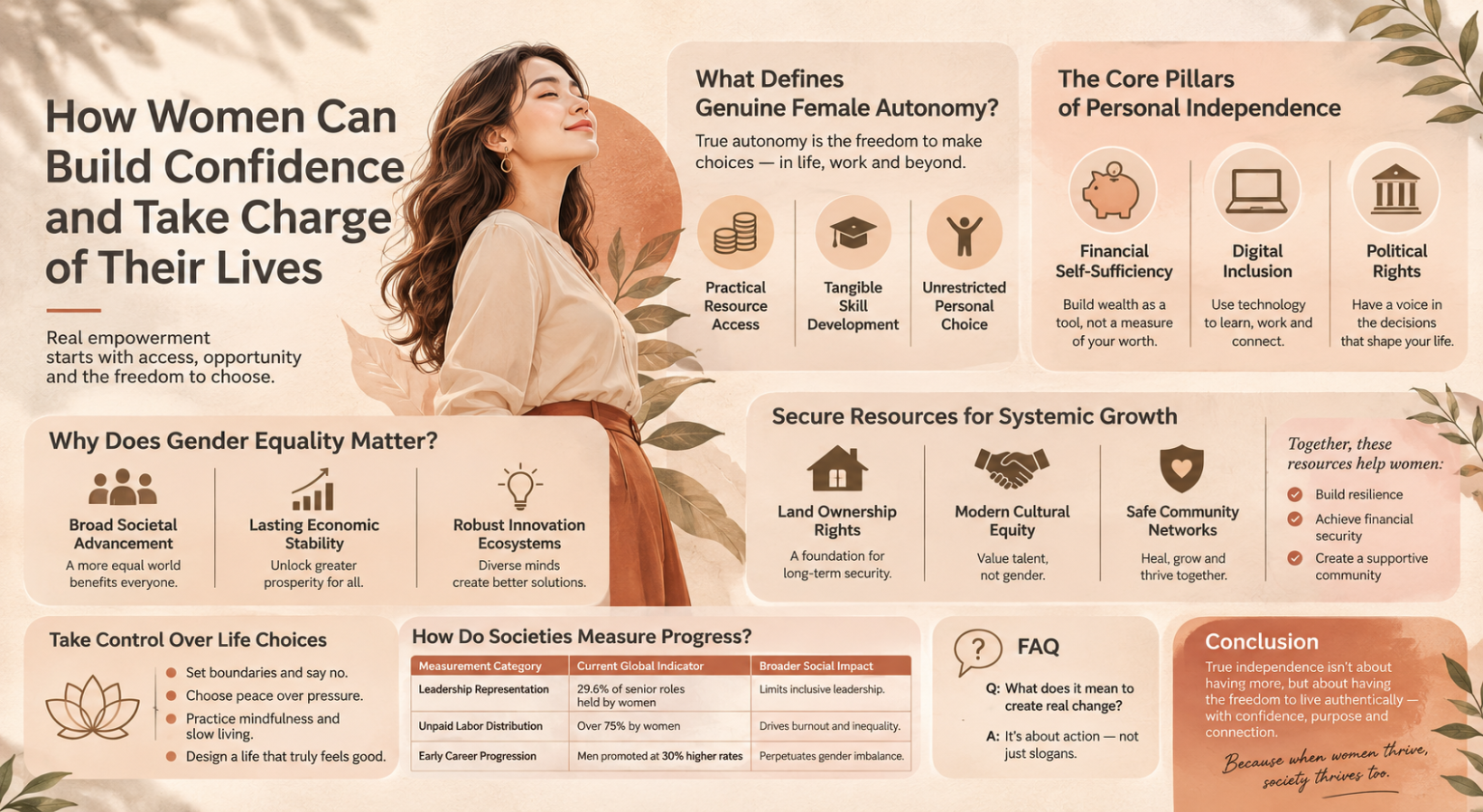
What defines genuine female autonomy?
Autonomy operates far beyond inspirational quotes. It requires the raw, unpolished ability to steer personal choices in a world that often demands behavioral compliance over genuine character development. True independence is evidence-based and practical. It is messy.
Practical resource access
Access to capital and physical resources forms the baseline of independence. Over 2.7 billion women globally face legal restrictions preventing them from pursuing the same jobs as men, according to the World Bank Women, Business and the Law tracker. When the law itself prevents someone from earning, autonomy remains a distant concept. These barriers are not abstract. They dictate who gets to eat, who gets to rest, and who has the bandwidth to nurture curiosity. Without basic resources, a person operates in survival mode. Earning a living wage provides the breathing room necessary for mindfulness and intentional connection. Finding guidance from a women’s empowerment coach often helps bridge the gap between theoretical knowledge and applied resilience, assuming the basic financial and safety needs are met first.
Tangible skill development
Confidence grows through competence. Gaining education and specific skills allows women to navigate complex professional and personal landscapes. Yet systemic roadblocks persist at every level. Nearly half of all countries still lack explicit legal protection for pregnant and parenting students, a glaring gap highlighted by UNESCO Key Data on Girls and Women’s Right to Education. True skill development requires environments that offer psychological safety, enabling individuals to learn without the constant threat of punitive consequences.
Unrestricted personal choice
The freedom to decide whether to marry, when to have children, or how to manage a career trajectory defines a self-directed life. A culture obsessed with scale and output views these personal decisions as economic variables. Reclaiming personal choice means rejecting the idea that human beings are merely units of production. It involves setting boundaries as a woman for better well-being and prioritizing human-first connections over arbitrary societal timelines.
Core pillars of personal independence
Financial self-sufficiency
Money is never just currency. It carries intergenerational identity and emotional history. It becomes the language families use to dictate who someone is allowed to be, who their parents needed them to be, and who they are still trying to prove they are. Developing an abundance mindset and building more wealth involves letting capital pass through as a tool rather than a measure of human worth. The current labor market makes this difficult. Data published in the Pew Research Center Gender & Work Data indicates women make up 47% of the U.S. civilian labor force, yet true financial parity remains distant globally.
Digital landscape inclusion
The modern public square exists online. Digital tools provide avenues for learning, remote employment, and community building. Restricting access to these spaces isolates women from critical networks of support. Digital inclusion allows marginalized voices to find co-regulation and shared understanding across geographical boundaries.
Fundamental political rights
Voting and participating in government decisions are non-negotiable elements of equality. Having a voice in policy ensures that laws reflect the reality of the entire population, not just a privileged subset. Political engagement shifts power dynamics from enforced control to earned authority.
Why does gender equality matter?
Broad societal advancement
Societies that prioritize punitive structures and rigid hierarchies fail to thrive. When communities support gender equality, they create conditions for authentic impact rather than mere compliance. The financial upside is undeniable. Closing the gender gap in employment and entrepreneurship could yield a 20% potential raise in global GDP, a figure modeled by the same World Bank Women, Business and the Law initiative.
Lasting economic stability
The burden of unpaid labor falls disproportionately on specific demographics. Women perform more than 75% of all unpaid care work worldwide, quietly subsidizing the global economy while eroding their own financial futures. Shifting this dynamic creates a more resilient workforce and a healthier environment for families.
Robust innovation ecosystems
Diverse leadership teams naturally challenge conventional wisdom. Women represent just 29.6% of senior leadership roles globally according to multi-region economic metrics outlined in the World Economic Forum Global Gender Gap Report 2026. A lack of representation stifles curiosity and limits the development of compassionate, human-centered solutions.
Secure resources for systemic growth
Land ownership rights
Owning physical space provides a literal and metaphorical foundation. It grants individuals the leverage to generate income, secure loans, and build stable environments for their families. It is the physical anchor for sustainable development.
Modern cultural equity
Corporate spaces frequently operate on outdated relational models. Research preserved in the Catalyst Research via Facebook Group / Catalyst Archive reveals Corporate America promotes men at 30% higher rates than women during early career stages. These invisible ladders perpetuate a culture where behavioral compliance is rewarded over genuine talent. True equity requires leaders who prioritize psychological safety over maintaining the status quo.
Safe community networks
Healing and growth happen in the context of safe relationships. Relational repair requires environments free from judgment. Creating these networks involves deliberate, conscious effort.
To cultivate these networks, communities must focus on several core practices:
-
Prioritizing co-regulation over isolation during moments of high stress.
-
Addressing the systemic roots of imposter syndrome in women rather than framing it as a personal deficit.
-
Fostering spaces where vulnerability is treated as a critical component of emotional intelligence.
-
Reframing wealth as a tool for community stability rather than a metric for personal superiority.
Take control over life choices
A person who operates out of fear of punishment has not learned how to make good choices. They have only learned how to avoid getting caught. Empowering women and girls requires stepping away from these fear-based paradigms. It demands the courage to practice slow living in a world optimized for relentless output. Taking charge means giving oneself permission to cancel engagements that drain mental health, to walk away from dynamics that demand too much, and to embrace the spaciousness that allows true character to deepen. Developing women’s mindfulness practices can anchor individuals in their own lived experience, filtering out the noise of external expectations.
How do societies measure progress?
Metrics and data points often betray the lived reality of the people they attempt to quantify. Still, structured evaluation provides a necessary baseline for accountability. The UNDP Gender Inequality Index Data Center tracks reproductive health, empowerment, and labor market disparities to highlight areas demanding immediate intervention.
|
Measurement Category |
Current Global Indicator |
Broader Social Impact |
|---|---|---|
|
Leadership Representation |
29.6% of senior roles held by women |
Limits the scope of trauma-informed leadership and compassionate policy making. |
|
Unpaid Labor Distribution |
Over 75% performed by women |
Creates massive hidden economic subsidies while driving severe burnout and fatigue. |
|
Early Career Progression |
Men promoted at 30% higher rates |
Perpetuates a cycle where authority is assigned by gender rather than earned through trust. |
FAQ
What does it actually mean to create change in this space? It means moving beyond superficial gestures and implementing evidence-based practices that provide real, tangible options. It involves recognizing that violence against women, poverty, and unequal health care access are not isolated issues. They are interconnected symptoms of a system that values hierarchy over human connection.
How do cultural expectations impact female confidence? Expectations dictate the unspoken rules of engagement. In highly competitive environments, the pressure to constantly achieve and upgrade leaves very little room for authentic self-discovery. Confidence built solely on meeting these external benchmarks is fragile. A firm commitment to dismantling these pressures allows for genuine clarity.
Conclusion
We live in a culture obsessed with scale, constantly pushing to expand platforms, increase margins, and optimize output. Unquestioned scaling at all costs erodes the very conditions that make people feel seen. Artificial intelligence adds another layer to this dynamic. Employees who use digital automation as a core part of their work report feeling lonelier and more socially disconnected from colleagues, even as their productivity increases. We are optimizing for output and quietly eroding human connection.
The power of in-person connection and authentic conversations remains the very thing many are now so hungry for. True independence does not look like a glossy corporate campaign. It looks like the quiet, radical choice to slow down, build resilience through secure relationships, and reclaim the narrative of one’s own life. Non-attachment is not detachment. It is the practice of letting resources pass through as a tool, without them taking a person’s sense of self when they go.