
Last updated on September 16, 2026
Corporate wellness programs often frame employee burnout as a productivity bottleneck requiring immediate clinical interventions to stabilize human capital metrics. Maximizing output demands optimizing the workforce, and mitigating these risks is essential to preserving organizational efficiency.
The reality of workplace burnout is far more deeply damaging. This is an occupational phenomenon characterized by chronic workplace stress that has not been successfully managed. It is not an individual medical condition. It is a structural response to a toxic or overwhelming environment. You cannot green-juice or yoga your way out of a culture that demands constant, unquestioned scaling at the expense of human connection. The signs of burnout are loud, provided you are willing to listen to what your body and mind are desperately trying to tell you.
How Does Occupational Exhaustion Differ From Stress?
Stress is over-engagement. You may care deeply. Your adrenaline is constantly pumping, and you are frantically trying to control the uncontrollable. Your emotions are heightened. Everyday stress feels like you are drowning in responsibilities but still fighting to reach the surface.
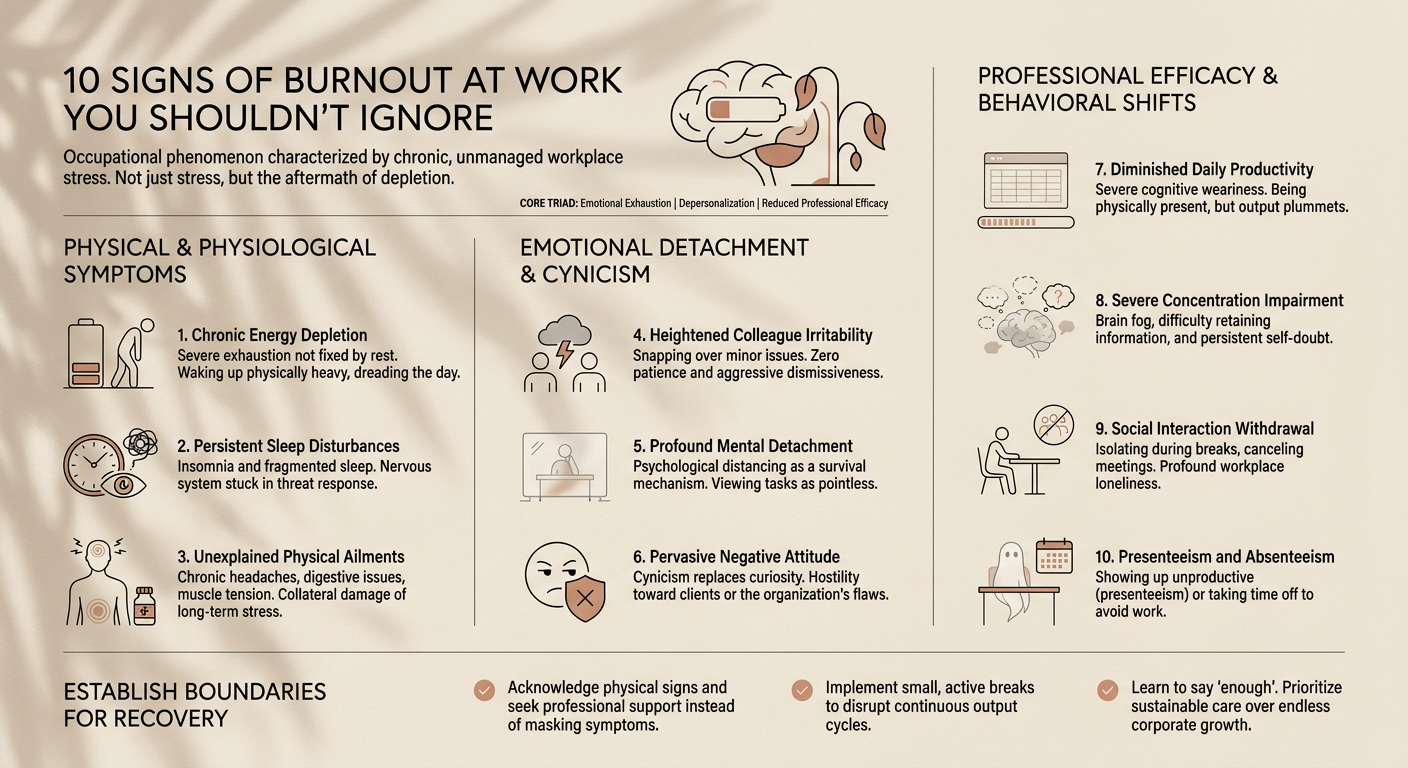
Burnout is the aftermath. You’ve run out of energy. You care about nothing. Foundational researchers established a unified triad of symptoms pointing to emotional exhaustion, depersonalization, and reduced professional efficacy. This model remains the gold standard for understanding occupational depletion. If you want to know what separates chronic burnout from everyday stress, look at the trajectory of your empathy. Prolonged stress makes you anxious and hyperactive. Burnout makes you cynical and detached. The work fatigue becomes a permanent state of being.
Spot Physical and Physiological Symptoms
Burnout lives in the body long before your brain recognises it’s struggling. We live in a culture obsessed with pushing through physical signs of distress, assuming a sick day is a sign of weakness.
1. Chronic Energy Depletion
This is not the kind of tired a nap can fix. It is severe energy depletion where individuals feel entirely completely exhausted. Ordinary rest or weekends cannot fix this. Your battery is not just low. Your energy keeps draining. You wake up physically heavy, dreading the demands of the day before your feet even touch the floor.
2. Persistent Sleep Disturbances
You would think being chronically exhausted means sleeping well. It does not. Sleep changes drastically when your nervous system is stuck in a threat response. Insomnia rules the night. You find yourself waking up sweating at 3 AM thinking about an unresolved email. Your body refuses to initiate the sleep recovery cycle because it fundamentally believes you are in danger.
3. Unexplained Physical Ailments
Chronic headaches. Gastrointestinal and digestive disorders. Muscle tension radiating through your neck and shoulders. We treat these health conditions as isolated incidents, popping ibuprofen and marching back to our desks. They are the collateral damage of long term stress. As global health authorities monitor these severe energy depletion markers, the connection between psychological strain and physical health becomes impossible to ignore.
|
Category |
Observed Signs and Symptoms |
|---|---|
|
Physiological |
Chronic headaches, gastrointestinal and digestive disorders, sleep disturbances, muscle tension, long-term cardiovascular risks. |
|
Psychological |
Feelings of helplessness, severe brain fog, intense anxiety, heightened risk of developing clinical depression. |
|
Behavioral |
Increased absenteeism, social withdrawal, presenteeism, high intention to quit, pervasive emotional withdrawal. |
Recognize Emotional Detachment and Cynicism
Compliance is not character, and showing up to work angry is not a sustainable career strategy. The second core dimension of occupational burnout is a profound shift in how you relate to others.
4. Heightened Colleague Irritability
Every message feels personal. You snap at the intern for a minor typo. Irritability becomes your baseline mood. You have zero patience for the very people you once collaborated with seamlessly. Frustration boils over into aggressive dismissiveness. This is a clear indicator that your emotional reserves are entirely empty.
5. Profound Mental Detachment
You sit in a meeting and realize you do not care if the entire company folds tomorrow. Mental distance from job responsibilities acts as a crude survival mechanism. Your brain is pulling the plug to save itself from further damage. You view your tasks as pointless. The meaningful work you once enjoyed now feels like digging a ditch.
6. Pervasive Negative Attitude
Cynicism replaces curiosity. A distinct shift in attitude marked by detachment and hostility takes root. You view clients or patients as burdens rather than human beings. This empirical analysis of workplace cynicism reveals how toxic work environments inevitably breed pervasive negative feelings toward the organization itself. You stop trying to improve things because you fundamentally believe the system is fundamentally flawed.
Identify Declines in Professional Efficacy
The third dimension destroys your sense of competence. You start believing you are a failure.
7. Diminished Daily Productivity
You stare at a spreadsheet for four hours and accomplish nothing. Diminished productivity is not about being lazy. It is a manifestation of severe cognitive weariness. Your brain simply refuses to process complex information. You are physically present, but your output plummets.
8. Severe Concentration Impairment
Brain fog settles in permanently. You read the same sentence five times and retain nothing. There is a tendency to procrastinate or severely doubt one’s capability. You lose the plot of your own career. You can review common workplace burnout indicators to understand how this erosion of competence mimics cognitive decline. The persistent feelings of inadequacy trick you into believing you were never good at your job to begin with.
Notice Key Behavioral Workplace Shifts
Behavior changes when the internal architecture collapses. You start hiding.
9. Social Interaction Withdrawal
Eating lunch in your car. Canceling every optional meeting. Workplace loneliness is an epidemic, and burnout accelerates it. Loneliness in the corporate hierarchy is profound. You can be surrounded by a team of fifty people and experience crushing loneliness because the culture punishes vulnerability. This specific loneliness erodes your physical health. Loneliness rewires your nervous system. The loneliness of feeling like you are the only one struggling creates a vicious cycle. You withdraw further, deepening the loneliness. When managers ignore this loneliness, they signal that output matters more than human connection. Addressing this loneliness requires radical psychological safety. Healing loneliness means fostering environments where people can actually share their burdens. Ultimately, the cure for corporate loneliness is authentic, unforced relational depth.
10. Presenteeism and Absenteeism
Taking a sick day when you are not physically ill just to avoid logging on. Or worse, presenteeism. Showing up physically but being completely unproductive. You are a ghost occupying a desk.
Establish Boundaries for Complete Recovery
Relational repair requires teaching people the difference between power and earned authority. You cannot heal in the environment that made you sick without installing rigorous boundaries. Recovery time is non-negotiable.
-
Acknowledge the physical signs immediately and seek professional support rather than masking the symptoms with caffeine.
-
Implement small breaks throughout your schedule to actively disrupt the cycle of continuous output.
-
Evaluate your daily tasks to ensure you are engaging in meaningful work rather than performing endless, superficial busywork.
-
Learn to identify physical, mental, and emotional exhaustion markers early so you can step back before a full collapse.
-
Take immediate steps to recognize signs of one-sided emotional burdens in your professional relationships and stop carrying weight that belongs to others.
Can Severe Fatigue Mimic Clinical Depression?
Absolutely. The overlap between a major mental health condition like depression and occupational depletion is significant. A severe mental health condition colors your entire existence. Depression follows you home to your family. Depression affects your parenting and your basic functioning. Job burnout, however, is generally tied to a specific stressor. A mental health professional must carefully distinguish between depression burnout and generalized depression. Treating severe depression requires distinct clinical protocols, sometimes involving medication management and intensive therapy. Ignoring deteriorating mental health in the workplace elevates the risk of severe crisis, including suicide. True mental health awareness goes beyond superficial corporate messaging. A real mental health benefit provides access to sustainable care for depression and other mental health conditions. We must stop pretending that a weekend off cures clinical depression. Mental health requires long-term commitment.
FAQ
What are the early warning signs of burnout for neurodivergent individuals? When we discuss the term neurodivergence, the conversation around work fatigue shifts entirely. People navigating neurodivergence face a unique vulnerability to structural stressors. For an individual with ADHD or OCD, the energy required to mask their neurodivergence in a rigid corporate environment accelerates emotional exhaustion. Workplace loneliness hits harder when your neurodivergence makes typical office social interactions feel unnatural. Accommodating neurodivergence is not a superficial mental health benefit. It is a necessity. If management ignores how neurodivergence interacts with daily tasks, they will inevitably push these employees out. Understanding neurodivergence requires curiosity. It demands that we stop treating neurodivergence as a deficit and start providing the exact professional support required for sustainable care. Ultimately, supporting neurodivergence in the office reduces the systemic loneliness that feeds chronic depletion.
How do we support Mental Health Awareness Month without being superficial? Stop offering pizza parties for overtired staff. Offer sustainable care. Expand your mental health benefit packages. Respect the sanctity of weekends. Invest in actual mental health workplace resources. Stop treating mental health conditions as an inconvenience to your quarterly goals.
Is there a printable checklist or mental health test to confirm employee burnout? Clinical tools like the Maslach Burnout Inventory exist to measure these stages. However, you do not always need a formal mental health test or a printable checklist to validate your lived experience. Peer help and honest self reflection are often enough to confirm you are running on empty. Pay attention to your physical signs and emotional withdrawal.
Conclusion
We are optimizing for output and quietly eroding the conditions that make people feel seen. Read that again. Workplace burnout is not a personal failure, a lack of resilience, or a sign that you are somehow broken. It is a rational, biological response to an irrational set of demands. Healing requires us to reject the myth burnout is just a phase we have to push through. It requires us to demand better support, advocate for sustainable caregiving, and prioritize our own functioning over endless corporate growth. It requires the courage to say that enough is actually enough.