
Last updated on August 29, 2026
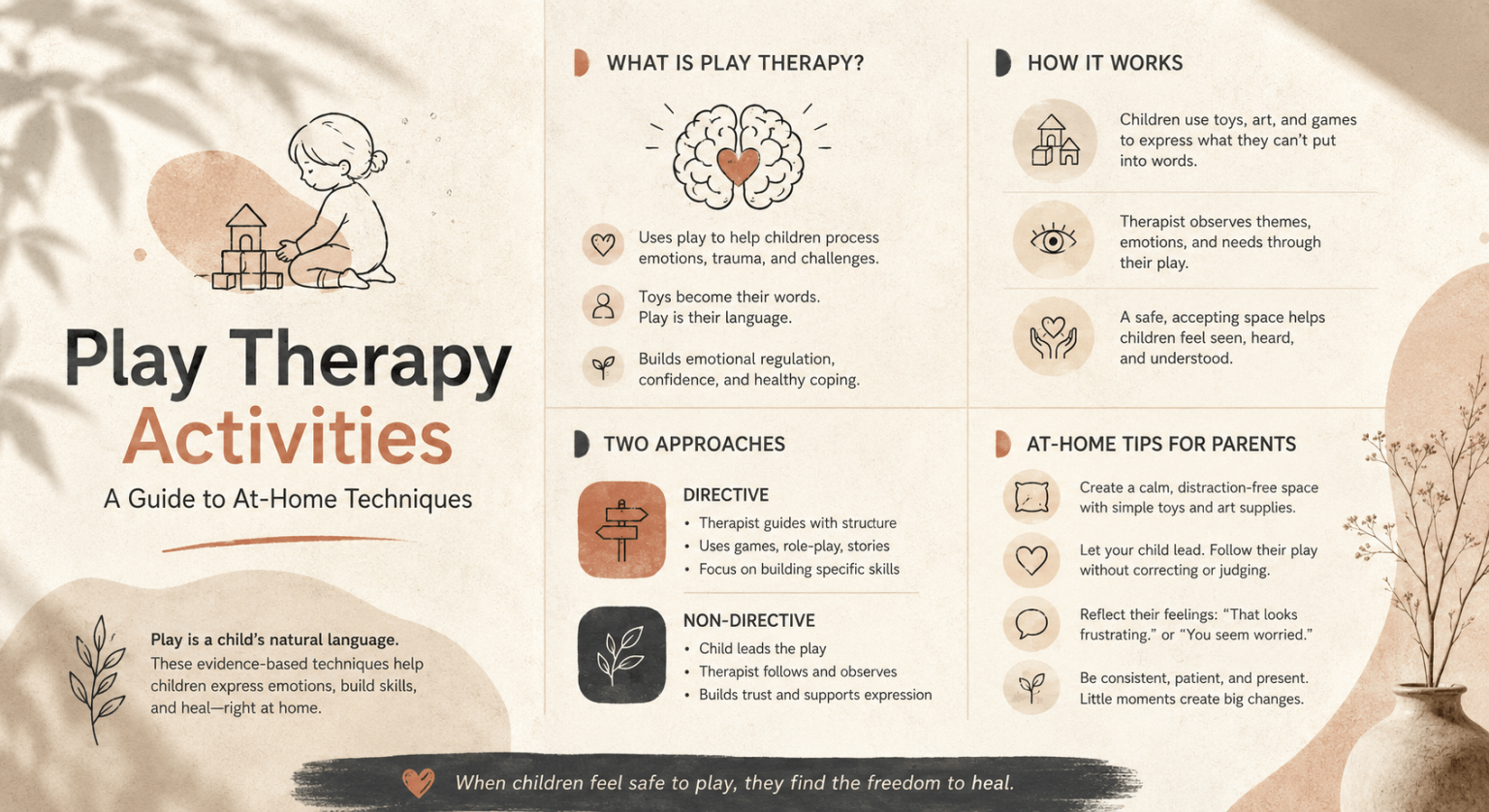
Play therapy activities are evidence-based clinical interventions that utilize physical objects, art, and games to help children process complex emotions, trauma, and behavioral challenges. Because children under the age of 11 generally lack the cognitive capacity for abstract thought and verbal processing, traditional talk therapy is highly ineffective for this demographic. Instead, mental health professionals employ structured play to communicate with young clients. Within this specific clinical modality, toys function as the child’s words and play acts as their natural language.
What Are Clinical Play Interventions?
Clinical play interventions are formalized psychological methods used to bridge the gap between a child’s internal distress and their external environment. I see parents drag their exhausted kids into the clinic every week hoping for a behavioral patch. They want compliance. They want the biting or the crying to stop so the family can get back to their busy routines. We live in a culture obsessed with optimization and output, and we frequently project that exact same pressure onto our preschoolers. But compliance is a terrible substitute for genuine character development. These clinical conditions require a completely different approach to pediatric psychiatric care. Children who are hurting do not sit in a chair and articulate their existential dread. They act it out. Play therapy gives them the psychological safety to do exactly that.
Toy Communication Mediums
For a young child navigating big feelings, vocabulary is profoundly limited. A qualified play therapist understands that putting a six-year-old in a therapy room and asking them to talk about their parents’ divorce is completely futile. The toys are the vocabulary. When a child picks up a miniature house and repeatedly knocks it over, they are communicating volumes about their ongoing struggles and their perception of stability. Every play therapy session relies on these physical mediums to build a bridge of understanding.
Empirical Efficacy Rates
The data supporting this work is staggering. Third-party researchers consistently report that play therapy generates a massive treatment effect size of 0.80 standard deviations when it comes to alleviating internalizing problems like anxiety and externalizing behavioral issues like aggression. We are not just tossing blocks on a rug. The clinical parameters defined by the Association for Play Therapy demand rigorous training and intentional observation. These playful activities restructure the neural circuits in a child’s brain, teaching emotional regulation far better than punitive measures ever could.
Psychological Projection Functions
Children safely project their internal chaos onto external objects. A child terrified of corporal punishment at home will not verbally report that fear to a counselor. Instead, they will use a plastic dinosaur to ruthlessly attack a smaller animal in the sand tray. This psychological projection allows the child to externalize complex emotions they cannot safely house inside their own bodies. They play out the trauma. They test the boundaries of power and authority at a safe distance of maybe 3 or 4 feet away from the actual source of their pain.
How Do Clinical Methodologies Differ?
Different clinical methodologies dictate exactly how a mental health professional interacts with the child during a session. Some children need a completely blank canvas to explore their trauma, while neurodivergent children or those with specific social skills deficits might require more structured guidance. The academic contextualization of play therapy frameworks generally divides these approaches into two distinct camps.
Directive Clinical Methods
In a directive approach, the play therapist intentionally introduces structured games, therapeutic storytelling, or specific role-playing scenarios to address targeted trauma clusters. The licensed therapist gently guides the session. If a child has severe ADHD or needs to learn frustration tolerance, the counselor might introduce a specific game with rigid rules to help them practice waiting their turn. The goal here is active, guided skill-building.
Non-Directive Permissive Approaches
Non-directive play therapy is entirely child-centered. The therapist creates a permissive, unconditionally accepting environment and lets the child lead the way. Building rapport through unstructured and semi-structured play activities requires immense patience because the adult must resist the urge to correct or guide the narrative. If the child wants to spend the entire 45-minute session burying a plastic car in the sand without speaking a word, the therapist holds space for that exact process.
Parent Participation Impact
Healing does not happen in a vacuum. The clinical consensus notes that outcomes improve significantly when parents participate in the process through filial therapy or family training. When parents learn how to mirror their child’s emotions at home, the therapy extends far beyond the clinic walls. A supportive environment nurtured by a curious caregiver is the ultimate catalyst for resilience.
Implement Core Toy Categories
Not just any toys belong in a child therapy guide. The objects selected for a therapy room are meticulously curated to cover the full spectrum of human emotional experiences.
|
Toy Category |
Clinical Function |
Common Examples |
|---|---|---|
|
Real-Life Relational |
Processing family dynamics and societal roles. |
Dolls, dollhouses, play kitchens, toy money. |
|
Aggressive Release |
Safe externalization of frustration and anger. |
Toy soldiers, foam swords, rubber knives. |
|
Creative / Expressive |
Mitigating anxiety through unstructured tactile input. |
Sand, modeling clay, paints, blank paper. |
Real-Life Relational Toys
Relational toys help children process the daily scripts they are handed. A struggling household or a highly tense family dynamic often plays out in the dollhouse. Children use these figures to explore who holds the power, who is allowed to be angry, and who gets left behind. It is a brilliant way to witness a child’s “Inner O.S.” operating in real time.
Aggressive Release Objects
We have a massive cultural aversion to letting children express anger. Aggression is often met with immediate physical punishment or shaming, which teaches a child to hide their feelings rather than process them. Play therapists explicitly stock aggressive toys like foam swords, toy soldiers, or a heavy 5-foot jump rope. These objects allow the child to release pent-up frustration and explore themes of power safely.
Creative Anxiety Mitigators
Anxiety lives in the body. Creative interventions bypass the analytical brain and ground the child in physical sensations. When a child works with a 5-pound block of modeling clay or wet sand, they are engaging in sensory play that physically calms the nervous system. The tactile feedback naturally lowers heart rates and encourages slow, regulated breathing.
Apply Emotional Expression Techniques
Turning theoretical methodologies into actionable play therapy techniques requires specialized tools that prompt the child to explore their inner world. These therapeutic activities are designed to bypass defense mechanisms.
Sandtray World Creation
Sand tray therapy is incredibly powerful. The therapist provides a shallow tray of sand and shelves filled with hundreds of miniature figures. The child is simply invited to build a world in the sand. Without saying a word, they construct landscapes of isolation, battlefields, or protected spaces. It is a profound method for uncovering unconscious conflicts and giving children agency over their own narratives.
Emotion Color Wheels
Art therapy techniques often intersect with play. Having a child map out an emotion color wheel helps them categorize messy, overlapping feelings. They might color anger red and sadness blue, and then paint a body outline showing exactly where those colors live inside them. Analyzing the clinical efficacy of pediatric anxiety interventions shows that these non-pharmacological activities give kids a tangible way to organize their internal chaos.
Puppet Role Enactments
Puppet play creates distance. A child who is too terrified to talk about bullying might gladly put a wolf puppet on their hand and have the wolf explain why it likes to hurt the little pigs. The puppet takes the blame. The puppet takes the shame. This allows the child to explore the dynamic of victim and aggressor without feeling exposed or vulnerable.
Practice Social Development Games
While individual play therapy activities focus heavily on trauma and emotional regulation, group play sessions and structured games are vital for social development. These methods are frequently used in outpatient therapy for neurodivergent children or kids struggling with peer relationships.
Cooperative Board Games
Board games are microcosms of society. They require turn-taking, rule-following, and dealing with the natural disappointment of losing. A counselor might use cooperative board games in structured group play to help children practice frustration tolerance and mutual support. It is a low-stakes environment to practice high-stakes emotional regulation.
Bibliotherapy Story Prompts
Therapy books and therapeutic storytelling give children narratives that mirror their own experiences. Reading a story about a bear who is scared of the dark provides a safe entry point to discuss a child’s own fears. Therapists often leave the story open-ended, asking the child to decide how the bear should solve their problem.
Mirror Emotion Exercises
Mirroring involves sitting face-to-face and taking turns copying each other’s facial expressions. It is a fantastic play therapy technique for building empathy and helping kids recognize subtle social cues. For children on the autism spectrum, these specific social play activities provide explicit practice in reading the room and connecting with others.
Guide Therapy Sessions at Home
Parents are the true agents of change. Taking these play therapy interventions out of the clinic and into the living room is where the real growth happens. However, engaging in therapeutic play at home requires parents to shift their mindset entirely.
Establish Safe Boundaries
You cannot have effective play therapy without physical and emotional safety. Boundaries must be clear. A parent might say that all feelings are allowed, but hitting people or breaking the television is not. You set limits on behavior to protect the physical environment, but you never set limits on the feelings themselves.
Maintain Permissive Environments
The hardest part for any caregiver is letting the child lead. If you are playing with blocks and the child wants to build a tower just to knock it down repeatedly for 20 minutes, you let them. You do not suggest building a bridge instead. You do not correct their play. You grant them the spaciousness to explore whatever theme their brain is currently stuck on.
Observe Without Judgment
Sit on the floor. Be present. Many of us are so hungry for connection but we fill every silent moment with chatter or instruction. Truly therapeutic purposes are served when you just observe your child with radical curiosity. Notice what they are drawn to. Notice when their breathing shifts. Being fully seen by an adult without the pressure of having to perform or behave perfectly is profoundly healing.
What Are Common Treatment Limitations?
Even the most robust play therapy techniques have boundaries. Understanding the situational indicators for child play interventions means acknowledging where this modality falls short.
-
Significant Time Investments: True relational repair takes months. Parents looking for instant results will be deeply frustrated by the slow, organic pace of child-centered play.
-
Lack of Standardization at Home: Without proper family training, parents often accidentally revert to punitive discipline, undoing the psychological safety built in the clinic.
-
Clinician Shortages: Finding qualified play therapists who are properly certified rather than just general counselors who happen to own a few toys can be incredibly difficult depending on your geographic location.
-
Severe Psychiatric Conditions: While excellent for behavioral issues and trauma, play therapy cannot replace necessary medical interventions for severe pediatric psychiatric emergencies.
FAQ
Can any therapist perform play therapy? No. Utilizing play techniques requires specific postgraduate supervision and certification. A licensed therapist must undergo extensive training to become a registered play therapist.
What is the difference between normal playing and play therapy? Normal playing is recreational and primarily for fun. Play therapy is a structured, intentional relationship where a mental health professional uses toys to resolve specific clinical conditions and psychological conflicts.
How long are typical play therapy sessions? Most sessions run between 30 to 50 minutes. Children naturally fatigue from the heavy emotional lifting required in a session, so capping the time is essential for their well-being.
Conclusion
We spend so much time trying to shape children into convenient, quiet adults that we forget to listen to what they are actually saying right now. We demand they use their words when their brains are literally not developed enough to do so. Integrating play therapy activities into clinical practice and home life is a radical act of empathy. It requires us to step down from our pedestals of earned authority, sit on the floor, and meet our kids exactly where they are. That is where real resilience is built. Not through lectures. Not through forced compliance. But through the messy, loud, and deeply human language of play.