
Last updated on August 28, 2026
While a personal life coach can function as a collaborative partner who helps individuals clarify their goals, identify systemic roadblocks, and execute actionable strategies for personal and professional growth, the reality is far more textured. Most individuals do not seek out professional support because they are logically confused about how to set a goal. They seek it because they are exhausted by their own thought patterns. They are tired of the relentless mandate to scale their lives, scale their output, and scale their happiness. The coaching industry has swelled in direct response to this modern fatigue. Recent data shows the worldwide market generating an estimated $5.34 billion USD in total revenue with a staggering 122,974 active practitioners. People are hungry for a space where they can be seen as human beings rather than mere engines of productivity.
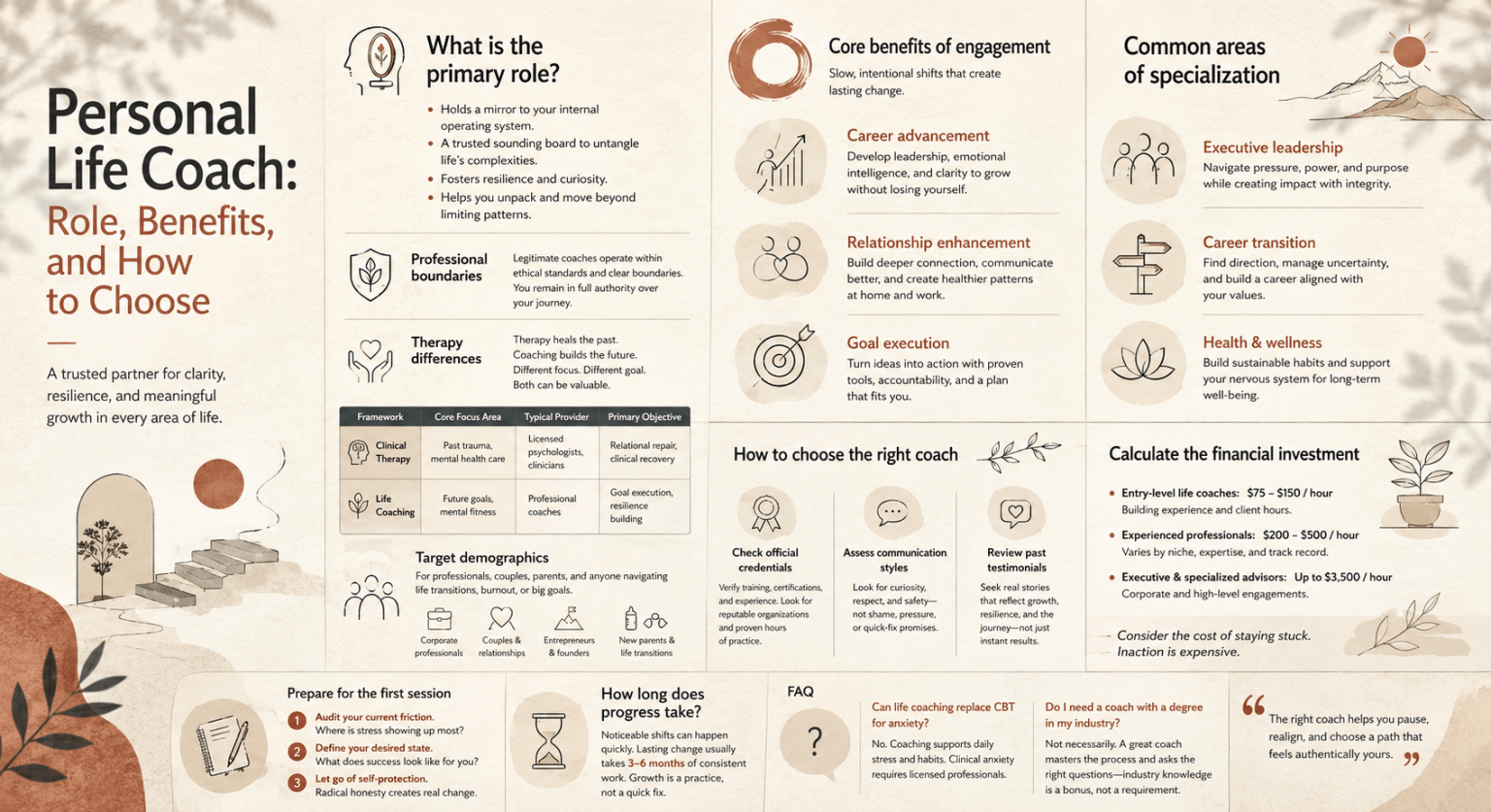
What is the primary role?
The primary role involves holding a mirror to a client’s internal operating system. A good coach does not hand out a prescriptive list of things to do. They act as a trusted sounding board to help individuals untangle the messy, complicated realities of their own lives. It requires navigating an individual’s unique ecosystem of stress and ambition without resorting to superficial cheerleading. A professional coach fosters resilience and curiosity. They help clients unpack the heavy expectations placed on them by society, family, and their own ingrained habits.
Professional boundaries
Because this remains a largely unregulated industry in many regions, establishing firm professional boundaries separates genuine expertise from unqualified practice. A legitimate life coach operates within strict ethical parameters. They recognize that their job is to nurture personal development, not to enforce compliance or create dependency. Institutional bodies provide frameworks where formal peer-reviewed ethical structures can sanction or suspend credentialed professionals who violate core industry privacy and conduct mandates. The relationship is inherently co-created. The client retains full authority over their journey.
Therapy differences
People routinely confuse the two professions. They walk into a coaching arrangement expecting a deep dive into childhood trauma only to find themselves frustrated by the forward-facing momentum of the sessions. Understanding the distinction is vital for psychological safety.
|
Framework |
Core Focus Area |
Typical Provider |
Primary Objective |
|---|---|---|---|
|
Clinical Therapy |
Past trauma, mental health care |
Licensed psychologists, clinicians |
Relational repair, clinical recovery |
|
Life Coaching |
Future goals, mental fitness |
Professional coaches |
Goal execution, resilience building |
Someone desperately searching online for cognitive behavioral therapy los angeles is likely experiencing acute distress. That person needs the specialized skills of clinical psychologists or social work professionals. A therapist diagnoses and treats mental health conditions. A personal coach focuses on optimizing existing strengths. While both fields demand a deep understanding of human behavior, clinicians focus on supporting mental health recovery. Coaches focus on building from a stable baseline toward meaningful goals.
Target demographics
The target demographic has shifted wildly over the past decade. It is no longer reserved exclusively for top-tier executives. Corporate professionals dealing with intense burnout frequently seek out career coaching to survive toxic work environments. Couples leverage relationship coaching to rebuild intentional connection rather than just managing a shared calendar. A husband working long hours in the booming entertainment industry faces entirely different stressors than a tech founder navigating the entrepreneurial scene, yet both often seek out life coaches when the endless possibilities of their respective fields morph into paralyzing anxiety. New parents struggling with the transition of bringing a child into a demanding lifestyle also represent a rapidly growing segment.
Core benefits of engagement
The real value of this work rarely fits neatly onto a spreadsheet. The benefits compound over time through slow, intentional shifts in how a person relates to their own life. Consumer insights regularly confirm that modern engagement topics center tightly on personal growth, life transitions, and core relationship building.
Career advancement
Climbing the corporate ladder often exacts a quiet, heavy toll. Career advancement through a human-first lens does not mean simply securing a higher salary or a better title. It means cultivating the emotional intelligence required to lead without burning out. Executive coaching helps leaders differentiate between wielding enforced power and earning genuine authority. It provides clarity. It allows professionals to build businesses and manage teams without losing their sense of self in the process.
Relationship enhancement
Intimacy requires presence. We are currently optimizing our relationships for output and quietly eroding the conditions that make our partners feel seen. A life coach helps individuals drop the aggressive, transactional habits they learn in the workplace before they walk through their front door. It requires massive vulnerability to admit that the communication styles making you successful in business are actively destroying your personal relationships. Coaching provides the necessary friction to unlearn those patterns.
Goal execution
Ideas are cheap. Execution is incredibly vulnerable. A professional coach provides the scaffolding necessary to bridge that gap. They utilize evidence-based tools to cut through the noise. Practitioners frequently utilize a 1-to-10 self-rated importance and confidence scale to evaluate baseline readiness before action planning. This prevents the all-too-common cycle of setting massive, shame-driven goals that inevitably lead to perceived failure a few weeks later.
Common areas of specialization
The profession has fractured into highly specialized niches. A generalist approach rarely works for individuals facing highly specific, nuanced pressures.
Executive leadership
Leadership is inherently lonely. Executive coaching unpacks the drive for money, status, and control. In high-pressure environments, money carries immense emotional weight. It dictates identity, network, and self-worth. Coaches working with executives focus heavily on untangling these narratives to foster trauma-informed leadership and psychological safety within large organizations.
Career transition
The narrative of constant upgrading forces many people into careers they actively despise. Career transitions require immense courage. A coach working in this space helps clients navigate the financial anxiety and identity loss that inevitably accompany massive professional reinvention. They help clients sift through the immense opportunities and pinpoint the ones that actually align with their core values.
Health and wellness
Wellness coaching strips away the toxic, aggressive diet culture that permeates modern society. It is not about forcing the body to meet unrealistic standards. It is a holistic approach to nervous system regulation and sustainable habits. Integrative health interventions led by qualified practitioners actively demonstrate measurable reductions in physiological biomarkers like HbA1c in patients. The focus remains squarely on compassionate, long-term health rather than instant results.
Evaluate potential candidates
Finding the right fit requires looking past slick marketing and high-pressure sales tactics. A flashy social media presence is a terrible proxy for clinical insight.
Check official credentials
In an unregulated industry, credentials matter deeply. Anyone can legally call themselves a life coach. However, respected organizations like the International Coaching Federation enforce strict standards. Achieving high-level certifications requires significant effort. For instance, PCC credentialing requires a baseline minimum of 125 hours of specific coach education and 500 hours of documented client coaching experience. Verify their training programs. Look for a bachelor degree or advanced education in psychology, organizational behavior, or formal coach training.
Assess communication styles
A good coach should make you feel slightly uncomfortable but entirely safe. If the individual relies heavily on shame, aggressive pushiness, or promises a quick-fix to your deepest struggles, walk away. You are looking for a facilitator who values curious inquiry. The initial consultation should feel like a deep, respectful conversation with a highly observant colleague.
Review past testimonials
Success leaves clues. Look at the specific language past clients use in their reviews. Are they praising the coach for handing them a rigid schedule, or are they praising the coach for helping them discover their own resilience? Authentic testimonials usually highlight the messy, non-linear journey of personal development rather than just overnight success.
Calculate the financial investment
Coaching is a financial commitment. It requires allocating resources toward intangible growth, which can feel deeply uncomfortable for people accustomed to buying material goods.
-
Entry-level life coaches: Often charge between $75 and $150 per hour. They are typically building their client hours for certification.
-
Experienced professional coaches: Usually range from $200 to $500 per hour depending on their specific niche and track record.
-
Executive and specialized advisors: Can demand vastly higher rates. Corporate engagements routinely see professional developmental guidance commanding top-tier advisory fees up to $3,500 an hour.
When calculating the investment, consider the hidden costs of inaction. What is the financial and emotional cost of staying stuck in a state of burnout for another five years?
Prepare for the first session
Preparation dictates the depth of the work. If you show up expecting the professional to magically fix your life while you passively take notes, the engagement will fail.
-
Audit your current friction. Identify the specific areas of your daily routine that cause the most stress.
-
Define your desired state. Articulate what success actually looks like to you, ignoring the metrics prescribed by your family or industry.
-
Let go of self-protection. Bring your authentic, unfiltered thoughts to the table. Therapy and coaching both require radical honesty to function properly.
How long does progress take?
There is no quick-fix for a nervous system that has been running on overdrive for a decade. Human behavior is deeply entrenched. While some clients experience a profound shift in perspective during their very first session, sustainable behavioral change usually takes a minimum of three to six months of consistent work. Resilience is built slowly. It requires testing new strategies, failing, experiencing the frustration of that failure, and bringing that data back to the coaching session for review. True personal fulfillment is a lifelong practice.
FAQ
Can life coaching replace cognitive behavioral therapy for anxiety management? Absolutely not. A personal coach can introduce excellent CBT strategies to manage daily stress and optimize habits. However, clinical anxiety requires the intervention of licensed psychologists or clinical therapists. Coaching is never a substitute for medical or psychiatric care.
Do I need a coach with a specific degree in my exact industry? Not necessarily. While a coach with a background in the entertainment industry might immediately understand the culture of an audition room, a great coach relies on their mastery of the coaching process itself. Their expertise lies in asking the right questions, not in knowing the specific technical details of your daily job.
Conclusion
We spend enormous amounts of energy trying to optimize our lives to meet the demands of an increasingly frantic world. A personal life coach offers something radically different. They offer an intentional pause. Working with a dedicated professional provides the crucial space needed to evaluate whether the ladder you are climbing is even leaning against the right wall. It is an investment in your own agency. True growth rarely looks like a perfectly upward trending graph. It looks messy, feels uncertain, and ultimately leads to a much more authentic way of moving through the world.