
Introduction
Most people imagine the glass ceiling metaphor as a dramatic collision. A professional reaching for the C-suite suddenly striking a solid, invisible barrier. I suspect this is a comforting fiction. It gives corporate culture a singular, easily defined enemy. The reality of subjective career advancement betrays a much quieter, more insidious erosion of ambition. It is rarely one big “no.” It is a thousand small, polite dismissals.
We live in a corporate ecosystem obsessed with visible ascent. Climb the corporate ladder. Secure the corner office. Maximize your leverage. Yet this unquestioned scaling of human capital ignores the relational foundation of actual work. When we talk about breaking the glass ceiling, we often frame it as an individual responsibility. We tell women and minorities to lean in, to speak louder, to adopt a posture of unrelenting masculinity. That advice is profoundly flawed. Breaking through these limitations requires dismantling entrenched organizational cultures and deeply embedded gender biases, rather than simply asking marginalized individuals to perform better within an unfair game.
Systemic Obstacles And Structural Bias
The architecture of the modern workplace was largely designed by and for a very specific demographic. When we attempt to integrate diverse populations into this legacy system without altering the foundation, friction is inevitable. Systemic bias does not always look like overt discrimination. Often, it looks like standard operating procedure.
Unconscious Cultural Prejudice
We all carry a societal glass ceiling within our own minds. Society conditions us early. A child who learns that assertiveness in boys is “leadership” while the same trait in girls is “bossiness” carries that exact gender bias into the boardroom twenty years later. These gender stereotypes dictate who is naturally presumed competent. When an organization lacks comprehensive inclusion policies, the default culture automatically reverts to these ingrained prejudices. People hire people who look and sound like they do. They promote those who share their motivations and backgrounds. This isn’t usually malicious. It is a biological drive for comfort, which unfortunately creates an exclusive, homogenized upper management tier.
Disproportionate Behavioral Scrutiny
There is a strange phenomenon that occurs when a woman enters a high-stakes environment. The margin of error practically vanishes. Psychological research continuously affirms that female executives are more rigorously scrutinized than men. They face harsher consequences for workplace behavior that would barely register as a misstep for a male counterpart.
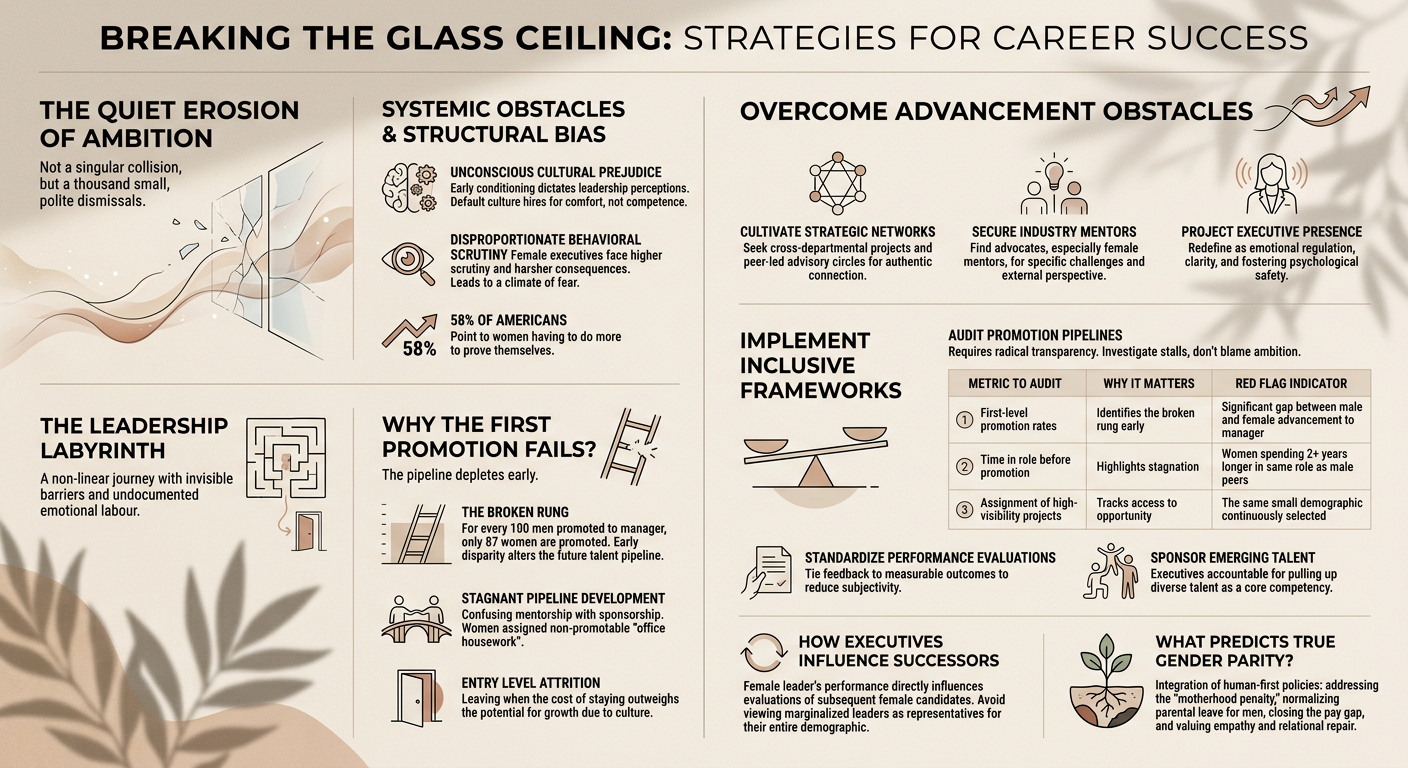
This hyper-vigilance creates a climate of fear. When you know your next mistake could define your entire career progression, your nervous system remains in a constant state of threat. It becomes incredibly difficult to take the creative risks necessary for true innovation. You stop playing to win and start playing simply to avoid losing. A culture that systematically applies excessive scrutiny inevitably drains the resilience from its most talented people. Interestingly, 58% of Americans point to women having to do more to prove themselves as a major obstacle to reaching top executive positions.
The Leadership Labyrinth
The metaphor of the corporate ladder implies a straight, vertical climb. If you just keep stepping up, you will eventually reach the top. But for anyone who isn’t a white male, the journey looks much more like a labyrinth. There are dead ends, hidden doors, and invisible barriers. Navigating this maze requires an immense amount of undocumented emotional labour. You have to figure out the unspoken rules of the work environment. You have to manage the fragility of colleagues who might feel threatened by your competence. The path to leadership positions is rarely linear, and pretending it is only gaslights those who are struggling to find their way through the maze.
Why The First Promotion Fails?
Everyone loves talking about the scarcity of women in the C-suite. It makes for compelling headlines. The uncomfortable truth is that the pipeline of talent does not suddenly vanish at the executive level. It depletes much earlier.
The Broken Rung
The narrative of a single, impenetrable ceiling ignores the earliest and most critical hurdle: the broken rung. The largest promotion gap actually happens during the initial transition from entry-level employee to middle management. For every 100 men promoted to their first managerial role, only 87 women are promoted.
This early disparity fundamentally alters the mathematics of the talent pipeline. If you do not have enough women entering middle management, it is mathematically impossible to achieve gender parity in the C-suite a decade later. We spend so much time looking at the top of the house that we completely ignore the cracked foundation.
Stagnant Pipeline Development
Organizations often confuse mentorship with sponsorship. They assign a senior leader to have coffee with a junior employee once a quarter. They call this career development. It is not. Mentorship is offering advice from a position ahead of the mentee. Sponsorship is tapping on your own social capital to open doors for someone else.
Without active sponsorship, personal development stagnates. Junior employees, particularly women and those from diverse backgrounds, are routinely assigned the “office housework.” They organize the team retreats, they take the meeting notes, they manage the birthday cards. These tasks keep the organizational culture running, but they do absolutely nothing for subjective career success. They are non-promotable tasks.
Entry Level Attrition
When the rung is broken and the growth is stagnant, people simply leave. Entry level attrition is rarely about the work itself. It is about the environment. If an employee looks up the organizational chart and sees absolutely no one who shares their lived experience, their motivation drops. If they experience subtle forms of harassment or constant microaggressions, their psychological safety is compromised. People do not abandon their aspirations lightly. They leave when the cost of staying outweighs the potential for growth.
Overcome Career Advancement Obstacles
The burden of fixing systemic issues should absolutely fall on the organization. However, while we wait for the slow wheels of corporate culture to turn, individuals must still figure out how to survive and thrive within the current reality.
Cultivate Strategic Networks
Networking has become a dirty word. It conjures images of superficial mingling and transactional business card swaps. True strategic networking is about intentional, human-first connection. It is about finding a community of peers who can hold space for your challenges and validate your experiences.
Here are a few ways to build a network rooted in authenticity rather than transaction:
-
Seek out cross-departmental projects that expose you to different leadership styles.
-
Form small, peer-led advisory circles that meet regularly without a formal agenda.
-
Focus on mutual exchange of knowledge rather than just asking for favors.
-
Actively align career trajectories with individual strengths by seeking peers who complement your blind spots.
Secure Industry Mentors
Mentorship is still a crucial piece of the puzzle. You need people who have already navigated the labyrinth to show you where the traps are hidden. But you must be incredibly clear about what you are asking for. Do not ask someone to “be your mentor.” Ask for their perspective on a specific challenge.
It is also vital to find female mentors who understand the unique intersectional hurdles you might face. Sometimes, securing an external advocate, like investing in confidence coaching for women leaders, provides the necessary distance and clarity that internal company mentors cannot offer.
Project Executive Presence
Executive presence is often weaponized as a vague critique against women. “She just doesn’t have the presence.” What they usually mean is she does not look or sound like a traditional male executive.
We need to redefine this. Executive presence should not be about volume or physical stature. It is about emotional regulation, clarity of thought, and the ability to foster psychological safety within a team. It is the capacity to remain curious and compassionate when the organization is panicking. You project true authority when you stop trying to mimic someone else’s leadership style and start embodying your own.
Implement Inclusive Organizational Frameworks
You cannot meditate your way out of a toxic workplace. Individual resilience is a fantastic tool, but it is a terrible substitute for structural reform. Organizations must take tangible, evidence-based steps to dismantle the barriers they have built.
Audit Promotion Pipelines
An inclusive workplace requires radical transparency. Companies must regularly audit their promotion data.
|
Metric to Audit |
Why It Matters |
Red Flag Indicator |
|---|---|---|
|
First-level promotion rates |
Identifies the broken rung early |
Significant gap between male and female advancement to manager |
|
Time in role before promotion |
Highlights stagnation |
Women spending 2+ years longer in the same role as male peers |
|
Assignment of high-visibility projects |
Tracks access to opportunity |
The same small demographic continuously selected for key initiatives |
If the data reveals that a specific demographic is stalling at a certain level, leadership must investigate the root cause rather than blaming the employees for a lack of ambition.
Standardize Performance Evaluations
Subjectivity is the breeding ground for gender bias. When evaluation criteria are vague, managers default to their unconscious prejudices. We see this constantly in feedback phrasing. Men are given actionable, business-focused feedback. Women receive subjective feedback on their communication style or personality.
Organizations must standardize these evaluations. Tie feedback directly to measurable outcomes and specific competencies. If a manager cannot justify a rating with empirical evidence, the rating should not stand.
Sponsor Emerging Talent
The transition from passive support to active sponsorship requires leadership commitment. Executives must be held accountable for the diversity of the talent they pull up behind them. This means officially recognizing and rewarding sponsorship as a core leadership competency, not just a nice-to-have extracurricular activity.
How Do Executives Influence Successors?
There is a fascinating and somewhat devastating paradox in organizational psychology regarding female executives. The assumption has always been that having a woman make it to the top automatically shatters the ceiling for everyone else. The data tells a different story.
Psychological research found that a female leader’s performance directly influences evaluations of subsequent female candidates. If the woman at the top struggles, the organization often penalizes the entire gender, quietly deciding that “women just aren’t suited for this level.” If a male CEO fails, he is a bad CEO. If a female CEO fails, it is seen as a failure of women in leadership. The presence of a single woman in power can actually hurt other women if she is not supported holistically by the board and the broader executive team. We have to stop viewing marginalized leaders as representatives for their entire demographic.
What Predicts True Gender Parity?
True gender equality is not achieved through superficial quotas or one-off training seminars. Corporate compliance is not character. A diversity checklist does not equal a safe culture.
Parity is predicted by the integration of human-first policies across the entire lifespan of an employee. It requires addressing the “motherhood penalty” where women face career stagnation after having children. It involves normalizing parental leave for men so that caregiving is not exclusively a female burden. It means aggressively closing the pay gap, as visually detailed by tools tracking intersectional wage data. Mostly, it requires a fundamental shift in how we value labour, recognizing that empathy, collaboration, and relational repair are just as vital to a company’s bottom line as aggressive expansion.
FAQ
What is the “glass escalator”? While the glass ceiling limits the upward mobility of women, the glass escalator refers to the phenomenon where men who enter female-dominated professions (like nursing or teaching) are often promoted faster and paid more than their female colleagues.
Are there industries where the ceiling is thicker? Yes. Heavily male-dominated fields like finance, engineering, and logistics often present thicker structural barriers. However, recent data tracking women running 10.4% of Fortune 500 companies shows gradual shifts even in historically rigid sectors.
How does intersectionality affect career advancement? The obstacles are significantly compounded for women of color, LGBTQ+ individuals, and women with disabilities. They face overlapping systems of discrimination that make navigating the corporate ladder exponentially more complex.
Conclusion
Breaking the glass ceiling is ultimately an exercise in reimagining power. For decades, the corporate world has operated under the assumption that power must be hoarded, enforced, and protected through aggressive exclusion. We have built workplaces that demand we leave our humanity at the door in exchange for a paycheck.
This model is exhausting, and quite frankly, it is failing us. Sustainable career success is not about morphing yourself into the organizational woman who perfectly mirrors the outdated ideals of the past. It is about fostering an environment where clarity, compassion, and authentic authority replace fear and behavioral compliance. We do not need more people simply surviving the labyrinth. Society needs leaders willing to dismantle the systemic barriers and build something spacious, mindful, and entirely new.