
Last updated on July 7, 2026
Corporate human resources departments often classify employee exhaustion as a metric of diminished productivity. The standard intervention usually involves an automated wellness portal, a generic seminar on resilience, and perhaps a brief period of medical leave. Organizations attempt to optimize their workforce output while minimizing absenteeism through structured productivity methods. This bureaucratic approach completely misses the reality of the human condition.
When a professional collapses under the weight of unyielding expectations, they are a human being operating in an environment entirely devoid of psychological safety. Recovering from burnout requires far more than surface-level self-care. It demands a radical reassessment of how individuals interact with their environments, their boundaries, and their own inherent worth.
What separates chronic exhaustion from everyday stress?
Everyone experiences normal stress. A looming project deadline triggers an adrenaline spike. The individual focuses, finishes the task, and the nervous system eventually returns to a baseline of calm. That mechanism is functional. It keeps people alive, alert, and employed.
Burnout happens when the stressor never actually ends.
Consider a person treading water in the open ocean. Everyday stress is a passing wave. They hold their breath, let the wave crash over them, and resume swimming. Experiencing burnout is realizing there is no shore in sight. The water is freezing. The legs simply stop kicking. It is the physiological and emotional result of prolonged stress where survival mode becomes the permanent daily routine.
The signs of chronic exhaustion are quiet, pervasive, and deeply disruptive:
-
A complete erosion of empathy toward colleagues, clients, and loved ones.
-
An inability to process simple information or make basic decisions without severe mental fatigue.
-
A lingering, unshakable feeling that the future holds absolutely no relief.
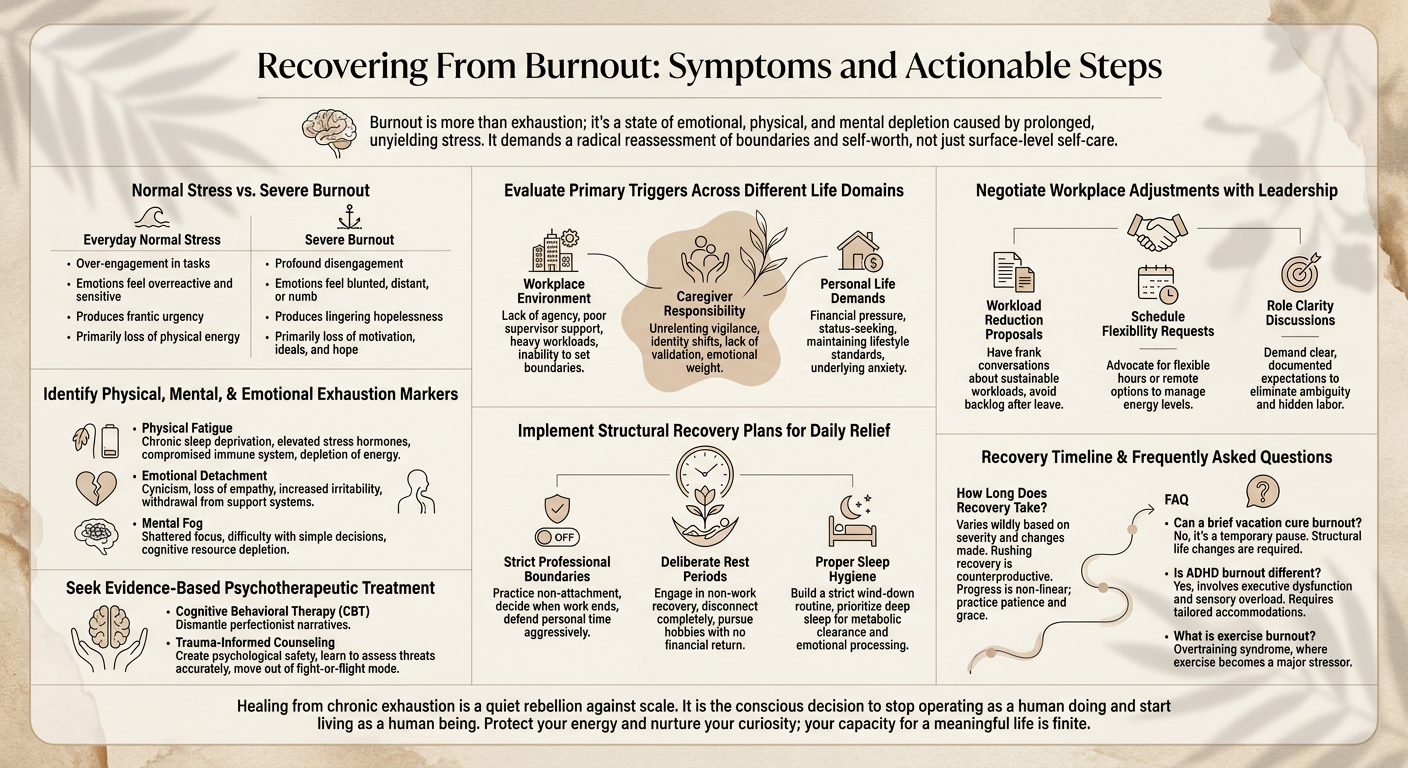
Here is a look at how the two states diverge biologically and emotionally:
|
Everyday Normal Stress |
Severe Burnout |
|---|---|
|
Characterized by over-engagement in tasks |
Characterized by profound disengagement |
|
Emotions feel overreactive and highly sensitive |
Emotions feel blunted, distant, or numb |
|
Produces a sense of frantic urgency |
Produces a lingering sense of hopelessness |
|
Primarily a loss of physical energy |
Primarily a loss of motivation, ideals, and hope |
Identify physical, mental, and emotional exhaustion markers
People love to dismiss their own symptoms. They convince themselves that everyone is tired. Pushing through the fatigue is viewed as the required price of admission for a successful life.
Physical fatigue symptoms
The body always keeps the score. Before the mind even registers a problem, physical health begins to unravel. Sleep deprivation becomes chronic. A person might spend eight hours in bed but wake up feeling entirely un-rested. Elevated stress hormones flood the system daily, leading to mysterious aches, a compromised immune system, and an absolute depletion of physical energy.
There is a very real link between organizational expectations and these physical crashes. In fact, recent findings evaluating workplace pressures indicate that poor supervisor support and heavy workloads directly trigger these physiological breakdowns.
Emotional detachment signs
Cynicism creeps in slowly. A once-passionate teacher suddenly feels nothing for their students. A dedicated nurse views patients as burdens. This emotional exhaustion serves as a protective defense mechanism. When the emotional cost of caring becomes too high, the brain simply cuts the wire. Individuals exhibit increased irritability, snapping at their partners or withdrawing entirely from their once-reliable support system.
Mental fog indicators
Focus shatters. Tasks that used to take twenty minutes suddenly stretch into hours. This mental roadblock is a biological response. The brain is literally rerouting its limited resources away from higher-order thinking to manage basic survival functions.
Evaluate primary triggers across different life domains
We live in a culture obsessed with scale. Everything must grow indefinitely. Scale the business. Maximize the output. Optimize the daily schedule. Unquestioned scaling at all costs creates an environment perfectly calibrated for total exhaustion.
Workplace environment pressures
Workplace stress rarely stems from simple task overload. The true culprit is a profound lack of agency. When employees have high demands placed on them but zero control over how they execute those tasks, severe burnout inevitably occurs. Modern corporate structures often prioritize hollow compliance over genuine character. Workers quickly learn that setting healthy boundaries is silently penalized.
Caregiver responsibility burdens
Caregiving is arguably the most intense form of labor in existence, yet society barely acknowledges it. Parenting an infant, managing a household, or handling eldercare involves unrelenting vigilance. New parents often deal with massive identity shifts on top of severe sleep loss. The stakes are incredibly high. There are no scheduled vacation days or performance reviews to validate the effort.
Personal life demands
Financial well-being carries immense emotional weight across the globe. Money dictates the neighborhoods people live in, the schools their children attend, and the subtle social hierarchies they navigate daily. The constant script of “upgrading” one’s lifestyle demands a continuous stream of income and status-seeking. Trying to keep up with these personal life demands while masking the underlying anxiety accelerates the path to total mental exhaustion.
Implement structural recovery plans for daily relief
You cannot heal in the exact same environment that made you sick without fundamentally altering the rules of engagement. Basic self-care routines are totally insufficient for addressing deep burnout. Structured recovery strategies are non-negotiable for long-term health.
Strict professional boundaries
Non-attachment is an incredibly useful practice. It allows the job to simply remain a job, without it dictating an individual’s entire sense of self when they log off. Setting professional boundaries means deciding exactly when the laptop closes and defending that time aggressively. If a workplace punishes someone for not answering emails at night, that is a toxic environment demanding subservience, not authentic effort.
Deliberate rest periods
Doom-scrolling on a couch for three hours drains cognitive resources. Genuine healing demands deliberate rest. Clinical analyses of recovery models emphasize the absolute necessity of participating in non-work recovery experiences. Taking time off and completely disconnecting is required. Getting out into nature. Engaging in hobbies that have zero financial return.
Proper sleep hygiene
Without good sleep, all other interventions inevitably fail. The brain needs deep sleep to clear out metabolic waste and process complex emotional events. Building a strict wind-down routine is critical medical infrastructure for a recovering nervous system.
Negotiate workplace adjustments with organizational leadership
Individual coping mechanisms can only stretch so far. Eventually, the structural issues driving the stress must be addressed head-on with management.
Workload reduction proposals
Taking a standard 12-week medical leave policy only to return to a massive mountain of backlogged work is completely counterproductive. True recovery involves having frank, difficult conversations with organizational leadership about reducing the actual volume of work permanently. An employee must clearly outline what workload is sustainable.
Schedule flexibility requests
The traditional desk format is deeply archaic. Flexible hours or remote work accommodations give individuals the agency to manage their own fluctuating energy levels. Requesting these adjustments is a proactive step toward long-term professional sustainability.
Role clarity discussions
Ambiguity is a massive, often invisible stressor. When job responsibilities bleed into three different departments, an employee constantly feels like they are failing at everything simultaneously. Demanding clear, documented role expectations eliminates the hidden labor that rapidly drains mental reserves.
Seek evidence-based psychotherapeutic treatment options
Sometimes the internal damage is simply too extensive to navigate alone. Therapy acts as a strategic intervention to rebuild cognitive and emotional scaffolding. Engaging with evidence-based mental health care helps individuals process chronic stressors in a safe environment.
Cognitive Behavioral Therapy helps dismantle the perfectionist narratives that drive people into the ground. Trauma-informed counseling, similar to the empathetic models used by specialized practices like Lily Counseling, focuses heavily on creating psychological safety. It teaches the nervous system how to accurately assess threats rather than staying stuck in permanent fight-or-flight mode. Various evidence-based approaches consistently show that professional, compassionate guidance drastically improves the long-term recovery trajectory.
How long does the recovery process take?
People always want a precise timeline. They want to know exactly how many weeks it will take to feel like themselves again.
The burnout recovery timeline varies wildly. It depends entirely on the severity of the exhaustion and how drastically the person can alter their daily routine. Mild mental fatigue might resolve after a month of strict boundary setting and prioritized sleep. Deep, severe burnout can take several months or even years to fully process and heal from.
Oddly enough, the desperation to speed up the healing process often prolongs it. Rushing recovery is just another form of toxic productivity. The timeline is the timeline. You have to give yourself the grace to experience the messy, completely non-linear progress of getting your life back.
Frequently Asked Questions
Can a brief vacation cure burnout? A vacation is a temporary pause. If the underlying stressors remain unchanged, the exhaustion will return the exact moment you step back into the office. Real recovery requires structural changes to your daily life, not just a brief escape using accumulated vacation days.
Is ADHD burnout different from standard burnout? ADHD burnout heavily involves executive dysfunction and profound sensory overload. Neurodivergent individuals exert massive amounts of energy masking their traits to fit into rigid neurotypical environments. Managing this specific type of mental exhaustion requires highly tailored lifestyle accommodations.
What is exercise burnout? Overtraining syndrome occurs when physical activity stops being a stress reliever and becomes a major stressor itself. Pushing a depleted body through grueling high-intensity workouts floods the system with even more cortisol. Sometimes, the healthiest physical choice is walking slowly.
Conclusion
We are culturally conditioned to view rest as a rare reward for a job well done. We view it as something that must be earned through grueling, relentless output. That exact mindset is what lands highly capable people in the therapist’s chair, completely devoid of joy.
Healing from chronic exhaustion is a quiet rebellion against the metrics of scale. It is the conscious decision to stop operating purely as a human doing and start living as a human being. Protect your energy. Nurture your curiosity. The endless work will always be there tomorrow, but your capacity to experience a meaningful, connected life is finite. Guard it fiercely.