
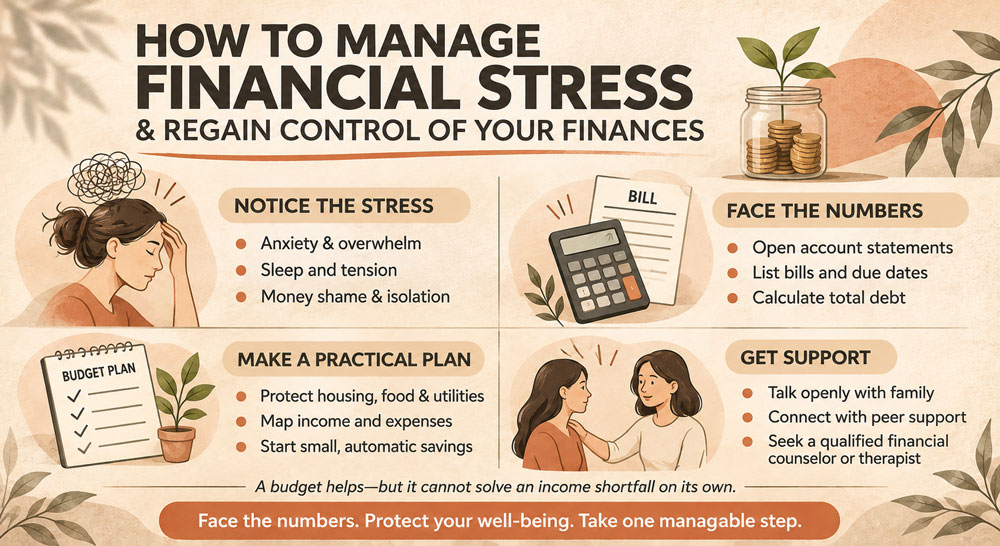
Many professionals hit a wall where they realize managing financial stress is no longer just a math problem, but a daily physiological battle. The knot in the stomach when an unknown number calls. The stack of envelopes gathering dust on the entryway table. We exist in a culture that relentlessly insists MORE is the only answer to happiness, subtly equating a growing net worth directly to our worth as human beings. The primary way to manage financial stress and regain control of your finances is to actively face your financial avoidance, document your exact debt obligations, and build an intentional spending plan that prioritizes household stability, all while dismantling the psychological isolation that keeps money shame alive.
Financial advice that starts and ends with “just make a budget” is overrated. A spreadsheet will never magically cover rent when your income cannot cover basic needs. Pretending this is entirely a mindset problem is nonsense. You have to address the structural friction and the emotional avoidance simultaneously.
How Does Financial Stress Impact Mental Health?
The body does not know the difference between a predator in the woods and an impending mortgage default. Both trigger the exact same biological alarm bells. When financial troubles mount, the nervous system becomes flooded, shifting resources away from higher-order thinking and empathy, trapping you in a perpetual state of survival.
Psychological Distress Indicators
When you do not know exactly how bad your financial situation is, your mind may fill in the blanks with catastrophe. Anxiety loves a vacuum. This cognitive overload quickly erodes emotional bandwidth. Recent data indicates that nearly half of adults experiencing severe economic uncertainty end up withdrawing socially from family and friends, according to the American Psychological Association. The shame attached to money problems forces people into isolation, which is the absolute worst environment for relational repair or problem-solving. People become incredibly irritable, unable to remain present with their children or partners, quietly suffocating under the pressure to maintain a facade of stability.
Physical Health Symptoms
You may carry this budget in your body. Chronic financial anxiety routinely manifests as severe insomnia, tension headaches, and gastrointestinal issues. When you are lying awake at 3 AM calculating how to afford groceries, your cortisol levels remain elevated, preventing the restorative sleep necessary for emotional regulation. The sheer cost of living becomes a biological stressor. Feeling low becomes a permanent physical baseline rather than a passing mood.
Systemic Income Vulnerability
Sometimes the math simply does not work, and acknowledging this is vital for your sanity. Public health researchers frequently point out that individual coping strategies have absolute limits when household income falls short of bare necessities. Over a quarter of adults report that they are finding it “difficult” or “very difficult” to get by financially due to persistent inflation and high prices. This is not a personal failing. It is systemic income vulnerability. Recognizing that the system itself carries inherent risks allows you to separate your personal identity from your current bank account balance, clearing the path to heal your relationship with money.
Face Financial Avoidance and Assess Debts
Psychologists observe that humans frequently cope with money anxiety through sheer denial. We look away. Avoidance offers a temporary illusion of safety, but it rapidly compounds debt and decimates self-esteem over time. Overcoming this requires facing the numbers directly, relying on evidence-based clarity rather than blind hope.
Open All Account Statements
The hardest part is often just logging in. The dread of seeing the actual numbers keeps people paralyzed. Gather every single statement, physical and digital. Open them. Lay them out on the table. You cannot manage a crisis you refuse to measure.
Record Payment Due Dates
Missing deadlines incurs late fees, which only accelerates the downward spiral of financial problems. Write down exactly when every bill is due.
-
List your fixed monthly expenses like housing, car payments, and insurance.
-
Identify variable expenses that fluctuate, like utility bills and groceries.
-
Note the minimum payment required for each revolving credit account.
-
Map these dates against your paycheck schedule to anticipate cash-flow gaps.
Calculate Total Debt Balances
Add it all up. The final number might be staggering, but it is finite. It is a boundary. Once you know the total burden, the amorphous fear of losing money transforms into a concrete logistical challenge. The monster in the closet is always scarier before you turn on the lights.
Create an Intentional Financial Plan
Non-attachment to money does not mean pretending money does not matter. That would be a lie. It means treating your finances as a tool rather than a scorecard of your character. An intentional financial plan focuses on sustainability and resilience, rather than punitive restriction.
Prioritize Essential Household Needs
Before worrying about the credit cards, secure your four walls. Rent or mortgage. Utilities. Groceries. Basic transportation to maintain your income. If your income cannot cover these basics, your plan must pivot toward seeking community resources, food banks, or social services.
Automate Monthly Cash Reserves
Friction is the enemy of consistency. Relying on willpower to save money at the end of the month rarely works because decision fatigue sets in. Research into consumer behavior shows that proactive budgeting and automated savings structures reduce psychological fatigue by drastically cutting down the number of active, high-friction financial decisions made per month. Set up a system where a small portion of your paycheck automatically routes to a separate savings account.
Avoid Expensive Software Subscriptions
Do not buy some fancy budgeting app to feel productive. Subscribing to a premium service when you are already struggling with unexpected expenses is an act of emotional spending disguised as financial planning. A free spreadsheet, or simply a pen and a notebook, provides exactly the same level of clarity without adding another monthly drain on your resources. It is entirely possible to break the spending cycle using nothing but a pencil and radical honesty.
Stop Money Shame and Seek Support
Money is never just money. It carries emotional weight, intergenerational expectations, and the heavy script of constantly “upgrading” our lives. I would stop treating money shame like a secret. Isolation just gives the anxiety more room to run wild. We desperately need human-first connection to navigate these stressors.
Join Local Peer Groups
Clinical research consistently highlights that isolation amplifies money-related shame. We heal in community. Participating in local peer support networks or community financial groups significantly reduces serious psychological distress. When you hear others articulating the exact same worries about retirement or debt, the crushing weight of personal shame begins to lift.
Consult Certified Financial Counselors
There is a profound difference between a wealth manager and a financial counselor. When you are overwhelmed by bills, you need practical, compassionate guidance to navigate debt consolidation, negotiate with creditors, or explore bankruptcy options. Experts strongly recommend facing numbers directly alongside a professional who understands both behavioral psychology and structural financial intervention.
Guide Anxious Family Members
Financial stress bleeds into your relationships. Children are incredibly perceptive; they easily read the room and internalize the tension of a struggling household. Relational repair requires transparent, age-appropriate communication. Do not hide the reality from your partner. Acknowledge the difficulties out loud to foster psychological safety, reinforcing that you are tackling the problem as a unified front.
Combine Mental Healthcare With Wealth Strategies
Standalone financial tips often fail because acute financial strain causes intense cognitive overload. You cannot budget your way out of clinical depression, just as you cannot meditate your way out of a foreclosure. True stability requires integrating mental health support with practical wealth strategies. Cultivating an optimistic outlook acts as a vital psychological resource, yet objective financial literacy scores do not always prevent subjective stress. In fact, emotional confidence and behavioral buffers play an equal role in stress mitigation. Working with a social worker or a therapist trained in financial psychology can help you uncover why you self-sabotage, allowing you to nurture long-term resilience.
When Does Basic Financial Advice Fall Short?
We are frequently told to simply skip the daily coffee to buy a house. Basic financial advice falls completely flat when it ignores the macroeconomic reality of wage stagnation and skyrocketing housing costs. When an unexpected medical crisis wipes out a family’s savings, telling them to “hustle harder” lacks basic human empathy.
This is where the obsessive corporate culture of scaling at all costs reveals its human toll. We may be tempted to optimize for output and erode the conditions that make people feel secure. Sometimes, regaining your peace of mind requires accepting that the game is rigged, giving yourself grace, and fiercely protecting your mental health boundaries from a society that demands infinite growth.
FAQ
How do I stop obsessing over my lack of money? Obsession usually stems from ambiguity. You stop obsessing by mapping the exact parameters of the problem. Calculate your exact net worth, income, and debt. Once the threat is defined on paper, the mind stops spinning in endless circles and shifts toward executing manageable daily steps.
Can financial stress cause physical health issues? Absolutely. Chronic financial anxiety keeps the nervous system in a state of hyperarousal. This sustained cortisol release directly contributes to insomnia, high blood pressure, muscle tension, and a weakened immune system.
What are the first steps to take when overwhelmed by debt? Stop borrowing immediately. Then, list all your debts from smallest to largest balance. Ensure your basic household needs (food, shelter, utilities) are covered first. Finally, contact your creditors; many hardship programs exist, but you must initiate the conversation before you default.
How can I support a partner who is stressed about money? Offer co-regulation rather than immediate solutions. Listen without interrupting. Validate their fear without agreeing with catastrophic thoughts. Once the emotional temperature lowers, gently suggest reviewing the finances together as a shared project, avoiding any language that implies blame or failure.
Conclusion
Spaciousness allows a deepening of who you are. Managing financial stress is rarely a quick, linear journey. It is a messy, deeply human practice of learning to separate your intrinsic value from your economic output. You will have moments of clarity followed by weeks of doubt. That is perfectly normal. By refusing to hide from the numbers, prioritizing your physical and emotional well-being, and reaching out for community support, you slowly rebuild your financial house on a foundation of reality rather than avoidance. Let the money pass through as a tool, but never let it take your sense of self when it goes.