
Last updated on August 28, 2026
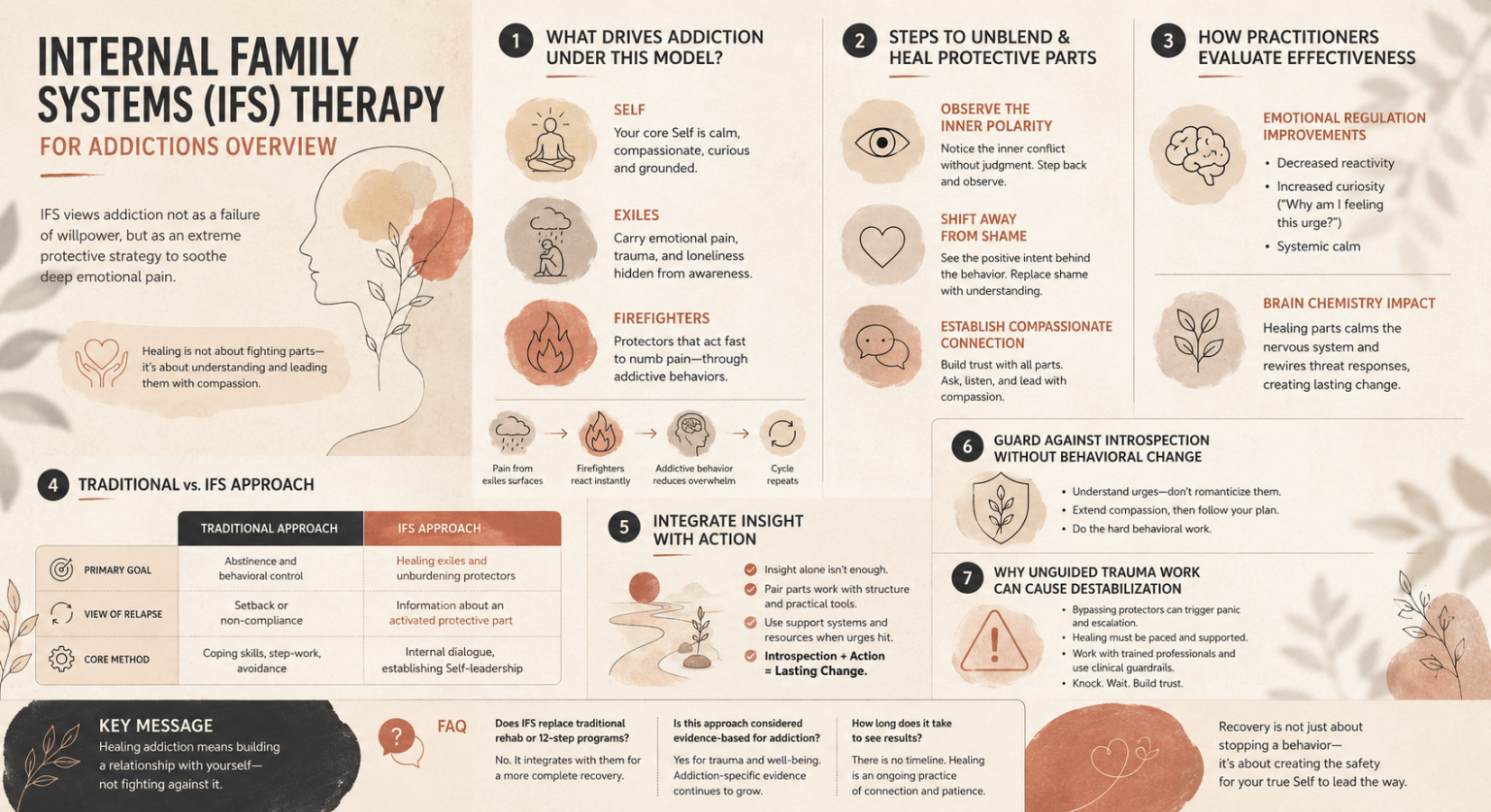
Internal Family Systems (IFS) therapy approaches addictions not as a chronic disease or a deficit of willpower, but as an extreme protective strategy. Within this clinical framework, the addictive behavior functions to soothe or distract from deep emotional pain carried by vulnerable psychological parts. The therapeutic process focuses on mapping these internal dynamics, reducing the extreme roles of protective mechanisms, and addressing the underlying trauma driving the compulsion.
I don’t buy the pitch that any single therapeutic model is a flawless, universally applicable cure for dependency. We treat an addict like a puzzle to be solved through sheer force. We optimize for compliance and quietly erode the conditions that make a person feel seen. Addiction can be challenging because it is an entire internal ecosystem. Anxiety, stress tolerance, identity, trauma memories, and social triggers all living in the same house. Internal family systems therapy offers a way to navigate that ecosystem. It does not hand you a map and walk the road for you.
What Drives Addictive Behaviors Under This Model?
We assume people engage in an addictive practice because they lack discipline. The IFS method suggests something entirely different. It suggests your mind is divided into subpersonalities, and some of those parts are working overtime to keep you from falling apart.
Concept of Self
Everyone has a core Self. This is the foundation of the internal family. The true self is inherently compassionate, curious, and grounded. It cannot be damaged by trauma. It cannot be corrupted by an addictive process. When a person operates from this space, they possess clarity and can lead their inner system with an empowering, holistic perspective. The problem arises when the noise of daily survival crowds out this core Self, leaving protective parts to seize control of the steering wheel.
Exiles and Emotional Pain
Beneath the surface behaviors lie the exiles. These are the parts of us that hold the emotional pain, the memories of past traumas, and the profound loneliness we pretend doesn’t exist. Society demands we function. We bury these exiles. We push them out of awareness because feeling that level of distress in a Tuesday morning meeting is socially unacceptable. But exiles are seeking attention or acknowledgment. They constantly threaten to flood the system with unresolved feelings.
Firefighters as Protective Strategies
Enter the firefighters. When exiles threaten to overwhelm the system, firefighters deploy instantly. Their only goal is to extinguish the pain. They do not care about collateral damage. Alcohol, drugs, internet addiction, gambling. These actions are firefighters. An uncontrollable habit isn’t a random glitch in your brain; it is a highly motivated protector trying to save your life the only way it knows how. As outlined in the theoretical foundations of the IFS model, these parts rely on extreme measures because they believe the alternative—feeling the exile’s pain—is entirely unendurable.
Steps to Unblend and Heal Protective Parts
You cannot aggressively force a protector to stand down. Attempting to coerce your own mind into submission usually triggers a strong emotional response. Healing requires a different negotiation.
Observe the Inner Polarity
The first step is noticing the inner conflict. You have a part that desperately wants to stop drinking. You have another part that insists drinking is the only way to survive the weekend. This is an inner polarity. The therapist helps clients map this conflict without taking sides. You are just observing. The moment you step back and look at these opposing desires, you are beginning to unblend from them.
Shift Away From Shame
Societal stigma tells you that you are deeply flawed. Traditional punitive systems operate on the belief that smaller people get hurt by bigger people, and behavioral compliance should be beaten into us. This environment breeds immense guilt. In therapy, reframing the narrative means recognizing the positive intent behind the dysfunction. Even the most destructive behaviors started as a survival mechanism. Acknowledging this intent neutralizes the self-loathing that typically fuels the relapse cycle.
Establish Compassionate Connection
Relational repair requires trust. You have to establish an internal connection with these parts. You extend the compassionate self toward the firefighter and the exile alike. You ask the protective part what it is afraid would happen if it stopped its job. This dialogue builds a bridge. You are nurturing the system rather than policing it.
How Do Practitioners Evaluate Effectiveness in Recovery?
Measuring growth in this space is complicated. We love hard metrics. Days sober. Urine screens. But emotional resilience doesn’t always graph neatly on a chart.
Empirical Validation Realities
While the clinical community praises this approach for its relational depth, large-scale empirical validation specifically targeting standalone addictions remains a work in progress. It doesn’t yet have the decades of rigid statistical backing that cognitive-behavioral therapies enjoy. However, independent reviews, such as a recent peer-reviewed evidence synthesis analyzing 27 studies, demonstrate strong acceptability and significant outcomes in self-compassion and trauma resolution. For those wanting to dig into the data, the foundation’s curated publication database tracks the ongoing scientific evaluation of these modalities.
Emotional Regulation Improvements
Practitioners look for shifts in how the nervous system reacts to distress.
-
Decreased Reactivity: When triggered, the client doesn’t immediately default to the addictive behavior.
-
Increased Curiosity: The ability to pause and ask “Why am I feeling this urge?” instead of blindly obeying it.
-
Systemic Calm: A general reduction in the baseline anxiety of the inner system.
Brain Chemistry Impact
Continual parts work actually participates in the rewiring of thinking patterns. Trauma locks the brain into a constant state of hyperarousal. By calming the protectors and retrieving the exiles, the brain’s threat-detection center begins to stand down.
|
Metric Focus |
Traditional Addiction Treatment |
Internal Family Systems Therapy |
|---|---|---|
|
Primary Goal |
Abstinence and behavioral control |
Healing exiles and unburdening protectors |
|
View of Relapse |
Setback or non-compliance |
Information about an activated protective part |
|
Core Method |
Coping skills, step-work, avoidance |
Internal dialogue, establishing Self-leadership |
Integrate Parts Work With Structured Action Plans
If you are expecting IFS therapy to behave like a 12-step structure—with clear rules, defined steps, and a strict relapse response—you will likely be frustrated. It doesn’t give you the same kind of container.
This is where the theoretical meets the pavement. IFS educator Cece Sykes and IFS author Martha Sweezy have deeply explored how these parts interact in addiction recovery, noting that insight alone isn’t a shield. You can get really good at emotional insight and still not build the plan you need for cravings at 2am. Introspection without behavior change can easily turn into procrastination, just with feelings.
If you are already in a structured recovery system, this psychotherapy slots in beautifully. It helps you understand what is driving the coping mechanism. But you still need guardrails. You still need to know who to call when the urges hit. Federal resources and hotlines, like the national substance support directory, remain critical infrastructure for immediate, practical intervention while the deeper trauma work is happening.
Guard Against Introspection Without Behavioral Change
IFS often gets framed as “all parts are welcome.” It sounds beautiful. It is deeply compassionate. It can also accidentally feel like permission.
Not permission to relapse, necessarily, but permission to interpret every destructive urge as an inner negotiation instead of taking responsibility in the plain, adult sense. You can spend years sitting in a room with a therapist, mapping out your subpersonalities, having a joyful therapy experience, and never actually stopping the behavior that is destroying your family.
The clients who do best with this approach usually hold a firm line. Cravings happen. Unrealistic thoughts happen. But you don’t romanticize them. You treat them like signals, you extend compassion to the part sounding the alarm, and then you execute your recovery plan anyway. You have to actually do the hard behavioral stuff.
Why Can Unguided Trauma Work Cause Destabilization?
Rushing into the basement to find the exiles without getting permission from the firefighters is dangerous. Unguided parts work can severely destabilize individuals, particularly those with complex trauma.
When you bypass a protector, that protector panics. It believes you are going to die from the emotional pain you are about to uncover. So it escalates. This is where we see sudden, severe relapses or intense emotional flooding. Healing must be paced. The official academic research tracking this model frequently emphasizes the necessity of clinical guardrails. Integrated approaches are paramount; for instance, specialized treatment protocols that combine trauma-informed care and medical pathways, like a recent 12-month pilot study on complex trauma, show that coordinated support is vital. Similarly, exploring internal personality dissociation requires highly calibrated techniques, as seen in protocols blending structural dissociation models with targeted therapies. You do not kick down the doors of your own psyche. You knock. You wait. You build trust.
FAQ
Does IFS replace traditional rehab or 12-step programs? No. It integrates with them. Many find that combining the systemic understanding of their internal family with the structured community support of a 12-step or similar program provides the most comprehensive path to recovery.
Is this approach considered evidence-based for addiction? It is recognized as an evidence-based practice for improving general well-being and treating trauma, which heavily overlap with addiction. Specific, large-scale empirical validation for standalone addiction treatment is growing but still evolving compared to older modalities.
How long does it take to see results? There is no timeline. Unblending from deeply entrenched addictive practices requires immense patience. It is an ongoing practice of internal connection, not a scheduled event.
Conclusion
We live in a culture that wants to scale everything, including human healing. We want the fastest, most efficient route to fix what we perceive as broken. But the human mind does not operate on a corporate timeline.
Addressing addictive behaviors through this lens is a request for radical vulnerability. It asks you to sit down with the darkest, most destructive parts of yourself and offer them a cup of tea. IFS founder Richard Schwartz built a model that forces us to look at our inner chaos and find the underlying intention. It demands resilience. It requires a willingness to slowly untangle the knots of your own history without resorting to harsh self-criticism. Recovery, ultimately, is not just about stopping a behavior. It is about fostering the psychological safety required to let your true self lead the way.