
Introduction
Corporate professionals constantly optimize their daily routines for maximum output. They track metrics, attend another weekend workshop, and consume self help books hoping to unlock an abundant lifestyle. The common narrative heavily promoted by wellness influencers suggests that if a person simply visualizes a goal with enough emotional intensity, the universe will deliver it on a silver platter. That narrative is a comfortable illusion. The human mind gravitates toward magical thinking because wishing upon a vision board requires zero caloric expenditure. Actually rewiring neural pathways demands rigorous effort.
The reality of manifesting abundance looks entirely different. It requires examining deeply ingrained beliefs about safety, value, and survival. Psychologists widely classify pure manifestation as pseudoscience because it lacks empirical backing and ignores systemic barriers. When individuals substitute actionable effort for passive wishing, they bypass the very emotional labor required for actual growth. True cognitive behavioral reframing forces a person to confront their internal operating system. It asks them to drop the superficial concepts and do the unglamorous work of changing how their brain processes reality.
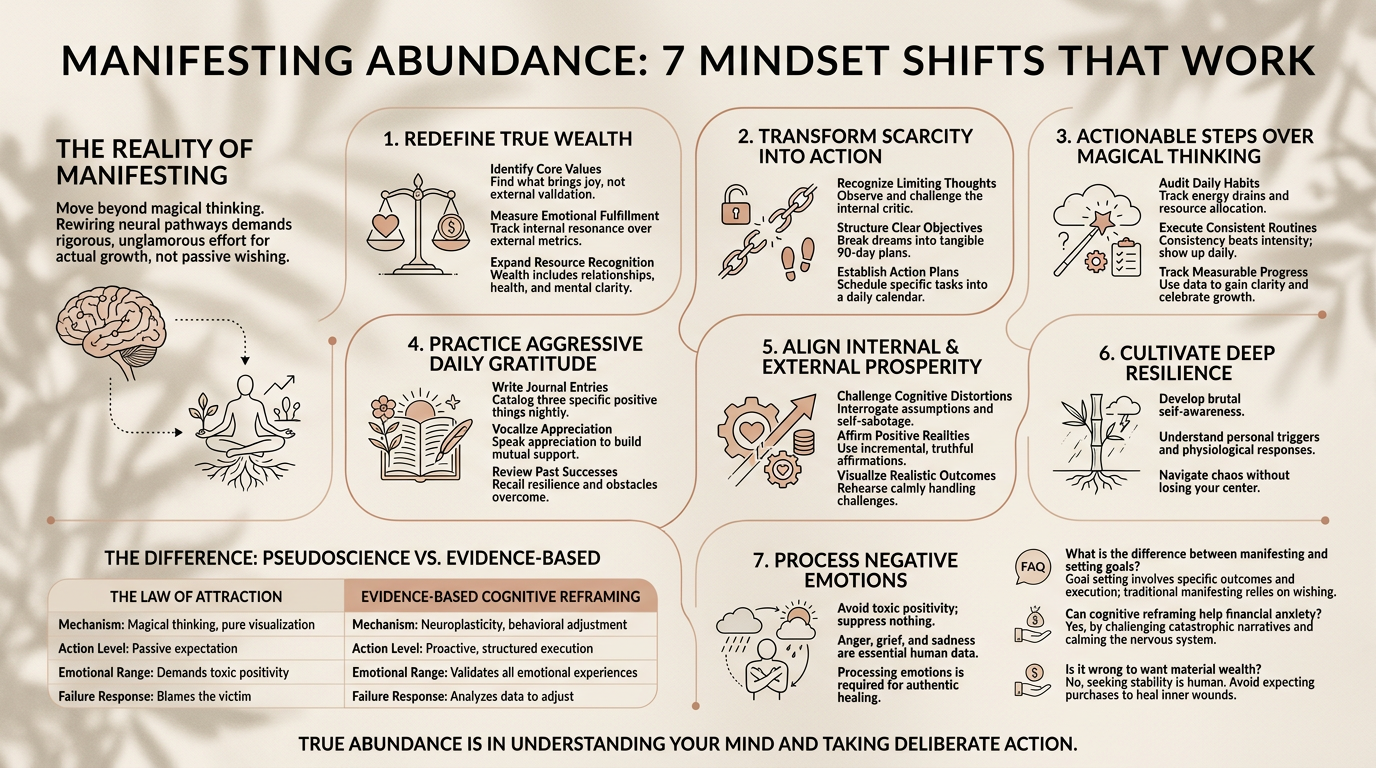
1. Redefine True Wealth Beyond Financial Metrics
Singaporean culture equates success with a highly specific, rigid trajectory. The relentless progression from an HDB flat to a private condo, and eventually securing a massive property, dictates how entire families operate. Money carries the heavy weight of intergenerational anxiety. Couples fighting over finances are rarely just arguing about bank statements. They are fighting for basic psychological safety. Taking the step to align on abundance psychology during financial therapy often uncovers these hidden scripts. A bank account balance hitting $200,000 means nothing if the nervous system remains stuck in survival mode.
Identify Core Values
A person must figure out what actually matters to them before they try to acquire more things. Too often, people adopt the goals of their parents or their marketing department peers. They chase book sales or a promotion to partner because they crave validation. Identifying core values requires stripping away external expectations. It means sitting in silence on a Tuesday afternoon and asking what brings actual joy, not just what looks good on a social media post.
Measure Emotional Fulfillment
Most metrics of success rely on external validation. A better approach involves tracking internal resonance. Does this career choice bring a sense of play into daily life? Does this relationship foster deep trust? Emotional fulfillment cannot be quantified by a street team billboard or a flashy new book launch. It lives in the quiet moments. A listener tuning into a podcast episode might feel more connected to their own potential than someone closing a massive corporate deal.
Expand Resource Recognition
Wealth extends far beyond liquid cash. It includes having a friend who will take a phone call at midnight. It involves physical health, time flexibility, and mental clarity. An abundant mindset recognizes all available resources. When someone stops fixating purely on money, they suddenly see the myriad ways the world supports them. They notice the opportunities previously hidden behind their own anxiety.
2. Transform Scarcity Mindsets Into Goal-Setting Behaviors
Scarcity mindset operates as a trauma response. It convinces the brain that there will never be enough time, money, or love. This fear restricts peripheral vision, forcing individuals to hyper-fixate on immediate threats. Women rebuilding self-worth and finding confidence frequently have to dismantle these inherited scarcity narratives. The shift from panic to proactive goal setting requires immense self-compassion.
Recognize Limiting Thoughts
The first step is observation. A person cannot change a thought pattern they refuse to see. They must catch themselves when they assume a negative outcome is inevitable. These limiting thoughts often disguise themselves as simple realism. They whisper that trying is dangerous. Acknowledging this internal critic strips it of its absolute power.
Structure Clear Objectives
Vague desires produce vague results. Saying you want a better life is useless. Structuring clear objectives means defining the exact parameters of success. It means breaking down a massive dream into a 90-day plan starting next week. This converts abstract wishes into a tangible roadmap.
Establish Action Plans
Without execution, an idea is just a hallucination. Establishing action plans requires scheduling specific tasks into a daily calendar. It demands discipline. A person might need to spend an hour every Monday reviewing their progress rather than scrolling through endless channels of digital noise. Action forces the mind to align with reality.
3. Replace Magical Thinking With Actionable Steps
Magical thinking is highly dangerous. Mental health experts warn that relying solely on positive thought causes people to avoid taking actionable steps toward their goals. Waiting for the universe to provide is a sophisticated form of procrastination.
Audit Daily Habits
Before a person can build an abundant lifestyle, they must halt the depletion. They need to audit their current routines ruthlessly.
-
Track energy drains: Identify the specific tasks, meetings, or relationships that leave the nervous system depleted.
-
Identify avoidant behaviors: Notice when scrolling on a phone replaces having a difficult conversation.
-
Map resource allocation: Write down exactly where every hour and every dollar goes during a typical week.
-
Eliminate toxic consumption: Stop consuming content that triggers inadequacy or panic.
Execute Consistent Routines
Consistency beats intensity every single time. Executing routines means showing up even when the initial motivation fades. It means waking up and engaging in a daily practice, whether that involves a magnetic energy meditation or simply drinking water and moving the body. Consistent action rewires the brain through repetition.
Track Measurable Progress
Growth requires evidence. Tracking measurable progress gives the brain the dopamine hit it needs to continue. This does not mean obsessing over every minor fluctuation. It means setting a benchmark in Jan and reviewing it objectively at the end of the season. Data provides clarity when emotions become messy.
4. Practice Daily Gratitude For Cognitive Reframing
Gratitude is not a soft, passive emotion. It is a highly aggressive cognitive intervention. Intentional gratitude practices directly enhance subjective well-being and lower anxiety. By forcing the brain to scan the environment for good things, a person physically alters their neural pathways. This practice shifts focus away from perceived deficits and toward an unlimited source of present value.
Write Journal Entries
Manifestation journaling often devolves into writing wish lists. True gratitude journaling grounds a person in their current reality. Putting pen to paper slows down racing thoughts. Writing three specific things they are grateful for each night forces the brain to catalog positive data before sleep.
Vocalize Appreciation Statements
Internal thoughts lack the friction of spoken words. Vocalizing appreciation statements makes the gratitude real. Playing an appreciation game with a partner over dinner fundamentally changes the relational dynamic. It builds a culture of mutual support rather than mutual criticism.
Review Past Successes
Human beings suffer from an inherent negativity bias. They remember failures vividly while forgetting massive achievements. Reviewing past successes reminds a person of their own resilience. Looking back at obstacles they already overcame proves that they possess the capability to handle future challenges.
5. Align Internal Beliefs With External Prosperity
A person will inevitably self-sabotage if their internal identity conflicts with their external success. If they secretly believe they are unworthy of care, they will unconsciously destroy healthy relationships. Learning what a money mindset coach really does reveals that the actual work is never about financial literacy. It is entirely about closing the gap between deep-seated beliefs and lived reality.
Challenge Cognitive Distortions
Cognitive distortions are lies the brain tells to maintain the status quo. Recognizing and challenging these distortions is a critical shift from self-sabotage during life coaching. A person must interrogate their own assumptions. Just because a thought feels terrifyingly real does not make it objectively true.
Affirm Positive Realities
Affirmations only work when they are rooted in possibility. Shouting “I am a millionaire” at a mirror while carrying heavy debt creates cognitive dissonance. Using abundance affirmations for wealth and success means stating incremental truths. “I am capable of making better financial choices today” is an affirmation the brain can actually accept and build upon.
Visualize Realistic Outcomes
Producing vivid mental imagery of future scenarios activates the same neural networks used during actual physical movement. Visualization is a rehearsal for reality. A person should visualize themselves handling a high-pressure meeting calmly, rather than just imagining the final paycheck. They should picture the actual mechanics of success.
6. Cultivate Deep Resilience Through Self Awareness
Resilience is not about bouncing back quickly. It is about allowing an experience to change you without destroying you. Building this capacity requires brutal self-awareness. It demands understanding personal triggers and physiological responses to stress. Embracing the core pillars of sustainable mindset shifts allows individuals to navigate chaos without losing their center. A highly resilient person can sit in a busy bar, listening to a loud sax playing, and maintain complete internal stillness. They know their own boundaries.
7. Process Negative Emotions To Avoid Toxic Positivity
The darkest side of the manifestation movement is its demand for constant positivity. Critics rightly point out that this philosophy forces people to suppress valid negative emotions. This toxic suppression can lead to severe victim-blaming, where individuals are told their chronic illness or financial ruin is a direct result of their own negative thoughts. Anger, grief, and sadness are essential human data points. Processing them is required for authentic healing. Suppressing them only ensures they will manifest destructively later. A spiritual practice that cannot handle human suffering is entirely useless.
Why Do Psychologists Criticize The Law Of Attraction?
The scientific community rejects the Law of Attraction because it fundamentally misunderstands physics and psychology. The core premise lacks empirical evidence and relies heavily on confirmation bias. It sells a seductive lie: that thoughts alone manipulate matter.
|
Feature |
The Law of Attraction |
Evidence-Based Cognitive Reframing |
|---|---|---|
|
Mechanism |
Magical thinking and pure visualization |
Neuroplasticity and behavioral adjustment |
|
Action Level |
Passive expectation of the universe |
Proactive, structured daily execution |
|
Emotional Range |
Demands toxic positivity |
Validates all human emotional experiences |
|
Failure Response |
Blames the victim for negative thoughts |
Analyzes data to adjust future strategies |
When a self proclaimed guru on a women channel tells an audience they can cure their trauma by thinking happy thoughts, they cause active harm. They strip away agency. True psychology builds agency by focusing on what a person can actually control.
How Does Cognitive Reframing Drive Real World Success?
While magical thinking is a trap, the mechanics of cognitive reframing are undeniably powerful. When a person intentionally alters their perspective, they change their behavior. High dispositional optimism leads to a significant reduction in mortality risk due to the proactive adoption of healthy lifestyle behaviors. Optimists do not just sit around hoping for the best. They take action because they genuinely believe their actions will yield results. Brief mindset interventions reliably alter behavioral choices, causing individuals to intentionally choose harder, more rewarding paths. They might skip the Cyber Monday deals or the Black Friday manifesting bundle to invest in real therapy instead. They might start taking energybits for health rather than searching a forum for dear gabbyd advice. They align their daily habits with their highest potential.
FAQ
What is the difference between manifesting and setting goals? Goal setting involves defining a specific outcome and creating a measurable, step-by-step plan to achieve it. Traditional manifesting often relies heavily on wishing and visualizing without necessarily demanding the rigorous physical execution required to bring that vision into reality.
Can cognitive reframing help with financial anxiety? Yes. Cognitive reframing helps individuals identify the catastrophic stories they tell themselves about money. By challenging these extreme narratives, a person can calm their nervous system and make rational financial decisions based on facts rather than fear.
Is it wrong to want material wealth? No. Seeking financial stability and comfort is a basic human drive. The problem arises when a person expects a luxury purchase to heal a psychological wound or provide a sense of fundamental worth that can only be generated from within.
How long does it take to change a scarcity mindset? Rewiring the brain is a continuous process, not a weekend project. While minor shifts in perspective can happen in a few weeks through consistent gratitude and awareness practices, deep systemic changes to an individual’s operating system often require months or years of dedicated effort.
Conclusion
The modern obsession with scaling everything from businesses to personal enlightenment has left people profoundly disconnected. True abundance is not found in a bank account overflowing with cash while the nervous system remains in tatters. It is found in the slow, deliberate work of understanding one’s own mind. The power of in-person connection and authentic conversations remains the ultimate form of wealth. Dropping the illusion of magical fixes allows a person to step into their actual life. It requires shedding the heavy armor of constant upgrading and choosing to show up exactly as they are. That is where real growth begins.