
Last updated on July 26, 2026
Key Takeaways
- Understand that artist burnout is frequently a reaction to systemic pressures such as monetizing your passion and the never-ending comparison spiral. It is not a personal failure but a response to a lifestyle that is untenable.
- Listen carefully for these warning signs: creative emptiness, deep cynicism, or physical exhaustion. These are your body and mind screaming that something has to change.
- You have to push back against the inner critic that feeds your perfectionism and failure phobia. Allow yourself to make messy art and turn blunders into lessons.
- Recovery isn’t just taking a rest. It’s reconstructing your craft and your heart. Explore therapy or plan unstructured play to rediscover your fire without pressure.
- Reclaim your power by redefining success on your terms, apart from validation or income. Nurture a tribe of artists to fight the loneliness of the craft.
- Recognize that reaching out for professional help is courageous and strong, not weak. A therapist can offer you customized tools to look beneath the surface and address the root causes of your burnout.
Therapy for artist burnout provides targeted psychological assistance for artists coping with the distinctive burnout associated with their craft’s emotional and professional challenges. I used to confuse the silence in my studio for uninspiration. No, it was the sound of burnout. You could very well be reading this and experiencing that same mute dread, questioning whether your own flame has been snuffed out. This is not a personal creative failure; it’s a systemic well-being crisis, according to data from arts organizations tracking a dramatic surge in these invisible battles. The answer isn’t simply personal fortitude. We need to have a braver discussion about cultivating places in which human beings, not just their production, can flourish.
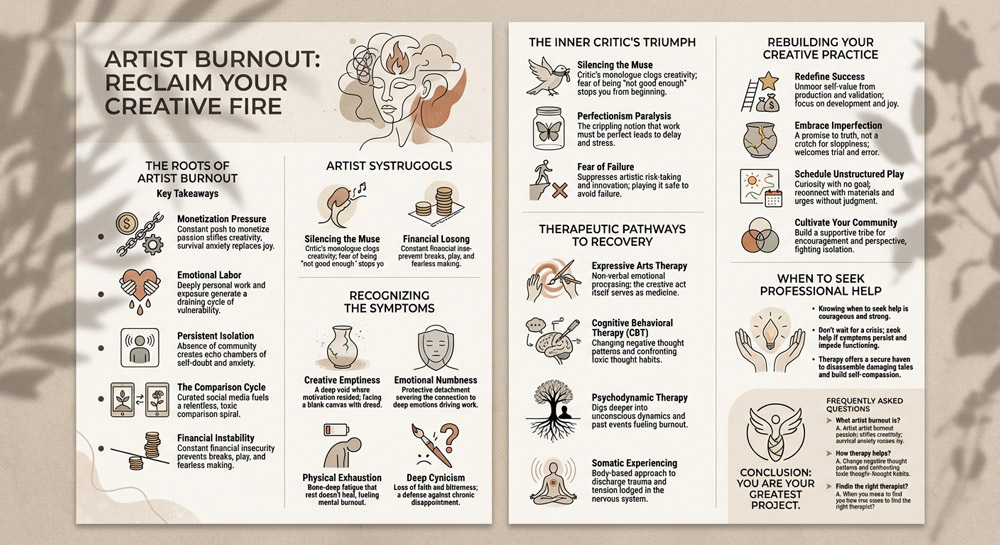
The Roots of Artist Burnout
Artist burnout is complex, not a personal flaw. It’s the convergence of compounding stresses that insidiously degrade the artistic soul. To understand it, we need to look past the individual and investigate the systems around them. Burnout is different for everyone, but its roots are usually planted in the same hard ground.
1. Monetization Pressure
The constant push to monetize your passion can be stifling. When your financial survival is at stake with each piece, the studio ceases to be a refuge and begins to feel like an assembly line. This perpetual push to peddle compels an exhausting compromise between creative passion and commercial considerations, where the happiness of art-making is extinguished by the anxiety of selling. Creativity turns into a thing, and the artist becomes a thing as well. This is an unsustainable formula for any human.
2. Emotional Labor
Making art is profoundly emotional work. Artists imbue their work with their life experience, including exposure, loss, and happiness.
It’s not simply hours logged, but a piece of your soul given away.
Putting that deeply personal work out into the world, then holding yourself open to criticism or dismissal, generates a draining cycle of emotional vulnerability. It is an unseen war that marches straight to burnout.
3. Persistent Isolation
Creative work can demand solitude, yet constant isolation is a burnout trigger. Absent the buffer of routine and meaningful human connection, an artist’s inner world can turn into an echo chamber of self-doubt and anxiety.
Building a tribe of peers is not a luxury; it is a vital protection. Connection offers the validation and perspective needed to support a creative life.
4. The Comparison Cycle
Social media presents a curated reality of peer success.
This fuels a relentless, toxic comparison cycle.
It plants seeds of insecurity and perfectionism.
Escaping it demands a deliberate transition away from external validation toward internal artistic development.
5. Financial Instability
The financial precarity so endemic in artistic careers generates a constant, low-level din of stress. This insecurity isn’t mere background anxiety; it bleeds directly into an artist’s ability to take breaks, to play, to make fearlessly.
Financial planning isn’t selling out. It’s about constructing a solid, sustainable base that shields your psyche and enables your artistry to flourish.
Recognizing the Symptoms
Burnout starts as a whisper, easy to ignore as just another tired day. For artists — whose work is intimately connected to their identity — these murmurs can be especially disorienting. Endlessly trying to juggle creative output, commercial demands, and personal well-being can leave you running on fumes. Identifying these symptoms is not a confession of frailty. It’s the brave initial move toward regaining your health and your art. We need early detection because intervention is more effective before the whisper becomes a roar.
Creative Emptiness
This is more than a creative block. It’s a deep emptiness where your motivation once resided. Burnout saps the emotional and cognitive reserves necessary to create, leaving you facing a blank canvas or a blank page with a feeling of dread, not potential. You’re uninspired because the tank is really empty. Here’s the secret to reigniting that spark: you have to get away from the production pressure. Allow yourself to be a consumer of art, not just a producer. Go to a gallery you’ve never been to, hear a totally new genre of music, or take a walk without your inspirational antenna up. Refill the well, do not squeeze water from a rock.
Emotional Numbness
When it gets overwhelmed, the brain occasionally constructs a buffer. This emotional detachment is a protective response to overwhelm, one that can sever the vital connection an artist has to their work. You could no longer tap into those deep emotions that used to drive your expression. Your art felt empty or phony.
Begin small to reconnect. Try some mindful awareness and just name your feelings without judgment. Pose the question, ‘What am I feeling right now?’ It’s not about correcting the feeling, but rather just noticing it. This quiet ritual can gradually reduce the barrier and enable you to sense and craft with vulnerability once more.
Physical Exhaustion
We tend to forget that art making is manual labor. The late nights, the monotonous movement, and the brute effort of maintaining a stance wear us down.
I don’t mean just tired, but a bone-deep fatigue that rest doesn’t appear to heal.
This physical depletion, in turn, directly feeds mental and emotional burnout, creating an inescapable cycle. Self-care is not a luxury; it’s a professional imperative.
|
Strategy |
Benefit |
|---|---|
|
Mindful Movement |
Reduces stress hormones, improves mood |
|
Nutrient-Dense Meals |
Stabilizes energy and cognitive function |
|
Consistent Sleep |
Restores the brain and repairs the body |
|
Digital Detox |
Lowers cortisol, allows for mental rest |
Deep Cynicism
This presents as a loss of faith. You begin to ask yourself what you are doing with your art and your voice.
The fire that used to fuel you is supplanted by bitterness and hatred for your profession, your fans, or even yourself.
This cynicism is a protection against chronic disappointment and burnout.
To fight back, reconnect with your ‘why.’ Remember what attracted you to your art in the first place. Seek out a peer community that understands your struggle, or mentor a young artist to recall the hope and mission that used to drive your work.
The Inner Critic’s Triumph
For most artists, burnout is about more than just exhaustion. It’s when the inner critic’s voice becomes the sole voice you hear. This story, stoked by insecurity and terror, can destroy a creative career from within. Recognizing this critic, not dismissing it, is the initial move toward regaining your craft and your sanity. Its victory is not that it shuts you up, but that you come to understand it at last.
Silencing the Muse
Your critic’s secret weapon is clogging your creative pipeline. It whispers that your ideas aren’t unique or that you don’t have the skill to pull them off.
This inner critic’s monologue creeps directly into your artistry, causing you to be timid and inflexible in places where you used to be free and inspired. The fear of not being good enough can keep you from beginning.
To crush this, you need to reintroduce play. Let the outcome go. Utilize art therapy to personify the critic. Sketch it and christen it. By externalizing the voice, you can control its messages rather than be controlled by them.
Perfectionism Paralysis
Perfectionism is frequently mistaken for a virtuous quest. For an artist, it is a prison. It’s the crippling notion that your stuff needs to be perfect, which results in delay and perpetual stress. This isn’t high standards; it’s a fear-based defense mechanism against criticism. The quest for an unattainable ideal guarantees you are perpetually coming up short, fueling your critic’s story that you aren’t enough. The cure is to be self-compassionate and reorient your attention away from the finished work and towards the work itself. Welcoming imperfection creates space for trial and error and expansion, which is the real center of all creative endeavor.
Fear of Failure
That inner critic so often wins through a fear of failure that suppresses the artistic risk-taking necessary to innovate. When you’re scared to fail, you play what’s safe, what you know. Your creativity dies a slow death because you’re too afraid to venture into the uncharted, where revolutionary work occurs. This terror stops you from engaging and shields you from your own possibility.
We need to frame failure as learning, which is an essential component of the creative process. It’s by accepting this fragility that you defuse the critic. This transformation can be like freedom from the shackles of insecurity and the courage to make again.
Therapeutic Pathways to Recovery
Burnout is essentially clinical emotional exhaustion. It’s your body warning you that the system you’re in is no longer viable. Navigating your path to wellness takes more than a getaway. It requires a journey toward therapy, and what works for one person does not work for another.
|
Therapy Type |
Primary Focus |
Best For Artists Who… |
|---|---|---|
|
Expressive Arts |
Non-verbal emotional processing |
Feel creatively blocked or struggle to articulate their feelings. |
|
CBT |
Changing negative thought patterns |
Are trapped in cycles of perfectionism, self-criticism, and anxiety. |
|
Psychodynamic |
Unconscious motivations & past |
Sense that deeper, unresolved issues are fueling their burnout. |
|
Somatic |
Body-based trauma & tension |
Experience physical symptoms of stress like chronic pain or fatigue. |
Expressive Arts Therapy
Here, the creative act itself serves as the medicine. It’s not the destination.
It gives you a means to work through difficult feelings that language can’t touch. As an artist, this can seem like returning home.
You’re invited back into creativity without an audience, without the spotlight.
This creates room for emotional therapy, helping you cultivate resilience in healing.
Cognitive Behavioral Therapy
Cognitive Behavioral Therapy (CBT) provides a pragmatic method to discover and confront the toxic thought habits driving your burnout. Most artists are imprisoned by perfectionism or an incessant internal critic, and intense work demands merely amplify these voices. CBT provides practical ways to rewrite thoughts such as, “If this piece isn’t perfect, I’m a failure.” In other words, by learning to handle daily stress with these techniques, you develop psycho-social resilience, protecting yourself from the burnout merry-go-round and establishing a more sustainable relationship with your work.
Psychodynamic Therapy
This therapy digs deeper, at the ‘why’ of your burnout. It dives into the unconscious dynamics and childhood events that mold your present pattern of behavior and connection to your creative self.
Individual psychotherapy can explore these root causes and treat the core emotional wounds that surface as an overwork addiction or impostor syndrome. It lets you figure out what’s really motivating you instead of just coping with the symptoms.
Somatic Experiencing
Burnout resides in the body. It is the tightness in your shoulders, the shallow breath, the bone-deep exhaustion.
Somatic Experiencing orients to this physical reality, helping you cultivate an increased awareness of your body’s sensations in order to gently discharge the trauma and emotional tension lodged in your nervous system.
It assists with emotional regulation, showing you how to hear your body’s cues before they grow into burnout.
Rebuilding Your Creative Practice
Recognizing burnout is the initial, bravest action. Rebuilding isn’t about banging your head against a metaphorical wall of creativity. It’s about delicately cultivating its return. It demands a transformational change in the way we connect with our work, our value, and ourselves as humans.
Redefine Success
We need to get real about what ‘success’ means when the markers we pursue—gallery representation, sales, social media likes—are the very things driving our burnout. This outside feedback is a brittle basis for a durable creative existence. Real success needs to be redefined in your own terms. It could be the serene pleasure of learning something new, the bliss of doing it for the sake of doing it, or having the bravery to make something that’s just for you, with no one else watching. It’s about unmooring your self-value from your production and instead grounding it in your development and joy. It’s a peaceful insurrection against the cult of ceaseless busyness.
Embrace Imperfection
Perfectionism is the poltergeist in the engine of exhaustion, murmuring that your efforts are insufficient. It flourishes in cultures that celebrate perfection and punish error, and it suffocates the creative spirit itself. Embracing imperfection is no crutch for sloppiness; it is a promise to truth.
Your signature voice thrives in the imperfections, the circuitous detours, and serendipitous moments. Release the result and permit yourself to play.
Schedule Unstructured Play
Play is not an indulgence. It’s a biological imperative for a creative mind.
Put time in your calendar with no other goal than to be curious. This is non-negotiable.
Try materials you hadn’t seen since you were a kid. Be messy. Follow an urge without asking where it is taking you. This reconnects you to the ‘why’ that began it all.
Cultivate Your Community
Burnout isolates us, telling us that we’re alone in our struggle. It’s the most treacherous lie.
A supportive community supplies the encouragement and perspective you can’t locate in solitude. It reassures you that your struggle is legitimate and shared.
Join a local workshop. Begin a mini-critique group. Discover your tribe offline, where the magic occurs. These are the connections that will support you.
When to Seek Professional Help
Knowing when to seek professional help is frequently the bravest act. The murmurs of burnout send hints. It could begin with a stubborn creative block or a sense of void where zeal once resided. You might experience an increasing psychological separation from your work, a fatigue that sleep doesn’t cure, or a sudden drop in your professional effectiveness. These are not failures; these are messages from your mind and body that something needs to shift. If left untreated, these emotions can have devastating effects. You might be reading this and thinking your situation isn’t “bad enough.” Seeking help isn’t about waiting for a crisis; it’s about preventing one.
The perfectionism will kill you. In creative realms, this quest can become so all-encompassing that it prevents us from acknowledging we’re in trouble. We consider ourselves an afterthought to our productivity. Therapy offers a secure, private haven to disassemble these damaging tales. It guides you to investigate the source of your burnout, formulate a plan to recover, and build the self-compassion needed to flourish. This is not about correcting a defect; it’s about solidifying your base as an artist and a person. A solid support system is invaluable, and a therapist can be an important cog in that machine.
Identifying the right professional is crucial. Seek out someone who understands the particular stresses of creatives. Modalities such as art therapy are effective possibilities, presenting a creative outlet for expression in conjunction with conventional talk therapy. Remember, seeking support is a sign of immense courage. It’s a commitment to your long-term health and the longevity of your creative practice. By putting your mental health first, you can do more than just reclaim your spark; you can construct a more robust, authentic creative life.
You Are Your Greatest Project — The Curious Bonsai Is Here
I remember the silence. The empty page looming like an accusation instead of a call to adventure. For so many artists, that’s what creative burnout is — a silent epidemic we’re expected to push through alone.
Your exhaustion is not a creative failure. It’s a human response to unsustainable pressure. Our culture loves the art but neglects the artist.
Seeking help is one of the bravest creative acts you can pursue. At The Curious Bonsai Therapy & Coaching, our licensed therapists specialize in therapy for artist burnout — because you’re not simply a maker. You’re a human being who deserves rest, support, and space to create sustainably again.
You are your greatest project. Let’s protect it.
Frequently Asked Questions
What is artist burnout?
Artist burnout is creative, emotional, and physical exhaustion from long-term stress. It frequently causes you to lose interest in your art and feel artistically hollow.
How can therapy help with my inner critic?
Therapy helps you find and question your inner critic’s voice. A therapist can show you how to manage self-doubt, cultivate self-compassion, and quiet the cruel voice that smothers your art.
What kind of therapy is best for artist burnout?
There’s no one type of ‘best.’ Therapies like CBT or art therapy can be effective. The key is locating a therapist who is familiar with the specific stresses faced by creatives.
When should I see a therapist for creative burnout?
Seek therapy if burnout symptoms persist for weeks, causing consistent distress and impeding daily functioning. If you’re hopeless or perpetually overwhelmed, professional support will offer direction and coping techniques.
Can therapy help me get my creativity back?
Yes. Therapy heals by getting to the roots of your burnout. It offers therapy for artist burnout, providing tools to handle the stress and reset a healthier relationship with your art, making room for your creativity to emerge once more.
Is artist burnout a real medical condition?
Burnout is what the World Health Organization calls an “occupational phenomenon.” Its symptoms of exhaustion and reduced effectiveness are very real and can be alleviated effectively with professional therapy.
How do I find a therapist who understands artists?
Look up therapists in search engines for “creativity,” “burnout,” or “artists.” You can read therapist profiles and approaches online to help you find a good match.