
In today’s highly competitive corporate landscape, maintaining peak productivity is considered essential for career advancement.
That is the standard, polished advice shoved into orientation manuals globally.
Frankly, reality is much messier.
Many professionals sit at their desks staring at a mountain of browser tabs, wondering why colleagues seem to effortlessly execute tasks while they navigate a daily, exhausting tension with their own cognitive wiring.
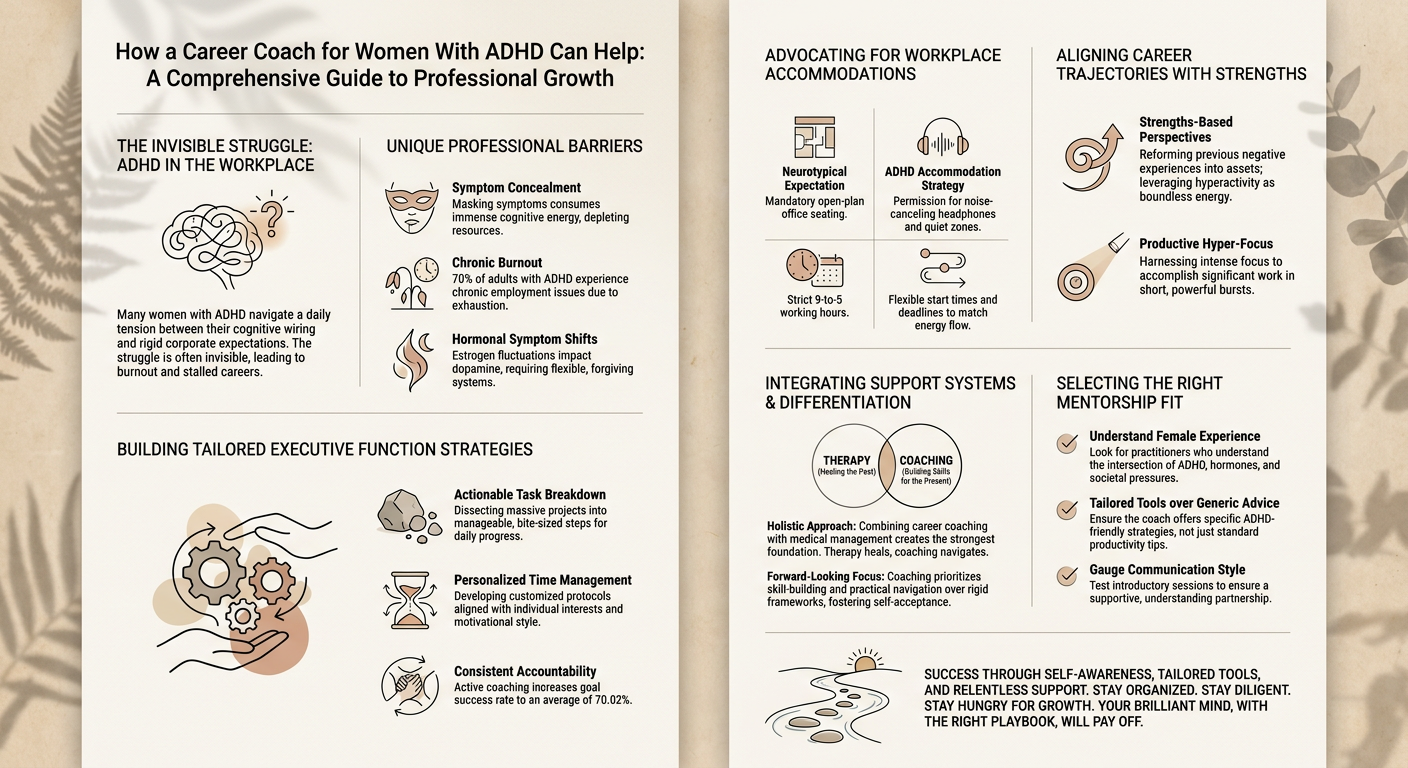
A career coach for women with ADHD bridges the gap between traditional therapy and professional development by offering tailored executive-function strategies. They help clients overcome workplace burnout, manage hyper-focus with calm, reframe negative self-talk, and establish routines that can also align with neurotypical or neurodivergent wiring.
The struggle is often invisible. Data confirms the medical diagnostic delays for females range from 16.3 to 28.6 years, leaving millions of women hitting the workforce entirely unaware of why they are struggling.
How does targeted mentorship actually fix this?
More deeply than one might suspect.
While comparing a professional journey to an Olympic track event might seem like a stretch, consider the daily hurdles that neurodivergent professionals face in the office.
Why Do Neurodivergent Women Face Unique Professional Barriers?
Standard office environments are fundamentally built for neurotypical brains.
When a woman enters a space designed for linear thinkers, she immediately encounters friction.
Symptom Concealment
Women with ADHD frequently mask their symptoms to fit into a rigid workplace culture.
They spend vast amounts of cognitive energy pretending they are not distracted, overwhelmed, or physically restless.
Because out of 1,737 clinical ADHD studies, only four evaluated females exclusively, the corporate world remains largely ignorant of how female presentation differs from hyperactive little boys.
Masking creates a façade of competence while internally steadily depleting the individual’s cognitive resources.
Chronic Burnout
Eventually, the façade cracks under pressure.
Industry surveys reveal that 87% of women with ADHD state their symptoms have actively harmed their careers.
They take on too much to compensate for perceived failures, spiraling into severe burnout.
Data shows that employees with untreated ADHD are 30% more likely to face chronic employment issues, frequently driven by exhaustion rather than a lack of actual skill or intelligence.
Hormonal Symptom Shifts
Most standard productivity advice completely ignores biology.
Throughout the month, estrogen fluctuations heavily impact dopamine levels, meaning a system that worked flawlessly on Tuesday might completely fail by next Friday.
A career coach recognizes these hormonal realities and helps build flexible, forgiving systems rather than demanding robotic consistency.
Build Customized Executive Function Strategies
Olympic athletes are not simply born to break records: they are forged through fierce training and highly individualized coaching.
Likewise, an effective workflow does not just fall from the sky for ADHD brains.
If a planner fails after three days, does that mean the user is broken?
Absolutely not. It means the tool was wrong for the job.
Common pitfalls that traditional career practitioners force upon neurodivergent clients include:
- Pushing rigid time-blocking methods that completely break down when the person encounters an unexpected interruption.
- Relying on generic motivational quotes instead of addressing the literal dopamine deficit in the brain.
- Ignoring time blindness and simply demanding that the person “try harder” to be punctual.
Instead of fighting brain chemistry, an ADHD coach builds systems that harness it.
Actionable Task Breakdown
Coaches assist clients in breaking down massive, overwhelming projects into manageable steps.
For instance, a software professional might start with a 20-minute daily planning ritual alongside their coach to dissect complex coding tasks into immediate action items.
This takes the overwhelming noise of a project and turns it into bite-sized, achievable targets.
Personalized Time Management
No single key unlocks productivity for everyone.
An effective ADHD career coach tosses out the one-size-fits-all workbook.
They develop customized time management protocols tailored to the client’s interests and motivational style, ensuring attention deficit disorder traits do not derail daily progress.
Consistent Accountability Partners
Accountability is the glue that holds these new systems together.
Clinical tracking shows that adults engaging in active coaching accountability achieve an average success rate of 70.02% in reaching their specific, individualized goals.
Regular check-ins keep clients moving forward rather than spiraling into procrastination.
Advocate for Reasonable Workplace Accommodations
Workplaces are evolving.
As researchers uncover new ways to integrate diverse minds, employees must adapt accordingly to raise their own standards and demand appropriate environments.
Accommodation Requests
A specialized coach equips clients with the language and confidence to advocate for their needs.
This includes navigating the sometimes intimidating process of requesting formal adjustments for individuals with physical disabilities, mental health issues or neurological challenges.
Workplace data indicates complaints of discrimination based on mental disorders filed rose significantly over the last decade.
Knowing legal rights protects professional lives.
Professional Communication Scripts
Asking for help is incredibly daunting for someone battling imposter syndrome.
Coaches provide actual communication scripts to request flexible deadlines or software supports without sounding incapable or overly demanding.
| Neurotypical Expectation | ADHD Accommodation Strategy |
|---|---|
| Mandatory open-plan office seating | Permission to use noise-canceling headphones |
| Verbal instructions during meetings | Written follow-up summaries provided post-meeting |
| Strict 9-to-5 working hours | Flexible start times to accommodate energy shifts |
Sensory Overload Prevention
Offices are loud, bright, and full of distractions.
Coaches teach clients how to manage their environment and mitigate sensory overload before it triggers emotional dysregulation.
Align Career Trajectories With Individual Strengths
It can take professionals years of rigorous grinding before they finally secure a fulfilling role.
Earning a top spot requires extreme patience.
Because the ADHD brain is highly motivated by interest, individuals often find themselves in a constant cycle of job-hopping or feeling chronically under-stimulated.
Strengths-Based Perspectives
Experts emphasize the importance of spinning previous negative experiences into positive assets.
Hyperactivity can translate into boundless energy for complex projects.
Shaping a strong vocational identity happens when individuals stop apologizing for their quirks and start leveraging them.
Productive Hyper-Focus
When engaged, an ADHD brain can accomplish a week’s worth of tasks in a single afternoon.
Learning to trigger and harness this productive hyper-focus is a game changer for building an exceptional career.
It is about directing the fire rather than letting it become counterproductive.
Career Transition Guidance
Impulsivity often leads to quitting a job out of sheer frustration.
Coaches help women pinpoint their specific strengths and navigate career transitions deliberately.
Whether exploring new passions or seeking confidence coaching for women leaders to secure an executive promotion, strategic guidance prevents reckless moves.
Integrate Professional Support With Medical Care
Funnels represent a massive amount of hard work in marketing.
Similarly, building a sustainable career path requires a multi-layered approach.
Many professionals discover that pairing career coaching with medical management creates the strongest possible foundation for success.
While therapy addresses deeper emotional trauma or coexisting disorders like anxiety, coaching provides actionable navigation skills for the immediate present.
The combined approach tends to produce the most durable, long-lasting gains in job satisfaction.
What Differentiates This Methodology From Traditional Therapy?
In a nutshell, therapy often looks backward to heal wounds.
Coaching looks forward to build skills.
While cognitive behavioral therapy offers excellent frameworks, ADHD coaching is uniquely appealing because it offers long-term, ongoing support between sessions.
It prioritizes lived experiences over the rigid psychological frameworks historically outlined by the american psychiatric association.
Professionals at research programs highlight that a core benefit of coaching is shifting the client from relentless self-criticism to practical self-acceptance.
It grants them permission to rest without the crushing guilt that usually accompanies untreated ADHD.
How To Select the Right Mentorship Fit?
Not every mentor matches every client.
ADHD is heavily nuanced, and the best results usually come from practitioners who truly understand the female experience.
If a professional is seeking career coaching for women over 50 after a late diagnosis, they need someone familiar with the intersection of menopause and executive functions.
Likewise, those attempting to repair a fractured self-image might look into specialized fields like body confidence coaches for women to compliment their professional development.
Test a few introductory sessions.
Gauge the communication style.
Ensure they tailor tools to specific ADHD challenges rather than repeating generic career advice.
FAQ
Can a career coach help with my job search directly?
They will not apply for jobs on your behalf, but they absolutely optimize the search. A neurodivergent career coach helps clarify career goals, refine soft skills for interviews, and structure the search process so you do not feel overwhelmed by the volume of job boards.
Is ADHD coaching recognized as a valid mental health support?
Yes. In fact, current statistics show that nearly 1 in 5 adults with ADHD have used an ADHD coach, with an overwhelming majority citing it as highly effective for managing common ADHD symptoms in the workplace.
Can coaching help with time blindness?
Nothing “cures” the structural differences of ADHD brains. Coaching provides robust external scaffolding, alarms, routines, and visual aids to manage managing time effectively despite the internal deficit.
How long does career coaching work take to show results?
The process feels slow at first. However, as new habits replace old struggles over a few months, clients notice a distinct shift from being completely overwhelmed to making tangible progress on hard skills and daily tasks.
Conclusion
Many working professionals live by the exhausted mantra of just surviving until Friday.
You should treat your career ambitions with far more respect than that.
If you are persistent and willing to implement new strategies, your professional journey has nowhere to go but up.
Yes, it is deeply frustrating to miss deadlines.
Yes, it is genuinely difficult when focus disappears at a critical moment during a critical meeting.
But that does not mean you should let your career fail out of frustration.
Do not expect your brain to miraculously start functioning like a neurotypical one overnight.
Realistic expectations grounded in a personalized assessment will keep you focused.
Keep pushing and keep testing new systems.
If a routine is broken, figure out why and collaborate with a professional to fix it.
The success of your career does not lie within a single magic planner or a flawless morning routine.
It is the combination of self-awareness, tailored tools, and relentless support that determines your ultimate potential.
Stay organized. Stay diligent. Stay hungry for growth.
Your mind is brilliant, and with the right playbook, your efforts will absolutely pay off.