
Last updated on May 28, 2026
Introduction
Driving anxiety is formally defined by clinical literature as a persistent, irrational fear of operating a motor vehicle that results in significant psychological distress, functional impairment, and extensive avoidance behavior.
Okay, so what does this actually mean for you?
Perhaps your hands are sweating through the steering wheel just thinking about the act.
Perhaps you’re mapping out absurdly long side-street routes just to avoid a single complex intersection.
Why do we let the fear of a daily commute hold our freedom hostage?
Mental health professionals consider Cognitive Behavioral Therapy (CBT) and exposure therapy as the absolute gold-standard treatments for driving anxiety.
Through cognitive restructuring, you identify your irrational catastrophic thoughts and systematically work through them, reducing the avoidance behaviors that keep your driving fears alive.
With enough intensity and focus, you can literally rewire your brain to treat driving as just another mundane task.
What triggers fear behind the wheel?
Fear is made as a result of intense psychological conditioning and negative experiences.
If your brain perceives a threat, it activates the emergency brakes on your nervous system.
But why does your brain think the car is an inherent danger in the first place?
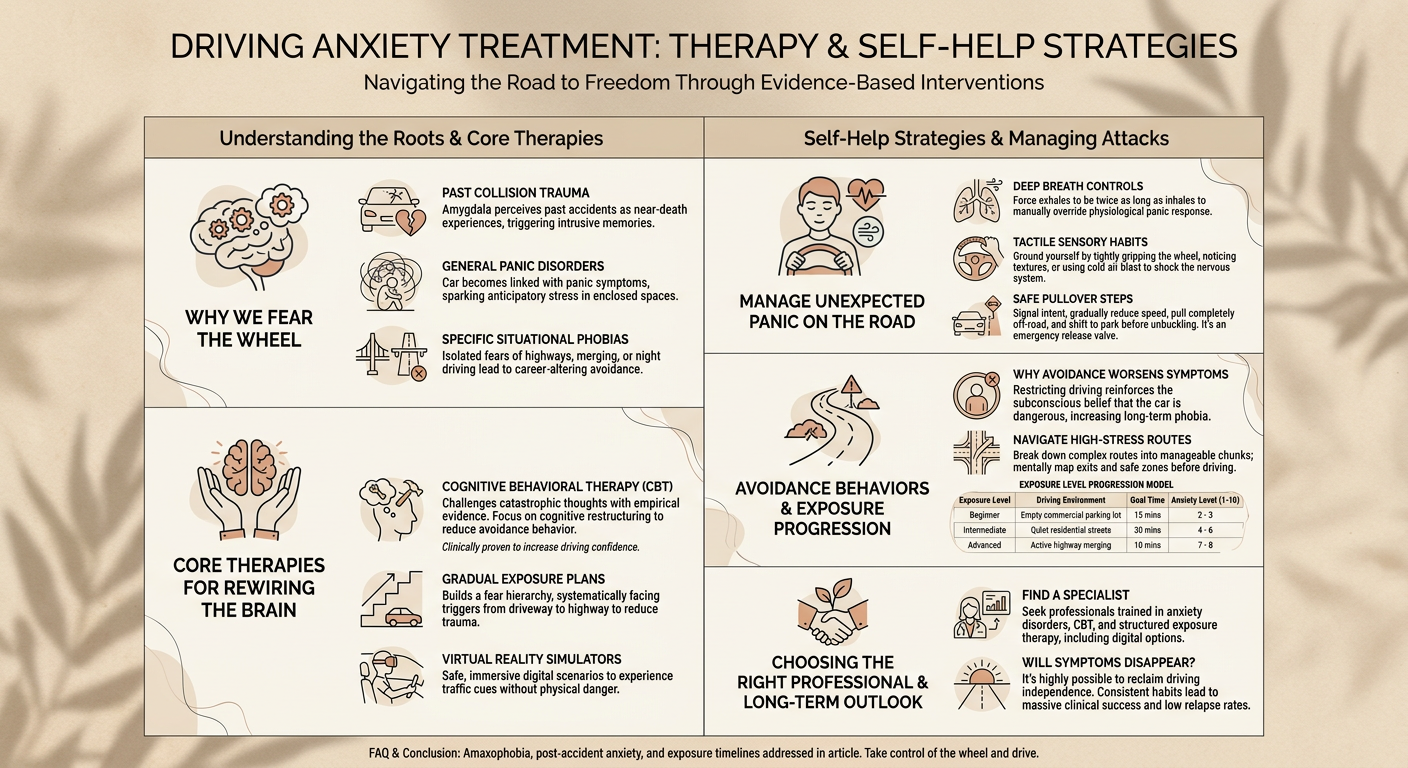
Past collision trauma
A fender bender might seem minor to a claims adjuster, but to your amygdala, it feels like a near-death experience.
In fact, up to a third of accident survivors navigate long-term driving-related trauma after dealing with the stressful aftermath of vehophobia and injury claims.
When you get back in the driver’s seat, those intrusive memories flood your consciousness.
Your brain is essentially overreacting, attempting to protect you from experiencing that traumatic stress ever again by making you terrified of the vehicle itself.
General panic disorders
Sometimes, the intense fear has absolutely nothing to do with cars.
General panic disorders can easily attach themselves to enclosed situations where you feel trapped or out of control.
If you’ve ever had a random panic attack while stuck in gridlock, your brain permanently links the car with the panic symptoms.
Now, just the thought of being a passenger or driver sparks intense anticipatory stress.
Specific situational phobias
Maybe it’s not all driving conditions.
Maybe you only freeze up on bridges, or when merging on the highway, or during night driving.
These deeply ingrained situational panics create a devastating lifetime phobia impact for millions of adults who literally organize their entire careers around avoiding specific overpasses.
Specific fears isolate the perceived danger to one environmental trigger, turning a normal commute into a terrifying ordeal.
Core therapies to rewire nervous system responses
You can’t always expect your overall anxiety levels to lower from the word “go.”
Remember: phobia treatment represents a marathon, not a sprint.
You may need evidence-based anxiety therapy to fix the misfiring alarms in your head.
Cognitive behavioral models
CBT doesn’t just ask “how does that make you feel?”
It actively navigates negative thoughts.
This exact process yields massive clinical reductions, driving a 22.5 effect size improvement in overall driving confidence once patients learn to objectively evaluate their phobias.
You learn to challenge catastrophic thoughts with actual empirical evidence, replacing physical discomfort with cold, hard logic.
Gradual exposure plans
You may need to face the feared situation. There are no shortcuts.
When you systematically face these triggers, you can actively reduce your trauma, resulting in noticeable PTSD remission through prolonged exposure as your nervous system learns to finally stand down.
You build a fear hierarchy to tackle your anxiety patterns incrementally.
Sit in the driveway. Then drive around the block. Then tackle a two-lane road.
Virtual reality simulators
What if you simply can’t stomach the actual road just yet?
Virtual reality exposure therapy serves as a safe, highly immersive adjunct to traditional CBT.
By running through these controlled digital scenarios, participants often find that they gain significant real-world mastery after simulator therapy, seamlessly transitioning from a digital headset to a physical dashboard.
It lets you experience actual traffic cues without any of the physical danger.
Manage unexpected panic attacks on the road
Even with an excellent mental health professional in your corner, a panic attack can blindside you.
The physical discomfort hits immediately: racing heart, shallow breathing, dizzy spells.
Do you just throw your hands up and let it take the wheel?
No. Allow yourself permission to take control.
Deep breath controls
When severe anxiety strikes, your breathing naturally becomes shallow and erratic.
This triggers a massive chemical alarm system in your brain, dumping adrenaline into your bloodstream.
Force your exhales to be twice as long as your inhales to manually override the physiological panic response.
Tactile sensory habits
Ground yourself in the physical reality of the car to stop your mind from spiraling into worst-case scenarios.
Grip the steering wheel tightly, notice the texture of the leather, and then intentionally release your grip.
Turn up the air conditioning and let the freezing air blast your face to literally shock your nervous system out of its panic loop.
Safe pullover steps
If the overwhelming fear truly becomes too much to handle, do not slam on your brakes in moving traffic.
- Put your blinker or filters on immediately to signal your intent to other drivers.
- Gradually reduce your speed while scanning for a wide, safe shoulder or a nearby exit.
- Pull completely out of the active traffic lane and shift the car into park before unbuckling or reaching for your phone.
Think of this as an emergency pressure release valve, not a personal failure.
Why do avoidance behaviors worsen symptoms?
It can be incredibly tempting to just throw in the towel and stay home.
Or to restrict your driving to a tight, familiar little five-mile radius.
In fact, many sufferers develop severe driving restriction metrics, trapping themselves within a tight hundred-mile weekly radius just to feel safe.
But every single time you avoid driving, you send a powerful message to your subconscious: The car really is dangerous, and avoiding it just saved my life.
Clinical consensus clearly stresses that avoidance behavior only reinforces your amaxophobia.
Furthermore, your exaggerated safety behaviors paradoxically increase your performance mistakes, creating massive driving variance scaling where your attempts to be hyper-careful actually cause unpredictable swerving and braking.
If you hope to maintain your independence, you simply can’t afford to avoid the road.
Navigate high-stress routes and complex intersections
Let’s talk about the big stuff.
Highway driving. High-speed merging. Six-lane urban intersections.
These are essentially the Olympics of stressful driving situations.
You don’t start here. You work up to this level.
Before attempting a high-stress route, drive it mentally in your head.
Map it out. Know exactly where your exits and safe zones are located.
Break the dreaded route down into manageable chunks rather than staring up at a giant, seemingly impossible commute.
| Exposure Level | Driving Environment | Goal Time | Expected Anxiety Level (1-10) |
|---|---|---|---|
| Beginner | Empty commercial parking lot | 15 mins | 2 – 3 |
| Intermediate | Quiet residential streets | 30 mins | 4 – 6 |
| Advanced | Active highway merging | 10 mins | 7 – 8 |
This table shows a highly basic progression model. Stick to the plan and don’t rush the process.
How do you choose the right clinical professional?
Not all therapists actually know how to tackle a specific phobia.
Generic talk therapy which is not trauma-informed may impact your progress.
You need a clinical specialist trained specifically in anxiety disorders, CBT, and structured exposure therapy.
Don’t ignore the rising wave of digital treatment options, either.
Many patients now leverage 12-week structured e-CBT efficacy to manage their therapy remotely without having to endure a highly stressful commute just to see their doctor.
Interactive digital behavioral tools regularly deliver a much larger effect size in behavioral symptom reduction compared to just reading static psychology pamphlets in a waiting room.
Find someone who uses structured, data-driven behavioral interventions rather than just asking about your childhood.
Will symptoms ever completely disappear?
Can you actually be “cured” of this intense fear?
Yes, it is highly possible to reclaim normal nervousness without dealing with the crippling panic attacks.
Patients who stick to their cognitive-behavioral routines experience incredibly low relapse rates years after treatment, maintaining their driving independence indefinitely.
By building deeply consistent habits, you can lock in massive clinical success maintenance and keep the panic completely suppressed.
Sure, you might still get annoyed in heavy traffic or feel a spike of stress driving through a violent thunderstorm.
But the debilitating, life-altering phobia? That can absolutely be beaten.
FAQ
What is amaxophobia? Amaxophobia is the severe, intense fear of riding in or driving a vehicle. It is a specific phobia that often leads to extreme avoidance of any driving conditions, drastically impacting daily life.
Can highway hypnosis trigger panic attacks? Yes. The trance-like state of highway hypnosis can suddenly cause an experienced driver to feel disconnected from reality, triggering acute panic symptoms or a sudden fear of losing control of the vehicle.
Is it normal to fear driving after a crash? Absolutely. Post-accident anxiety is a completely normal psychological response. However, if the fear response persists for months, causes severe avoidance, and disrupts your life, it may be classified as a mental health condition like post-traumatic stress disorder.
How fast does exposure therapy work for driving fears? Relief timelines vary widely based on the individual, but structured exposure therapy can significantly reduce overall anxiety levels in as little as 8 to 12 weeks of consistent, highly dedicated practice.
Conclusion
Conquering your driving anxiety represents a massive amount of hard work.
There are no magic pills, and there are no easy shortcuts to rewiring your mental health.
Much like Olympic athletes training for the gold, you have to actively lean into the physical discomfort, aggressively challenge your catastrophic thoughts, and consistently show up to practice.
The world moves incredibly fast.
Let’s now allow anxious tendencies to keep us permanently trapped in the passenger seat.
It’s time to take control of the wheel and drive.