
Last updated on November 18, 2026
Introduction
Family counseling serves as a highly specific psychological intervention designed to reveal and rewire the hidden behavioral loops challenging a household. It goes far beyond simply asking people to talk nicely to each other. By mapping the complex ways family members interact, evidence-based therapy targets the root causes of emotional distance, aiming to rebuild secure attachment and foster long-term resilience.
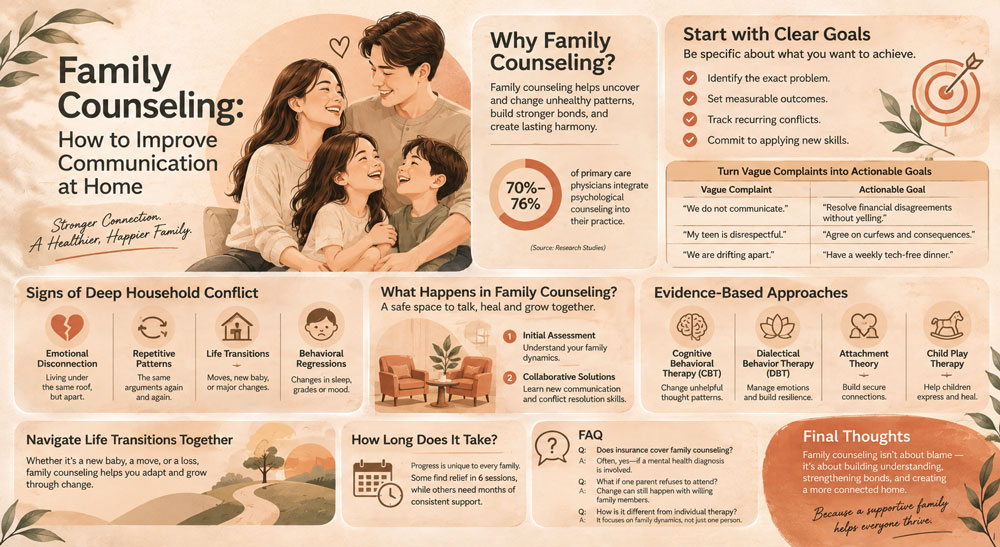
Research clearly indicates that physical and relational health are deeply intertwined, which is why upwards of 70% to 76% of surveyed primary care physicians actively integrate psychological counseling or direct mental health referrals into their routine patient care. When tension runs high, the entire ecosystem of a household suffers. Addressing these systemic issues organically creates a space where authentic connection replaces forced compliance.
Why do vague, unclear communication goals fail?
Family counseling may be less helpful without clear goals when it is just a vague promise to improve communication. The clinical listings all say basically the same thing about managing conflict and navigating family dynamics. That is not a functional plan. Dropping $150 to $300 or more for an hour of time is real money to spend on generic advice. Nobody should pay that premium just to have everyone sit in a formal counseling setting and revisit the same disagreement they just had in the car.
A household needs a specific problem and a specific goal before booking anything. Otherwise, that hour is an extremely expensive way to hear a professional confirm that families have conflicts. Vague objectives lead to circular conversations. A social worker or licensed professional counselor cannot magically generate clarity if the individuals involved refuse to pinpoint what is actually causing their distress. Without precise aims, sessions may become focused on expressing frustrations without clear direction rather than an environment for genuine personal growth.
Establish specific targets before appointments
Before walking into a clinic, a family must agree on exactly what they are trying to achieve. Healing requires a roadmap. Establishing parameters prevents the sessions from drifting into aimless complaining and ensures everyone understands their responsibilities.
-
Identifying the exact friction point causing daily distress.
-
Agreeing on what a successful outcome looks like for each individual.
-
Tracking how often specific old arguments resurface during the week.
-
Committing to practicing emotional regulation tools outside the therapy room.
Define the exact problem
A vague complaint like stating that family members fight too much gives a therapist nothing actionable to work with. Is the problem an unequal division of domestic labor? Is it a teenager rejecting curfews? Families must name the exact behavioral patterns causing tension in order to dismantle them.
|
Vague Complaint |
Actionable Clinical Target |
|---|---|
|
“We do not communicate.” |
“We need to resolve financial disagreements without yelling.” |
|
“My teen is disrespectful.” |
“We need to agree on curfews and consistent consequences.” |
|
“We are drifting apart.” |
“We need to establish a dedicated weekly tech-free dinner.” |
Structuring these concerns allows a counselor to provide targeted coping strategies rather than philosophical musings.
Outline measurable desired outcomes
Therapy needs a definitive endpoint. The desired outcome might be holding a weekend dinner without an argument breaking out. It could mean parents agreeing on a unified discipline strategy without actively undermining each other. The focus should rest on measurable change. Data supports this structured approach, as relational systems therapies are actively practiced by roughly 70% of systemic specialists and consistently achieve equivalent efficacy markers to individual modalities.
Prevent repetitive past arguments
Couples and family members often drag ten-year-old resentments into current, unrelated disagreements. A competent therapist will help interrupt this recurring pattern. Recognizing how past behaviors influence current reactions is vital, and understanding what is trauma dumping, signs, causes, and boundaries prevents relatives from weaponizing historical grievances to win an argument today.
Identifiable signs of deep household conflict
Things are rarely fine when the silence in a house becomes louder than the yelling. Conflict does not always look like slammed doors. Sometimes it looks like polite, emotional distance or limited communication.
Severe emotional disconnection
Roommates living under the same roof. Emotional distance creeps in slowly and quietly. People stop sharing the details of their days. They spend more time in separate rooms after dinner, scrolling on devices to avoid interpersonal contact. This profound lack of emotional communication points directly to a fractured secure attachment style.
Repetitive negative patterns
Arguments follow a highly predictable script. A parent criticizes, a teen stonewalls, the other parent intervenes to smooth things over, and everyone storms off feeling unheard. These cycles run on complete autopilot. The family members are no longer reacting to the current problem. They are reacting to the deeply ingrained patterns of behavior they expect from one another.
Unresolved life transitions
Major life transitions disrupt the delicate ecosystem of a home. A cross-country move, a new baby, a career change, or a sudden loss can shatter established routines. Families navigating major life transitions often struggle with grief and loss, turning their anxiety inward instead of leaning on one another for support.
Constant behavioral regressions
Children effortlessly absorb the unspoken stress of the adults around them. A child might start wetting the bed again after months of dry nights. A teenager might suddenly drop their grades or act out aggressively at school. These behavioral regressions act as possible signs of emotional stress signaling that the family systems are buckling under unseen pressure.
What occurs during standard sessions?
A clinical setting is not a court of law. The practitioner does not act as a judge declaring who is right or wrong. The environment is designed to foster curiosity and empowerment.
Initial assessment phase
The first few meetings serve as a mapping exercise. The counselor observes exactly how family members interact. Who speaks for whom? Who interrupts? Who physically shrinks in their chair when a certain topic is raised? This phase reveals the unspoken rules and boundaries governing the household, allowing the therapist to assess the baseline family dynamics.
Collaborative conflict resolution
A practitioner actively teaches communication skills. They might roleplay a difficult conversation to demonstrate healthier ways of relating. Parent strategy sessions are frequently utilized to align expectations. The goal is to build a nonjudgmental environment where individuals practice emotional communication without fear of a negative reaction.
Core therapeutic frameworks utilized
Professionals draw from highly specific evidence-based models to treat different family concerns. A counselor will match the modality to the precise issues presented during the assessment.
Cognitive Behavioral Therapy
CBT targets distorted thought patterns. It helps individuals understand how their internal assumptions fuel their outward reactions. Changing a persistent negative thought directly changes the resulting behavior.
Dialectical Behavior Therapy
DBT provides critical tools for emotional regulation and distress tolerance. It proves highly effective for intense, volatile environments where emotions rapidly escalate out of control. Mindfulness practices are often integrated here to ground family members in the present moment.
Attachment theory principles
Attachment style largely dictates how people seek comfort during times of high stress. A secure attachment fosters deep trust and resilience. Insecure attachment leads to seeking frequent reassurance or closeness or pulling away from emotional conversations. Healing requires recognizing these underlying emotional needs. Other specialized modalities like EMDR for trauma processing, ACT for acceptance, or IFS for internal family systems work may also be blended into the care plan.
Child play therapy
Children often process complex emotions through play rather than conversation. A child might lack the vocabulary to articulate their anxiety about an impending divorce, but they will clearly demonstrate it in a sandbox. Play therapy creates vital opportunities for healing without relying on adult-level verbal processing.
Navigate difficult life transitions together
Transitions severely test a family’s resilience. Exploring empirical outcome baselines across clinical trial categories reveals that systemic interventions significantly aid recovery during adolescent substance abuse or mood disorder episodes triggered by sudden life changes. Families must learn to nurture curiosity rather than punishing the resulting behavioral issues. Navigating these hurdles sometimes overlaps with evaluating the core marital relationship, which is why understanding the nuances of couples therapy vs marriage counseling proves beneficial when the parents’ dynamic is the actual root cause of the wider household tension. For families separated by geography, exploring whether long-distance couples therapy is right for you can also bridge the physical and emotional gaps.
How long does resolution typically take?
Progress is non-linear. Some families find immense clarity and relief in just six sessions after addressing a specific communication breakdown. Others dealing with complex trauma, severe depression, or deeply entrenched marital issues require months of consistent care. The timeline depends entirely on the willingness of all family members to practice their new coping strategies outside of the clinic.
FAQ
Does insurance cover family counseling? Many insurance plans cover sessions if one family member has a qualifying mental health diagnosis, such as anxiety or depression. The coverage often depends on the specific billing codes used by the clinical social worker or therapist.
What happens if one parent or family member refuses to attend? Family therapy can still proceed. Change in one part of the family system inevitably forces change in the rest. A willing parent and child can still develop healthier boundaries and communication techniques even if another family member opts out.
How is this different from individual therapy? Individual therapy focuses strictly on a person’s internal landscape. Family therapy focuses on the space between people. It examines the relational dynamics, the shared environment, and how the behavior of one person directly impacts the emotional well-being of everyone else in the room.
Conclusion
Human connection cannot be forced through strict rules or punitive measures. Building a functional, compassionate household requires a profound willingness to look closely at the uncomfortable dynamics we often try to ignore. Family counseling strips away the superficial layers of daily conflict to address the raw, fundamental need for safety and understanding. When families commit to this level of holistic work, they stop reacting to each other from a place of fear and start responding from a place of profound relational depth. Growth is messy and deeply uncomfortable, but it is the only path toward true resilience.