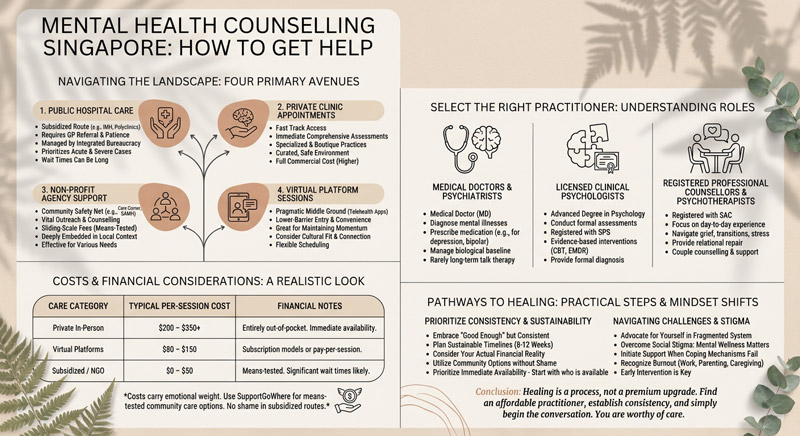
Mental health counselling in Singapore operates across four primary infrastructures: public psychiatric hospitals, private psychological clinics, non-profit social service agencies, and digital therapy platforms. That is the logistical answer. The human reality is far messier. The moment you realize your internal operating system is crashing, the local instinct is to optimize the crisis. We want the best therapist. The fastest route. The most prestigious clinic. We open spreadsheets. We treat finding mental health support like researching a mortgage for a new condo.
Searching for the absolute perfect practitioner when you are actively struggling is often just a coping mechanism disguised as productivity. It feels responsible. But usually, it just delays the actual work of healing.
What Are the Main Therapy Options in Singapore?
The landscape of mental healthcare providers here is distinctly tiered. Depending on your urgency and financial bandwidth, you will find yourself navigating one of these four environments.
- Public Hospital Care: The subsidized route. Institutions like the Institute of Mental Health (IMH) and neighborhood polyclinics offer psychiatric and psychological services. The tradeoff for lower fees is time. Navigating the MOH network of mental health services requires patience, as wait times can stretch into months.
- Private Clinic Appointments: The fast track. Private practices offer immediate access to comprehensive psychological assessments and customized, trauma-informed interventions. You bypass the wait, but you absorb the full commercial cost.
- Non-Profit Agency Support: The community safety net. Organizations like Care Corner Insight, Shan You, and the Singapore Association for Mental Health (SAMH) provide vital outreach and counselling sessions. These youth agencies and family centres do heavy lifting for the community, offering sliding-scale fees based on income.
- Virtual Platform Sessions: The pragmatic middle ground. Telehealth apps provide a lower-barrier entry to care. It takes the commute out of the equation, though building a deep therapeutic relationship through a screen requires a different kind of intentionality.
Public Hospital Care
Going through the public system means accepting the bureaucracy of integrated care. You usually start with a referral from a general practitioner at a polyclinic. This triggers a triage process. The clinical professionals here are highly qualified, managing acute mental illnesses and complex psychiatric needs. However, the sheer volume of patients means your therapy sessions might be shorter and spaced further apart. It is a system built on triage, prioritizing severe mental health challenges over preventive care.
Private Clinic Appointments
If you possess the financial means, private counselling eliminates the waiting game. You are purchasing spaciousness. Places like Alliance Counselling or specialized boutique practices allow you to handpick your clinician. Here, you will find niche expertise, whether you need specialized
therapy for complex PTSD to address childhood wounds, or a trained art psychotherapist. The environment is deliberately curated to feel safe and unhurried.
Non-Profit Agency Support
Do not mistake non-profit for low quality. Some of the most dedicated professional counsellors work within the social service sector. Agencies like Care Corner Counselling Centre manage thousands of cases annually, handling everything from family therapy to severe emotional support crises. They are heavily subsidized and deeply embedded in the local cultural context, making them incredibly effective for individuals who feel alienated by stark clinical environments.
Virtual Platform Sessions
Online evening counselling has exploded. Apps and virtual portals offer a streamlined way to connect with therapists. It is highly convenient. Yet, you have to weigh the cultural fit and the matching speed. Virtual care is excellent for maintaining momentum, especially for corporate professionals trying to squeeze a session between board meetings.
Compare Expected Costs and Available Financial Subsidies
Money carries emotional weight in Singapore. It dictates who we are allowed to be. It also dictates how we access mental health treatment. Below is a realistic look at what you will spend.
| Care Category |
Typical Per-Session Cost |
Financial Notes |
| Private In-Person |
$200 – $350+ |
Entirely out-of-pocket. Immediate availability. |
| Virtual Platforms |
$80 – $150 |
Subscription models or pay-per-session. |
| Subsidized / NGO |
$0 – $50 |
Means-tested. Significant wait times likely. |
Expected Private Rates
Expect to pay upwards of $200+ for a 50-minute hour. Specialists, such as a clinical psychologist administering formal diagnostic tests, will charge more. You are paying for their overhead, their ongoing clinical supervision, and the immediate access to their schedule.
Standard Virtual Fees
Digital platforms hover around the $100 mark. The overhead is lower, and those savings are passed on to you. It is a highly accessible price point for early intervention, though you sacrifice the physical co-regulation that happens when you sit in a room with another human being.
Available Subsidized Routes
If affordability is the core issue, treat cost as a feature, not a failure. There is zero shame in utilizing subsidized routes. The SupportGoWhere portal is a central government database designed to help you locate means-tested community care. If you can only do subsidized care, that is still care. The judgment you place on yourself for not accessing “premium” therapy will hurt you far more than the financial limitation itself.
Select the Right Practitioner for Your Condition
The titles are confusing. They all sound authoritative. Understanding the difference prevents you from wasting weeks sitting across from someone fundamentally mismatched to your needs.
Medical Doctors and Psychiatrists
A psychiatrist is a medical doctor. They diagnose mental illnesses and prescribe medication. If you are dealing with severe, biologically rooted depression or bipolar disorder, they manage the chemical baseline. They rarely do long-term talk therapy. Their primary tool is psychiatry, stabilizing the physical symptoms so you can actually engage in the psychological work.
Licensed Clinical Psychologists
These professionals hold advanced degrees in psychology. They are the ones who conduct formal psychological assessments. Registered with the Singapore Psychological Society (SPS), they utilize evidence-based interventions like
Cognitive Behavioral Therapy (CBT) or
EMDR. If you need a formal diagnosis for work or school accommodations, you need a clinical psychologist.
Registered Professional Counsellors and Psychotherapists
Counsellors and psychotherapists, typically registered with the Singapore Association for Counselling (SAC), focus on the day-to-day lived experience. They help you navigate grief, relationship transitions, and workplace stress. They provide the relational repair necessary to survive a high-pressure environment. If your marriage is buckling under the weight of financial stress, exploring couple counselling to strengthen your relationship with a skilled professional counsellor is often the most direct path to clarity.
Prioritize Treatment Consistency Over Perfect Therapist Matches
I see this constantly. Someone decides they need help, and they spend three weeks analyzing the bios of fifty different therapists. They want the perfect match.
In the real world, therapy is like physical training. The magic is not in picking the perfect gym. The magic is showing up. If you land a clinician who is “good enough” but consistent, you will progress significantly more than with a perfect, highly-credentialed match you can only afford to see once every three months.
Plan Sustainable Timelines
Pick a starting point you can realistically sustain for 8 to 12 weeks. Even if you find a therapist you absolutely love, if the $250 weekly bill causes massive financial anxiety, you will eventually discontinue therapy. You will convince yourself you “need a break.” Build a sustainable timeline based on your actual bank account, not your aspirational one.
Embrace Lower Cost Options
Many people feel a quiet shame for choosing community options over swanky private clinics. Drop the ego. The Samaritans of Singapore (SOS) and neighborhood family service centres save lives daily. They are staffed by friendly care professionals who understand the gritty reality of local stressors. Accessible mental health support is a right, not a luxury purchase to be flaunted.
Prioritize Immediate Availability
Mental health does not politely schedule itself around your preference for the ideal therapist. When your internal alarms are ringing, start with whoever can see you within the week. You can always transition to a different mental health professional later. Get your foot in the door. Establish a baseline of safety.
How Do You Navigate Systemic Care Fragmentation?
The system is disjointed. Academic evaluations frequently point to deep systemic hurdles. An analysis published in Frontiers in Public Health highlighting care gaps identifies a severe shortage of mental health staff and frustrating cross-sector coordination issues.
You might get a psychiatric evaluation at a hospital, but wait months to be assigned a counsellor. The referral pathways are clunky. You have to become your own advocate. Keep physical copies of your psychological assessments. If you are moving from public outpatient treatment to a private psychotherapist, you are responsible for bridging that information gap. Do not assume the institutions are communicating with each other. They rarely are.
Overcome Social Stigma to Start Treatment Confidently
We live in a culture obsessed with face. The script is constant “upgrading.” PSLE scores, BTOs, career promotions. Admitting you are struggling feels like an admission of failure in a society that worships output.
Yet, the data betrays our collective exhaustion. National Population Health Survey findings reveal that 1 in 4 young adults reported poor mental health recently. You are not an anomaly. You are the norm. Studies published by Taylor & Francis Online on Singaporean help-seeking behaviors suggest that a person’s individual attitude is the strongest predictor of whether they get help, outweighing external social stigma.
You have to decide that your mental wellness matters more than the perceived judgment of your extended family. Compliance with societal expectations is not character. Protecting your psychological safety is.
When Should You Initiate Professional Support?
Do not wait for a complete systemic failure. The time to seek guidance is when your usual coping mechanisms stop working. When a glass of wine becomes a bottle. When workplace burnout requires specialized therapeutic intervention just to get you out of bed on a Tuesday.
If you are a parent noticing withdrawal in your teenager, early intervention through specialized couples therapy or family support for teens can shift the entire trajectory of their adult life. If the daily grind of supporting an aging parent is eroding your empathy, recognizing caregiver burnout and finding a therapist is a necessary act of survival. You do not need to be broken to deserve a space to heal.
FAQ
Do I need a doctor’s referral to see a counsellor in Singapore? If you are accessing private counselling or non-profit agencies, no referral is needed. You can contact them directly. If you want subsidized care through the public hospital system (like polyclinics to IMH), you must start with a general practitioner for a referral.
Are therapy sessions confidential? Yes. Psychologists and counsellors operate under strict ethical codes mandated by associations like SPS and SAC. Information is only breached if there is an imminent risk of harm to yourself or others, or under specific legal court orders.
Is online counselling as effective as in-person therapy? For many mental health concerns like mild anxiety or stress management, telehealth is highly effective. However, for severe trauma, acute mental illnesses, or intensive play therapy for children, in-person therapeutic presence is generally required for safety and co-regulation.
Conclusion
Finding mental health counselling in Singapore is an exercise in navigating both a fragmented medical system and our own deeply ingrained cultural baggage. We are conditioned to want the premium upgrade. We want the fastest fix. But relational repair takes time. It requires teaching yourself that you are worthy of care, even if that care happens in a modest community center rather than a high-end clinic. Stop agonizing over the perfect choice. Find a practitioner you can afford, map out a sustainable schedule, and simply begin the conversation.